Forgiveness: Not a Virtue, But a Dangerous Practice

Over the millennia, religion has done much harm, in myriad ways. Of the major world religions, the one that places the greatest emphasis on forgiveness is, to my knowledge, Christianity. This was an error in reasoning made many centuries ago, and it is impossible to calculate the amount of harm this doctrine has caused . . . but the number of people harmed by this terrible idea certainly numbers in the millions.

Consider one of the most oft-quoted passages from the New Testament concerning this topic, from Matthew 18:21-22 (NASB):  “Then Peter came and said to Him, ‘Lord, how often shall my brother sin against me and I forgive him? Up to seven times?’ Jesus said to him, ‘I do not say to you, up to seven times, but up to seventy times seven.’” Seventy times seven is, of course, 490, but it is rare to find anyone who takes that number literally. It is much more common to encounter the explanation that large numbers were viewed differently in the ancient world, and “seventy times seven” was simply a way for Jesus to say, in a way Peter would understand, “an indefinitely large number.”

Now, consider what we know about the modern world. At least one-third of women are raped during their lifetimes. Serial killers often murder dozens of people before getting caught. Powerful people, in positions of public trust and great responsibility, betray that trust for their own selfish reasons. This list could be much longer, but I trust the point has been made:  you live in a world with many others in it who are not nice people . . . and many of them have no intention of changing.

Consider this:  a newly-married woman discovers her husband is betraying her in one of the worst possible ways, by sexually molesting children who live in nearby homes. She decides to leave him, and contacts her (devoutly religious) family, asking for help – only to be told that marriage is a sacred covenant, divorce is a sin, and the evil deeds of others are, according to the Bible, supposed to be forgiven. “Pray for him,” she is told — but the real support she is asking for is not given. She tries to forgive him. She stays in the marriage for many more years. The unsurprising result? Dozens more children are abused by the man over the following decades, with far-reaching, horrible consequences.

That last example was not hypothetical. The woman, and her family, are people I know.

There are people – many of them – who simply do not deserve to be forgiven for the crimes they commit. They are dangerous, and will remain so, until and unless they are stopped. Some stop only when they die — and those deaths, I do not mourn. Others are caught, tried, convicted, and imprisoned. However, those people are, too often, released while still dangerous, due to another nonsensical idea (that of having paid one’s “debt to society”), or simply because prisons are overcrowded with many people who only committed non-violent illegal acts. Both problems are easy to solve, however. First, we should stop locking up non-violent offenders – that’s the obvious part of the solution. The other part is more difficult, for it would require major legislative changes:  the abolition of specific, time-limited sentences for violent criminals.  Why lock up, say, a murderer or rapist for ten years, and then let them go, more dangerous than ever? It would make more sense to leave such people – anyone who is clearly dangerous to the rest of us – locked up for life, or at least until they have become so weakened by illness or advancing age that they are no longer capable of harming other people.

What about lesser offenses? What if, for example, you catch someone you know in a harmful, deliberate, and malicious lie? Should you forgive them? My answer is often a flat “no” – at least, not until the person has regained the trust they have damaged or destroyed, and sometimes that simply is not possible. (Who decides when trust is restored? The person who was lied to, of course.) Forgive a pathological liar, and what you are really doing is inviting them to lie to you again. A far better thing to do would be to warn others not to trust the liar, and explain exactly why that is the case.

Some who wish to cling to their religious beliefs, even when those very beliefs cause obvious problems, have devised a way to try to get around the problem that forgiving those who harm you, or your loved ones, invites further harm. You are likely to have heard it, or something like it:  “I forgive them, but I will not forget what they have done, for they may well do it again, and I must be on my guard.” Such a statement is an improvement over total, unconditional forgiveness, but it is not without problems. First, if one is constantly vigilant for a repeat offense, has forgiveness really taken place? Not by the Biblical standard of divine forgiveness of the evil deeds of people, it hasn’t, as Hebrews 8:12 (NIV) makes clear: “For I will forgive their wickedness and will remember their sins no more.” Many other verses tie the acts of forgiving and forgetting together. Separating the two, as many people do now, is an improvement, to be certain . . . but it is in no sense an idea rooted in either the Bible, or in traditional Christian doctrine. It is, instead, a modern concession to reason and common sense.

What about really small things?  Accidents, honest mistakes . . . that sort of thing?  Is there a problem with forgiveness in those sorts of situations?  No, there isn’t . . . but there also would have been no problem with not getting angry at a person for such a “crime” in the first place. As a good rule of thumb, if it made perfect, rational sense to get angry at someone because they did something truly terrible, then it does not make sense to forgive them for it ten minutes later, nor the next day . . . perhaps not even until they die, because at that point, the chances of them repeating the offense drops to zero. In other words, it isn’t yet time to forgive a person who still poses a danger. This is simple logic.

Monsters in human form, like everything and everyone else, are part of the physical universe. If one or more of them does something terrible to you, or to someone you care for, it makes sense to take steps to prevent their repeating such an act. It does not make sense to forgive them for it. To do so is the equivalent of telling the universe that you want you or your loved ones to have to endure further suffering. That is not a logical way to live one’s life. “Forgiveness is a virtue” is a pernicious idea – one we should, as a species, leave in the past, if we want to make progress in the future.

Proposed Radiobiohazard Symbol

Image

Proposed Radiobiohazard Symbol

We’re all familiar with the radiation-hazard symbol:

KTjed7aTq

And, of course, the biohazard symbol:

Biohazard_Symbol_HH12_OSHA

However, what if some unforeseen disaster threatens us with living, radioactive pathogens? Clearly, we need a radiobiohazard symbol for just such an eventuality, and I’m proposing the top picture here as a rough draft for one, inspired by the two already-existing warning symbols.

To the TSA, FEMA, the NSA, and the rest of the alphabet soup of “keep-us-safe” agencies: you’re welcome.

Some Strange Laws We Have in Arkansas

Image

Some Strange Laws We Have in Arkansas

If you drink alcohol, and are about to travel in Arkansas, you might want to buy your booze before your trip. You can’t buy liquor on Sundays or religious holidays (a blatant First Amendment violation) in this state. In some counties, first-time visitors learn the term “dry county” when they are told by a clerk that they can’t buy alcohol there on any day of the week. Yes, we still have prohibition here, in many parts of Arkansas!

If you see the sign above, and have you have the urge to utter “Arkansasssss,” pronouncing the second “s,” you’d better do it quickly, if you want to mispronounce the name of our state legally. Once here, it’s actually against the law.

Husbands can even legally beat their wives here . . . but only once a month.

Blindfolding cattle on a public highway is illegal here, even though that’s just good sense, and probably would never be done if our state government hadn’t suggested it with this law. Here’s my favorite dumb Arkansas law, though:

lr-lrt-stc-main-st-bridge-238-20041204x_lh

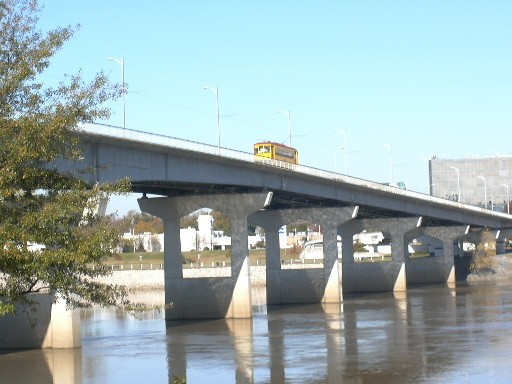
This is the Main Street Bridge across the Arkansas River. It separates Little Rock and North Little Rock. Perhaps as a flood-control measure, our state legislature (#50 among American state legislatures in college achievement) passed a law forbidding the Arkansas River from rising above the level of this bridge.

I’m sure there are more.

Why Is Arkansas Political Geography Such a Mess?

Image

Why Is Arkansan Political Geography Such a Mess?

Technically, we live within the city limits of North Little Rock, but we’re surrounded by Maumelle, and also live in the Pulaski County Special School District, not the North Little Rock School District. Telling people we live in NLR causes confusion, so we say “Maumelle” instead, but mail won’t reach us unless it includes “North Little Rock” in the address. What’s more, that’s all in one county, Pulaski, near the center of the state.

The weirdness doesn’t stop there. Nearby is a city named Conway. I went to college there. It isn’t located in Conway County, though; that’s further West.

Head Southwest on I-30 from Little Rock, and you’ll soon encounter Benton (not in Benton County, although at least Bentonville is), and then get a chance to take an exit to go visit Hot Springs — but you won’t find it in Hot Spring County. Van Buren is right next to Oklahoma, and a long drive from Van Buren County. Is the City of Jacksonville to be found in Jackson County? Of course not — not in this state. Boonville, similarly, is not located in Boone County.

We have a Mississippi County here, and it borders two other states. We also have a long border with the state of Mississippi. However, Mississippi County, Arkansas isn’t one of several counties which do border the State of Mississippi. Instead, it borders Tennessee and Missouri.

Even things which seem intuitively obvious about my state’s political geography end up being wrong. Ask someone familiar with a U.S. map which state(s) you can find South of Arkansas, and they’ll almost certainly answer with Louisiana, perhaps including Texas, as well. However, the states of Oklahoma, Missouri, Tennessee, and Mississippi also include land that is South of carefully-chosen points in Arkansas. Here’s visual proof, which you can enlarge with a click:

arinus

Yes, all six states which border Arkansas are technically South of us, in a sense.

Perhaps the strangest thing about Arkansan political geography is that the town of Lonoke is actually in Lonoke County. It’s even their county seat. What are they trying to do there, confuse people?

A Note, from Arkansas

Image

A Note, from Arkansas

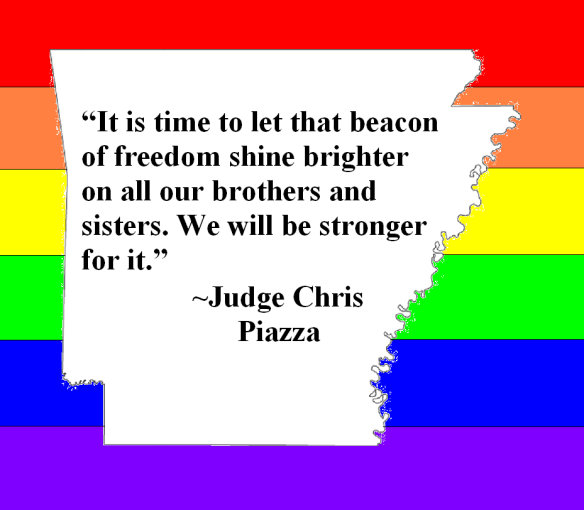
Here, with so many shameful things in our state’s history, it’s nice to have the opportunity to be proud to be an Arkansan. The cause of this pride? Judge Chris Piazza’s ruling, yesterday, allowing the first legal gay marriages in all of the American South to occur in this state — my state — today.

Dare I hope that this is the beginning of a progressive trend here?

Judge Strikes Down Same-Sex Marriage Ban in Arkansas

Image

Judge Strikes Down Same-Sex Marriage Ban in Arkansas

Same-sex couples are getting legally married for the first time in Arkansas — today. I live in Arkansas. I didn’t expect to see this happen in my state for at least a decade.

Thank you, Judge Piazza.

(For more information, simply google “Arkansas gay marriage.” It’s all over the news.)

Hello, Out There!

Image

Hello Out There!

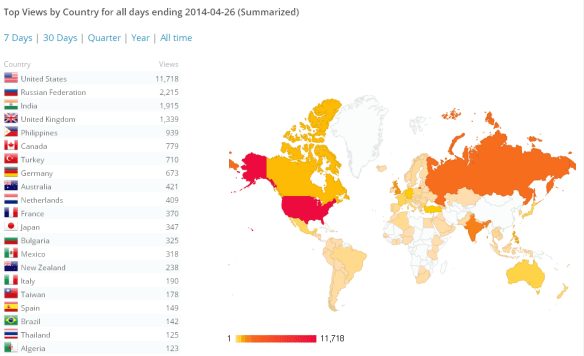
This map shows where the hits on this blog have come from, since its inception.

A notable exception: Iran shows zero hits. However, I know that people in Iran have seen https://robertlovespi.wordpress.com/2012/12/02/love-letters-from-iran/ — but access to the Internet from inside Iran is difficult. Hits from inside Iran show up on this map, no doubt, but they show up as hits from other, less repressive countries.

I also don’t believe for one moment that no one from China has seen my blog. The suspiciously high number of hits from Taiwan make me suspect Internet traffic is simply being routed from The People’s Republic, through Taiwan, to get to the rest of the world.

Information wants to be free. People do, too — and are finding ways around those forces which seek to control us.

Can a Public School Student Read a Bible in Class?

Image

Can a public school student read a Bible in class?

Yes, but not loudly, waving it around, while I am explaining the safety protocols for laboratory use of silver nitrate in chemistry class.

It’s dangerous stuff, as you can see here: http://www.sciencelab.com/msds.php?msdsId=9927411.

Did this actually happen? Of course — I don’t think I could make up a story like that. It happened in a different class than the one I am teaching this year, though. The student’s name is being withheld, to protect his identity (and my job).

On the Geography of Eurasia, and Its Major Divisions

Image

On the Geography of Eurasia, and Its Major Divisions

By any reasonable non-political definition, Eurasia is a single continent. Its area is 54,759,000 km², which is over one-third the earth’s total land area.

The politics of history have created, however, the “continents” of Europe, with an area of 10,180,000 km² (18.59% of Eurasia), and Asia, with an area of 44,579,000 km² (81.41% of Eurasia). These figures for Asia’s land area include that of the “subcontinent,” India, which has an area of 4,400,000 km². (Note: the subcontinent of India is a geographical term, and does not match the borders of the nation of India perfectly. The major reason for this is that India the subcontinent includes the nations of Pakistan and Bangladesh, in addition to the politically-defined nation of India.)  The subcontinent’s area is 8.04 % that of Eurasia, and 9.87% that of Asia.

Europe is a large peninsula, a part of Eurasia with a sizeable portion of its area. So is the Indian subcontinent. So, for that matter, are the Southern portions of both South America and Africa, yet no one calls them separate continents, nor even subcontinents.

Giving India a special designation of “subcontinent” makes no sense, nor does the designation of Europe as a separate continent. Both are simply parts of Eurasia.

My Wikipedia Userboxen Collection, Part IV

Image

My Wikipedia Userboxen Collection, Part IV

If you’re also a Wikipedean, and want some of these userboxen for yourself, feel free to copy them from my userpage. To help you find it: my username on Wikipedea is RobertAustin at the time of this posting, but should change to RobertLovesPi in just a few days.