
My Wikipedia Userboxen Collection, Part III

Image

My Wikipedia Userboxen Collection, Part III

And, yes, there are even more….

My Wikipedia Userboxen Collection, Part II

Image

My Wikipedia Userboxen Collection, Part II

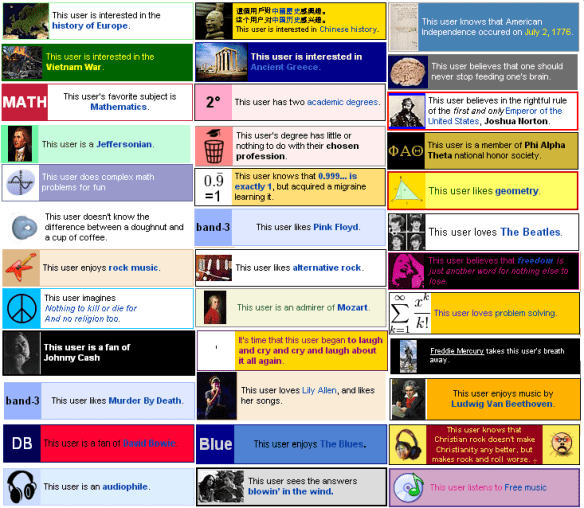
Collecting userboxen on Wikipedia is fun, but almost no one (except other Wikipedians) ever sees such collections. Since you can learn a lot about a given Wikipedian by their collection of userboxen, my blog seems like a good place to re-post my collection. It’s being done in pieces, simply to maintain legibility.

My Wikipedia Userboxen Collection, Part I

Image

My Wikipedia Userboxen Collection, Part I

I’ve been editing Wikipedia under my own (legal) name for years, although I just submitted a request to have my Wikipedia-name changed to match the name of this blog. Every Wikipedia user has a user page, and can put these userboxen on it. Here’s the first part of my collection.

How to Fix the Gay Marriage Debate, and All Other Legal Problems Related to Marriage and Divorce, All At Once

Image

How to Fix the Gay Marriage Debate, and All Other Legal Problems Related to Marriage and Divorce, All At Once

The government is now deeply involved in the process of people getting into and out of marriages, but this was not always so. Marriage is simply an agreement — a contact — between at least two people. Or a person and a toaster, perhaps, for that doesn’t really hurt any of us, now, does it?

Churches do lots of weddings, and they’re used to this role. They can keep doing it the same way they have been, except for parts which involve government. Churches could issue marriage licenses; we don’t need the state doing it.

Now, of course, people shouldn’t be required to be religious, or pretend to be, to get married. Any organization or individual could issue marriage licenses. For that matter, we could simply have official recognition of people’s relationship statuses on Facebook.

Yes, I mean that. Why not?

It used to be really simple. There’s no good reason for it to have become so complicated. Let’s fix that, with separation of marriage and the state.

Now, at the same time, we will need to change certain other things. Right now, the state encourages people to marry, with varying tax rates for married and single people. I contend that this is not a proper role for the state. There should be no reward for marrying, nor should there be any kind of penalty. They’re our marriages, not the government’s. Government should simply have stayed out of such matters, and should get out of them now.
Bell Hooks, on Rage

Image

Bell Hooks, On Rage

Not “Dead Presidents”

Image

Not Dead Presidents

Attention, Americans:

These two men, Alexander Hamilton and Benjamin Franklin, are, indeed, dead. However, neither of them ever served as president. Therefore, please stop calling money “dead presidents,” unless you are excluding these two denominations, and, moreover, please stop this immediately.

Your cooperation is appreciated.

The Strange American Custom of Holiday Observance

Image

The Strange American Custom of Holiday Observance

Today is not Dr. Martin Luther King, Jr.’s actual birthday. The anniversary of his birth came, this year, last Wednesday. As you can see above, that’s January 15. However, it’s being observed today — the date circled above — to give people a three-day weekend.

That’s related to something else, apart from the sheer inaccuracy of moving a date on the calendar, that bugs me about “MLK Day,” as it is often called. It’s essentially the same thing that bothers me about Memorial Day, and Veteran’s Day. To honor people we respect and admire for their hard work — for civil rights, defending the nation in battle, or anything else — what do we often do, as a nation? We close schools, many businesses, the stock market, mail service, etc., all to give as many people as possible a day without work. How does a day off, of all things, honor the hard work of anyone?

Something You Likely Did Not Know, About the “Pledge of Allegiance”

Image

I thought I knew the (rather complicated) history of the “Pledge of Allegiance” well — until I saw this picture. This was the original “flag salute” pose American students were taught to use, nationwide, until World War II was well underway. It had been in use since 1892, and was called the “Bellamy salute.”

The current “hand over the heart” gesture didn’t go into effect until 1942, and was changed in reaction to the Nazis using essentially the same salute which you see American schoolchildren displaying in this (circa 1941) photograph. From where did this gesture really originate? A common belief is that it started in ancient Rome, but the article at http://en.wikipedia.org/wiki/Roman_salute — and the sources cited there — throw doubt on this idea. It seems that, instead, this gesture was depicted in an 1874 painting of an ancient Roman scene, spread into other neoclassical artworks, then plays and other performances, until it was well-established in the public consciousness as something the ancient Romans did — but that belief appears to be unsupported by the relatively small number of actual writings, or works of art, which have survived from ancient times.

It was twelve years after the change in the civilian American flag-salute gesture that Congress made another, much better-known change — the 1954 addition (unconstitutional, in my opinion) of the words “under God.” Just as the early gesture-change was made, in wartime, as a reaction against the practices of an enemy, arguments have been made that this change in the wording of the Pledge was made for similar reasons, given that we were then in the early years of the Cold War, with America’s enemies, in that long struggle, being what were often called the “Godless Communists.”

[Additional source, beyond the one given above: http://en.wikipedia.org/wiki/Pledge_of_Allegiance (with more sources cited at the bottom of that article)].

“He wrote that . . . .”

Quote

“He wrote that he cared not a whit whether a neighbor believed in no god or in many gods, since such a private opinion ‘neither picks my pocket nor breaks my leg.'”

The above is from a book by the late Christopher Hitchens, writing about, and then quoting, Thomas Jefferson.

In my opinion, we’d all be better off if those atheists who actively try to destroy the faith of believers would follow Jefferson’s example, as described here, and follow the simple advice of the saying, “live and let live.”

Every American Who Is Old Enough Remembers 9/11/2001

Here’s the main thing I remember about that day. I was teaching 9th graders when the attacks occurred.

Student, 12 years ago today: “Mr Austin! Mr. Austin! Turn on the TV! Someone just flew an airplane into the World Trader Center!”

Me: “Yeah, RIGHT.” I was finally convinced to turn it on — just in time to see the second plane hit the other tower.

I don’t think I’ll ever live THAT one down. I had to spend the rest of the workday trying to reassure my students that Mayflower, Arkansas had zero strategic importance, and that they could relax about their fears of their small town being the next target. This was not easy.

The boiling anger set in after I no longer had to take care of students, and remained with me for days. Many (or most) Americans experienced this same emotion.