The Unintentional Bomb: A True Story

picric acid

Nineteen years ago, I began my teaching career at a small, private Arkansas high school. One of the classes I taught was Chemistry, and my principal happened to be a former chemistry teacher, himself.  We were both new to the school, and knew that there was a high turnover rate there for teachers in that field. They’d had perhaps eight teachers for that class in the previous five years. I stayed there six years, teaching chemistry every year.

The new principal saw the need for upgraded laboratory facilities, and we got them, including a new, larger chemical stockroom. The old stockroom was a nightmare, and the chemicals needed to be transferred to their new home. This was a massive undertaking, for many of my predecessors had ordered chemicals, not taking the time to inventory the stockroom to see if the school already had what they needed. Even worse, the chemicals were stored in approximate alphabetical order.

Experienced chemists and chemistry teachers know how scary the phrase “alphabetical order” is, in this context. For reasons of safety, chemicals need to be stored by families, using a shelving pattern that keeps incompatible chemicals far apart. I was not an experienced teacher of anything at this point, but the principal showed me the classification scheme he’d used before, himself. It’s the one recommended by Flinn Scientific, and you can see it at http://www.flinnsci.com/store/Scripts/prodView.asp?idproduct=16069. At his direction, over a couple of weeks, I took the chemicals from the old storage area to the new one, de-alphabetizing them into a much safer arrangement, onto category-labelled shelves. In the process, of course, I saw every laboratory chemical that school had, recognizing many (jar after jar of liquid mercury, for example) as highly dangerous, and making certain proper precautions were taken with such substances. If I didn’t recognize a chemical well enough to categorize it (sulfates together, halides together, etc.), I looked it up, in order to find its place. I wouldn’t even open a container with an unfamiliar chemical in it, until researching it. As it turned out, my caution with unfamiliar chemicals literally saved my life.

There are hundreds of different acids, and I doubt anyone knows them all. When I encountered a hand-labeled jar reading “picric acid,” I had never heard of that chemical, the structure for which is shown above. When I looked it up, I learned picric acid is safe if it is all in solution with water, but is a shock-sensitive explosive in solid form. I examined the liquid carefully, without actually touching the container. Sure enough, solid crystals had already started to form, over the years, as some of the water in the container slowly evaporated, and escaped.

Great, I thought, sarcastically — a shock-sensitive explosive. I then kept reading the hazard alerts, and noticed that they stated that picric acid should never be stored in any container with a metallic lid, because that invites the formation of explosive metal picrates which can be detonated simply by the friction caused by an attempt to open the lid. The picric acid I was dealing with, of course, not only had the dangerous solid crystals — it also had a metal lid, and a partially corroded one at that.

I never so much as touched that lid. Very carefully, I gently carried this container to the new stockroom, gave it a shelf all by itself, and didn’t so much as give it a nasty look, for the rest of the time I taught there. Leaving it alone, with me being the only person with access to that room, was the safest thing I could think of to do, as long as I was teaching there. For six school years, since it was carefully undisturbed, the picric acid behaved itself — and then, seeking a higher salary, I found a job for the following Fall, teaching at a public school. I knew I would not be able to leave this private school, though, without dealing with this picric acid problem once and for all, along with other dangerous chemicals the school did not need. I could have simply turned my keys in, and left, but that would have risked a potentially-fatal explosion in that school in future years, for I could not safely assume the next chemistry teacher would be familiar with, nor research, picric acid. My conscience would not permit that.

The school year being over, I went to see the school’s new principal. Unlike his predecessor, the new principal had never taught chemistry, but he’d been on the faculty, before his promotion, for longer than I had been there, and so we knew each other well. When I went into his office, with my keys, for end-of-the-year checkout, and calmly told him that there were many serious toxins and an unexploded bomb down the hall, he knew immediately that I wasn’t joking. With his permission, I kept my keys into the beginning of the Summer, getting things ready for professional chemical-disposal experts to come in and remove the dangerous materials. Before long, four cardboard boxes had been filled with dangerous chemicals the school did not need, slated for disposal — and that’s after I had already disposed of most things that needed to go, if I had the knowledge, and means, to dispose of them properly.

The first group of professionals who were called in, for help, were from the local fire department. They took some of the chemicals away, without charge, but only the ones that they knew how to deal with safely. The principal and I were informed that, for the remaining chemicals (down to one box now, in which was the picric acid), a professional “hazmat” team would need to be called in, and it wouldn’t be cheap.

It wasn’t. The bill from the hazmat team exceeded US$2000. They took away three or four kilograms of mercury, as well as a lot of other nasty stuff, but also told us, with apologies, that they weren’t taking the picric acid, it being too dangerous for a “mere” professional hazmat team. To get rid of that, we were told, we’d need to call in the bomb squad from the state’s capital city, Little Rock.

I had heard the phrase “bomb squad” in movies, and on TV, but not in real life. Judging from the look on his face, the same can be said for the principal. As it happened, I wasn’t in town on the day the bomb squad came to school, but I did hear numerous first-hand accounts of what transpired, when I came back the following day to turn in my keys.

One of many surprises reported to me by these witnesses is that the FBI arrived with the bomb squad, asking questions and interviewing people. Apparently there wasn’t supposed to be any picric acid in Arkansas schools, for a statewide sweep had been made to gather it all up, and dispose of it, in the 1970s. My guess, and that’s all it is, is that this very old bottle had been overlooked because of it being in a private, rather than a public, school. If the FBI wants to contact me now to ask me questions about this stuff, I’ll answer them, but, at the time, I didn’t mind a bit that I missed out on the interrogation-portion of these events. After the FBI had finished their on-site investigation, the bomb squad began their work.

This K-12 school has a very large campus, with multiple buildings, and my classroom was at one corner of it. The disposal site they chose — the nearest area sufficiently remote from people and buildings — was far behind the gymnasium, at least half a kilometer away, at the opposite corner of the campus. As it was described to me, two bomb squad guys put on what I call “moon suits,” wrapped the picric acid bottle up, with a lot of padding, and placed this padded bundle on a stretcher.  They then walked the stretcher, with its deadly cargo, around and between buildings, across railroad tracks and a street, around the gymnasium, and back into an empty lot, where a deep hole was dug. One of the guys in moon suits then put the picric acid container at the bottom of the hole, along with a stick of dynamite, the idea being to use the smaller dynamite explosion to trigger the much larger explosion of the picric acid.

The bomb-squad “astronaut” lit the long fuse on the dynamite, and scrambled out of the hole as quickly as his moon suit would permit. The fuse burned, right up to the dynamite — and then, just as everyone expected a deafening explosion, it fizzled out. They had unknowingly used a stick of dynamite with a defective fuse.

After waiting a while, just to give the dynamite time to, well, change its “mind” about exploding (which didn’t happen), the suited-up bomb squad guy was sent back into the hole, with a second stick of dynamite, which he placed next to the first one. I hope he got paid extra for this, for I would have quit, immediately, rather than re-enter that hole. He, however, did enter, lit the second dynamite stick, and got out in time. This time, the detonation was successful, and the picric acid and both sticks of dynamite were utterly obliterated.

At the time of the explosion, a former student of mine, who had graduated from this same school a few years before, was working in an office building, three or four kilometers away. I got an e-mail from him, and laughed when I read it. Apparently the entire building he was working in had just been shaken by an explosion in the direction of his former school, and he had one question for me:  had I had anything to do with this? I laughed, and replied with an honest answer.

My Four Favorite Authors

favorite authors

Whenever people ask me to name my favorite author, I always have to ask them to be more specific, for I cannot bring myself to choose just one. If gender is specified, and either fiction or non-fiction is, as well, then I am able to choose a favorite author in each of the resulting four categories.

My two favorite writers of fiction, Flannery O’Connor and Robert A. Heinlein, are shown at the top. Flannery O’Connor was often described as a Southern gothic writer with an excellent ability to describe the grotesque, mostly with short stories, while Robert Heinlein was often called the greatest of all writers in the genre of science fiction. I wish it were possible for them to write even more, but, unlike the two authors described next, they are no longer living.

Shown below O’Connor and Heinlein are my two favorite authors of non-fiction, Jung Chang and Sam Harris. Jung Chang writes about Chinese history, eloquently, from the perspective of someone who actually was a Red Guard during the utterly insane period known as the Chinese Cultural Revolution, as a teenager, but later managed to get out of the People’s Republic — and, crucially, she was also able to mentally escape the powerful cult of personality which surrounded that nation’s leader for over two decades, Chairman Mao Zedong. She has gone on to become one of Mao’s harshest critics.

Sam Harris, a neuroscientist, began his career as an author by writing books criticizing religion, in the wake of the 9/11 terrorist attacks of 2001. He has since moved on to other topics (and writing better books than his earlier work, in my opinion), such as the corrosive effects of lying, the question of the existence or non-existence of free will, and a scientific approach to dealing with issues involving good and evil. He also has a new book coming out in September.

Other than their amazing skill at the difficult craft of writing, these four have little in common . . . but who wants to read the same sort of books all the time? If you aren’t familiar with their work already, I recommend giving each of them a read, and seeing what you think of their books. For one of them, Sam Harris, you can even give some of his writing a try for free, for he maintains a blog you can check out for yourself, at http://www.samharris.org.

For the other three, it isn’t quite that easy to get started, but their books may still be found in any decent public library, or, of course, websites such as Amazon. For O’Connor, the best place to start is with her collected short stories (Amazon link: http://www.amazon.com/The-Complete-Stories-Flannery-OConnor/dp/0374515360/ref=sr_1_2?ie=UTF8&qid=1405366654&sr=8-2&keywords=collected+short+stories+of+flannery+o%27connor). For Jung Chang, I recommend starting with the story of what happened, against the tumultuous backdrop of Chinese history, to her grandmother, mother, and finally herself, in Wild Swans:  Three Daughters of China (see http://www.amazon.com/Wild-Swans-Three-Daughters-China/dp/0743246985/ref=sr_1_1?s=books&ie=UTF8&qid=1405366792&sr=1-1&keywords=wild+swans). Heinlein’s works are numerous, and there are many good starting places to be found. Among the best books with which to start reading Heinlein are Stranger in a Strange Land (his most famous work), Friday, The Moon Is a Harsh Mistress, and Job:  A Comedy of Justice. Amazon’s Robert Heinlein page may be found at http://www.amazon.com/Robert-Heinlein/e/B005GDIOHM/ref=sr_tc_2_0?qid=1405367065&sr=1-2-ent.

Enjoy, and, if you have book recommendations of your own, I invite you to leave them in a comment to this post.

Seven Moving Lights in the Sky, the Seven Days of the Week, and Other Significant Sets of Seven

days of week and lights in the sky

Have you ever wondered why the number seven appears in all the places it does? We have seven days in the week. Churches teach about the seven deadly sins, and “seven heavens” is a common phrase. There are seven wonders of the ancient world, and seven of the modern world. The number seven has appeared in many other socially significant ways, in societies all over the world, for millennia.

It is no coincidence, I think, that the ancients were able to see seven lights in the sky which are either visible in daylight, or move against the background of “fixed” stars at night. They ascribed great significance to what went on in the sky, since they viewed “the heavens” as the realm of the gods in which they believed. The evidence for this lives on today, in the names of the seven days of the week, and numerous other sets of seven, all over the world.

It is possible to see the planet Uranus without a telescope, but it is very dim, and you have to know exactly where to look. No one noticed it until after the invention of the telescope. If Uranus were brighter, and had been seen in numerous ancient societies, I have no doubt that we would have eight days in the week, etc., rather than seven.

Pie Chart for Main-Belt Asteroid Masses

Image

Pie Chart for Main-Belt Asteroid Masses

I looked up enough asteroid masses to use them to make this pie chart. I now have three reactions.

First: oh, that’s why only Ceres is round!

Second: who was stupid enough to name an asteroid Europa? That name is taken!

Third: wow — those small ones sure do make up a lot of the total!

A Simulation of Crystalline Growth Using Polyhedral Augmentation

Crystals and crystalline growth have been studied for centuries because of, at least in part, their symmetry. Crystals are cut in such a way as to increase this symmetry even more, because most people find symmetry attractive. However, where does the original symmetry in a crystal come from? Without it, jewelers who cut gemstones would not exist, for the symmetry of crystalline minerals themselves is what gives such professionals the raw materials with which to work.

To understand anything about how crystals grow, one must look at a bit of chemistry. The growth of crystals:

  • Involves very small pieces:  atoms, molecules, ions, and/or polyatomic ions
  • Involves a small set of simple rules for how these small pieces attach to each other

Why small pieces? That’s easy:  we live in a universe where atoms are tiny, compared to anything we can see. Why is the number of rules for combining parts small, though? Well, in some materials, there are, instead, large numbers of ways that atoms, etc., arrange themselves — and when that happens, the result, on the scale we can see, is simply a mess. Keep the number of ways parts can combine extremely limited, though, and it is more likely that the result will possess the symmetry which is the source of the aesthetic appeal of crystals.

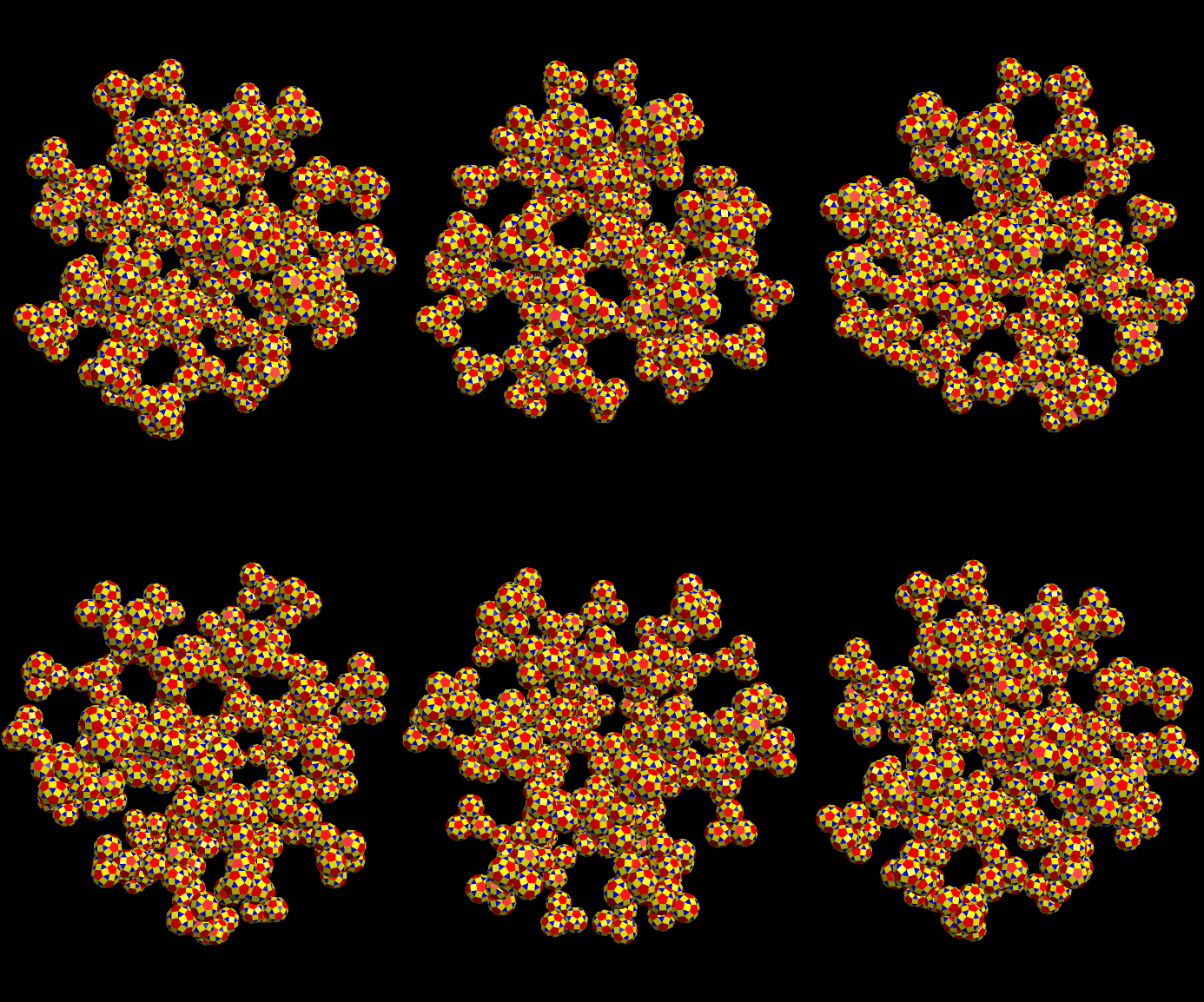
This can be modeled, mathematically, by using polyhedral clusters. For example, I can take a tetrahedron, and them augment each of its four faces with a rhombicosidodecahedron. The result is this tetrahedral cluster:

Image

Next, having chosen my building blocks, I need a set of rules for combining them. I choose, for this example, these three:

  1. Only attach one tetrahedral cluster of rhombicosidodechedra to another at triangular faces — and only use those four triangles, one on each rhombicosidodecahedron, which are at the greatest distance from the cluster’s center.
  2. Don’t allow one tetrahedral cluster to overlap another one.
  3. When you add a tetrahedral cluster in one location, also add others which are in identical locations in the overall, growing cluster.

Using these rules, the first augmentation produces this:

Image

That, in turn, leads to this:

Image

Next, after another round of augmentation:

Image

One more:

Image

In nature, of course, far more steps than this are needed to produce a crystal large enough to be visible. Different crystals, of course, have different shapes and symmetries. How can this simulation-method be altered to model different types of crystalline growth? Simple:  use different polyhedra, and/or change the rules you select as augmentation guidelines, and you’ll get a different result.

[Note:  all of these images were created using Stella 4d: Polyhedron Navigator. This program is available at http://www.software3d.com/Stella.php.]


Astronomy Update

Image

Astronomy Update

The brightest star in the picture above is Mintaka, from Orion’s Belt. We just adopted a cat, and named her Mintaka. I think that calls for an astronomy update — just the basics, stuff that everyone should know much of.

  1. Starting with our solar system:
    1. Planets:
      1. Mercury, smaller than earth’s moon, no atmosphere to speak of, no moons, tidally locked with the sun
      2. Venus, no moons, hottest planet in solar system due to thick carbon dioxide atomsphere
      3. Earth, one planet-sized moon, only known location of life
      4. Mars, thin carbon dioxide atmosphere, two small, irregularly-shaped moons
      5. (Many asteroids in main asteroid belt, between orbits of Mars and Jupiter)
      6. Jupiter, largest of four gas giants and everything else in the solar system except the sun, 67 known moons (four are planet-sized, and three of those four have known or suspected sub-surface water oceans — Europa, Callisto, and Ganymede)
      7. Saturn, gas giant with most extensive ring system in the solar system, 150 known moons and moonlets, including one planet-sized moon, Titan, with a thick atmosphere and possible subsurface ocean, and another moon with a known subsurface water ocean, Enceladus)
      8. Uranus, planet with axis of rotation closest to the ecliptic, 27 known moons
      9. Neptune, one large moon, Triton, among 14 known moons
    2. Dwarf Planets:
      1. Ceres, only dwarf planet in the asteroid belt
      2. Pluto/Charon double dwarf planet system
      3. Haumea
      4. Makemake
      5. Eris, largest dwarf planet
      6. Sedna
  2. Other known solar systems:
    1. 1,795 exoplanets
    2. 461 exoplanets in multiplanet systems
    3. Total of 1,114 exoplanet systems, all within our galaxy
  3. Nearest known star, other than the sun: Proxima Centauri, 4.2 light-years distant
  4. Number of stars in the Milky Way, our galaxy:  ~300 billion
  5. Number of galaxies in the known universe:  ~100-200 billion

Twelve Rotating Images of Barred Spiral Galaxy NGC1300

Image

Twelve Rotating Images of Barred Spiral Galaxy NGC 1300

After using Google to find the image of this galaxy, I used software called Stella 4d (available at http://www.software3d.com/Stella.php) to project it onto the twelve pentagonal faces of an icosidodecahedron, and then hid the triangular faces, as well as the vertices and edges — and then set the galaxies to rotate on the faces, as well as around the axis of the polyhedron.

Proposed Radiobiohazard Symbol

Image

Proposed Radiobiohazard Symbol

We’re all familiar with the radiation-hazard symbol:

KTjed7aTq

And, of course, the biohazard symbol:

Biohazard_Symbol_HH12_OSHA

However, what if some unforeseen disaster threatens us with living, radioactive pathogens? Clearly, we need a radiobiohazard symbol for just such an eventuality, and I’m proposing the top picture here as a rough draft for one, inspired by the two already-existing warning symbols.

To the TSA, FEMA, the NSA, and the rest of the alphabet soup of “keep-us-safe” agencies: you’re welcome.

The Sun, On a Trip Through the Electromagnetic Spectrum

Image

The Sun, On a Trip Through the Electromagnetic Spectrum

The image above shows the sun’s output of radio waves, which have the longest wavelengths, lowest frequencies, and lowest energies of any part of the electromagnetic spectrum.

IDL TIFF file

This image, above, shows the sun’s microwave output.

Next, infrared:

sun infrared

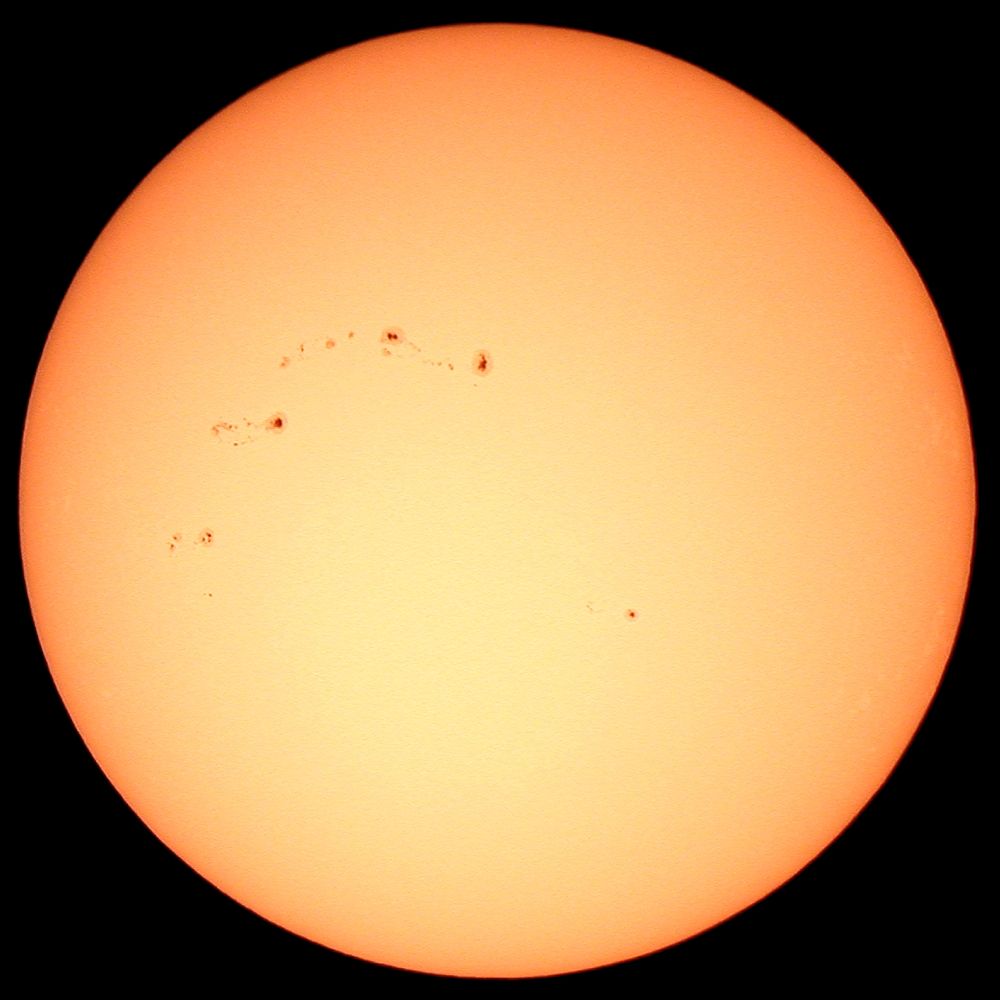
This next one should be familar. It’s visible light. (Don’t stare at the sun, though.)

Sun visible light

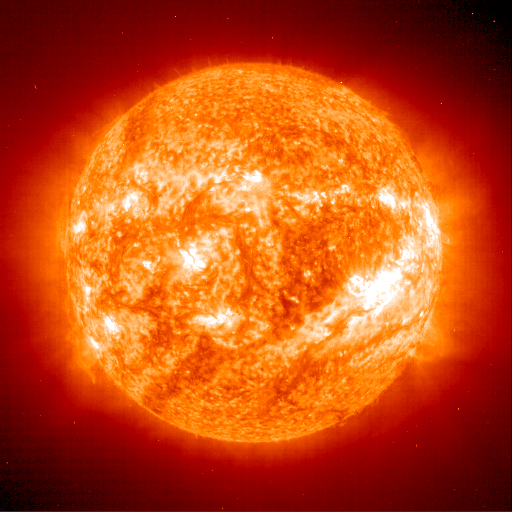
Moving on through the spectrum, ultraviolet is next:

sun ultraviolet

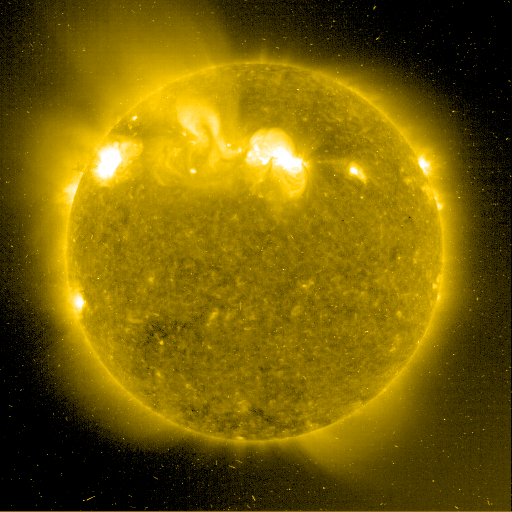
After that, x-rays:

sun xray

And, finally, we arrive at the other side of the spectrum, where the electromagnetic radiation has its shortest wavelengths, and highest frequencies, as well as energy per photon. This is the sun in gamma rays:

sun gamma

Most of these images, all found using Google image-searches, use false colors, of course . . . or you wouldn’t be able to see them!

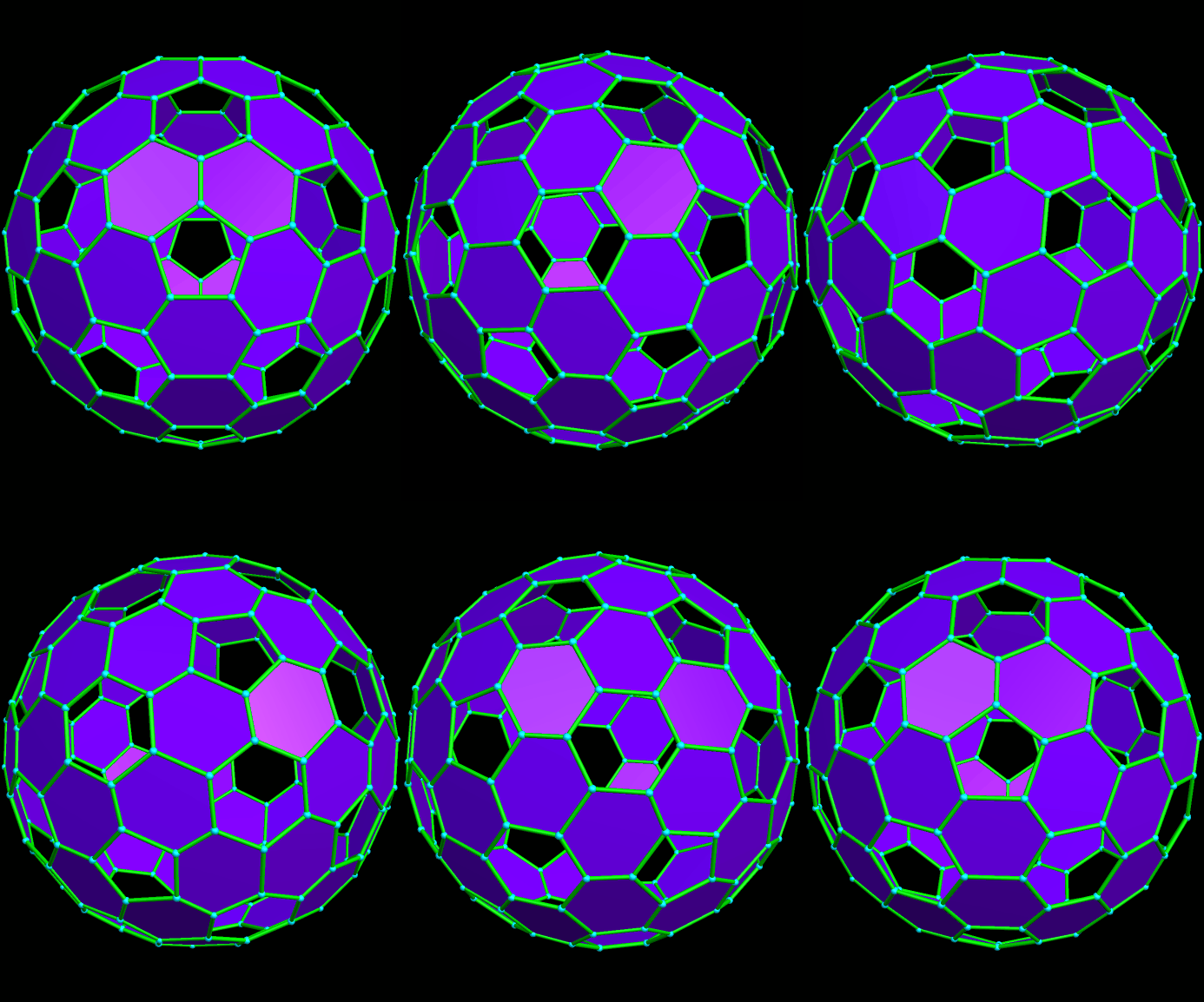
A Truncated Icosahedron with Sixty Extra Hexagons

Image

A Truncated Icosahedron with Sixty Extra Hexagons

I created this using Stella 4d, which is available (including a free trial download) at http://www.software3d.com/Stella.php. With adjustments in edge lengths to make the bond lengths correct, this would be the shape of a C180 fullerene molecule.

If the thirty-two faces of the truncated icosahedron are hidden, and only the sixty extra hexagons are visible, this polyhedron looks like this:

Dual of Geodesic Trunc Icosa

In “rainbow color mode,” it has an even more interesting appearance:

Dual of Geodesic Trunc Icosa