Proposed Radiobiohazard Symbol

Image

Proposed Radiobiohazard Symbol

We’re all familiar with the radiation-hazard symbol:

KTjed7aTq

And, of course, the biohazard symbol:

Biohazard_Symbol_HH12_OSHA

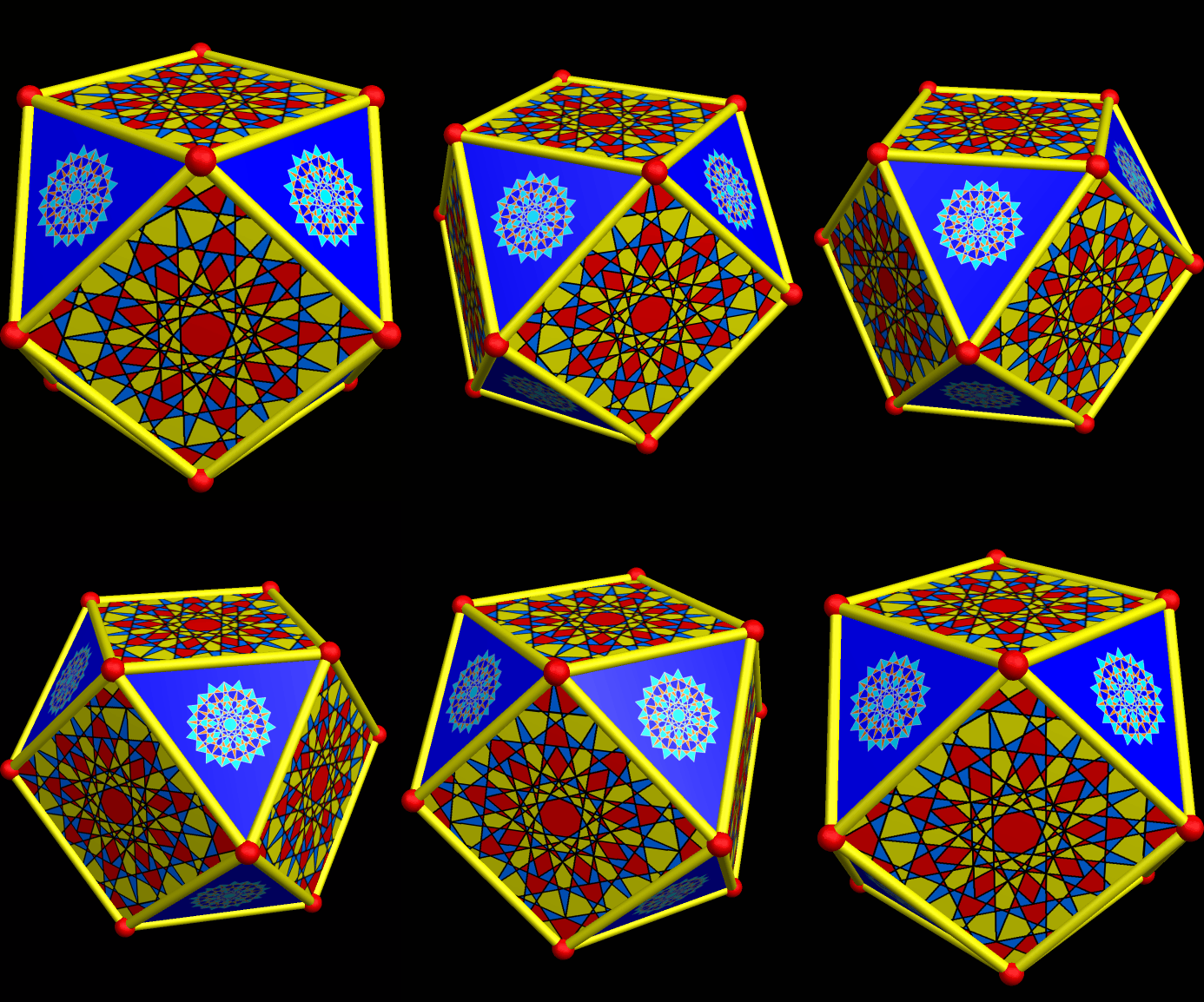
However, what if some unforeseen disaster threatens us with living, radioactive pathogens? Clearly, we need a radiobiohazard symbol for just such an eventuality, and I’m proposing the top picture here as a rough draft for one, inspired by the two already-existing warning symbols.

To the TSA, FEMA, the NSA, and the rest of the alphabet soup of “keep-us-safe” agencies: you’re welcome.

A Chiral Tessellation

A Chiral Tessellation

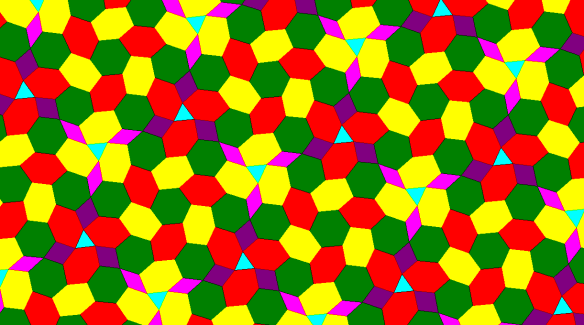
In this chiral tessellation, the blue triangles and green hexagons are regular. The yellow hexagons are “Golden Hexagons,” which are what you get if you reflect a regular pentagon over one of its own diagonals, then unify the two reflections. The pink and purple quadrilaterals are two types of rhombi, and the red hexagons are a third type of equilateral hexagon. All of the edges of all polygons here have the same length.

There are three different types of points of three-fold rotational symmetry repeated here. Two of these types are centered in the middle of blue triangles, while the third is centered in the middle of some of the green hexagons — specifically, the ones surrounded only by alternating red and yellow hexagons.

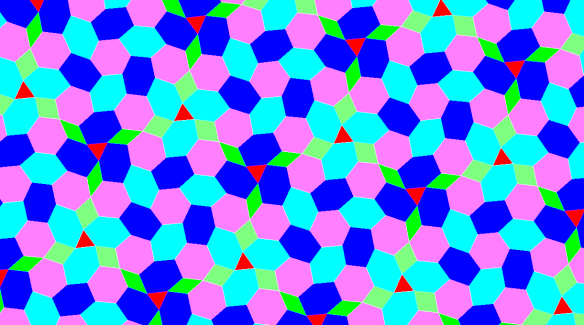
When I try to generate the mirror-image of this tessellation, it overloads Geometer’s Sketchpad, and crashes the program. However, inverting the colors of the same reflection, in MS-Paint, to make a color-variant, is easy:
weird tessellation

A Truncated Form of the Rhombic Dodecahedron

Image

A Truncated Form of the Rhombic Dodecahedron

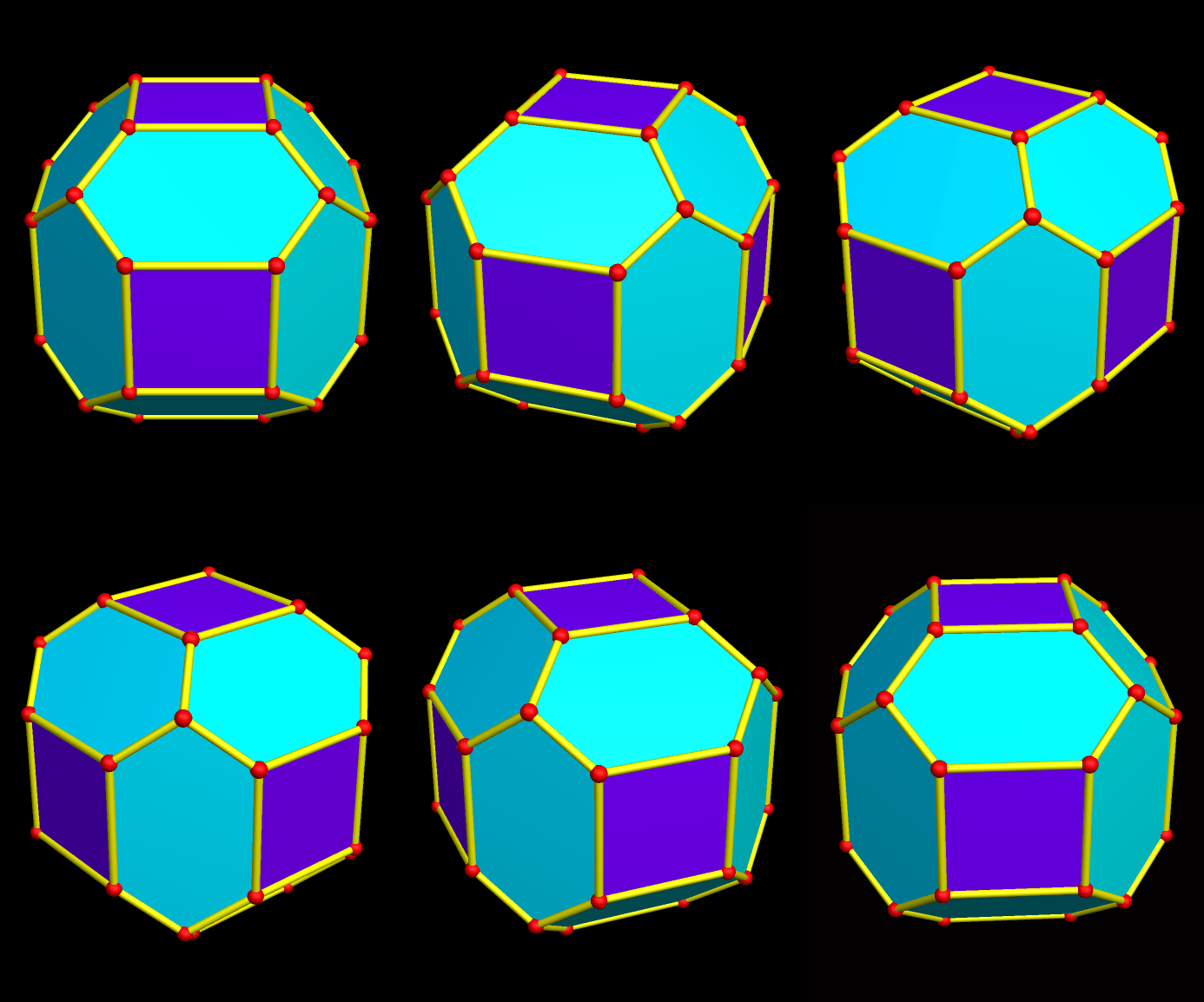
This is not the only truncated form of the rhombic dodecahedron. In this polyhedron, square-based pyramids have been “truncated away” from the rhombic dodecahedron’s four-valent vertices, but the three-valent vertices remain untouched.

If this truncation is done in such a way as to leave the hexagonal faces equilateral (which is not done here), so that all edges of the polyhedron have the same length, the result is called a “chamfered cube.” This closely-related figure may be seen at https://en.wikipedia.org/wiki/Chamfered_cube.

[Image credit: this rotating model was created using Stella 4d, software you can find right here, with a free trial download available.]


Triskelion of Regular Polygons

Image

Triskelion of Regular Polygons

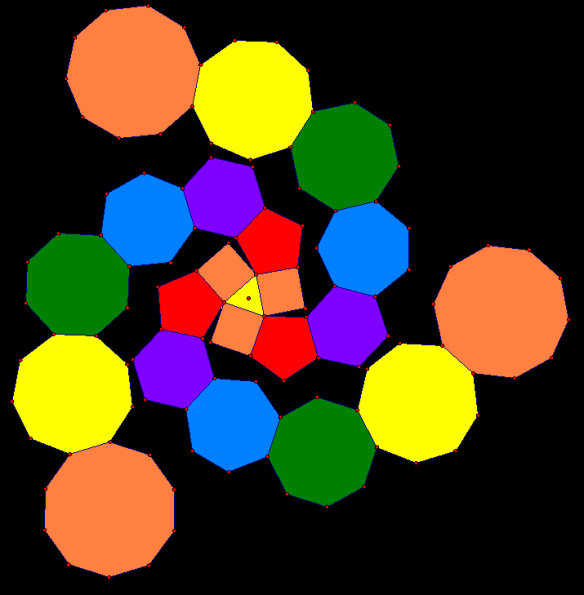
Tessellation Using Equilateral Triangles, Isosceles Triangles, Squares, Regular Pentagons, and Equilateral, Non-Convex Octakaitetracontagons

Image

In this tessellation, regular polygons have been given the brighter colors, while the two non-regular polygons have pastel colors.

Tessellation of the Plane with Regular Hexagons, Squares, and Tetraconcave, Equilateral Octagons, #1

Image

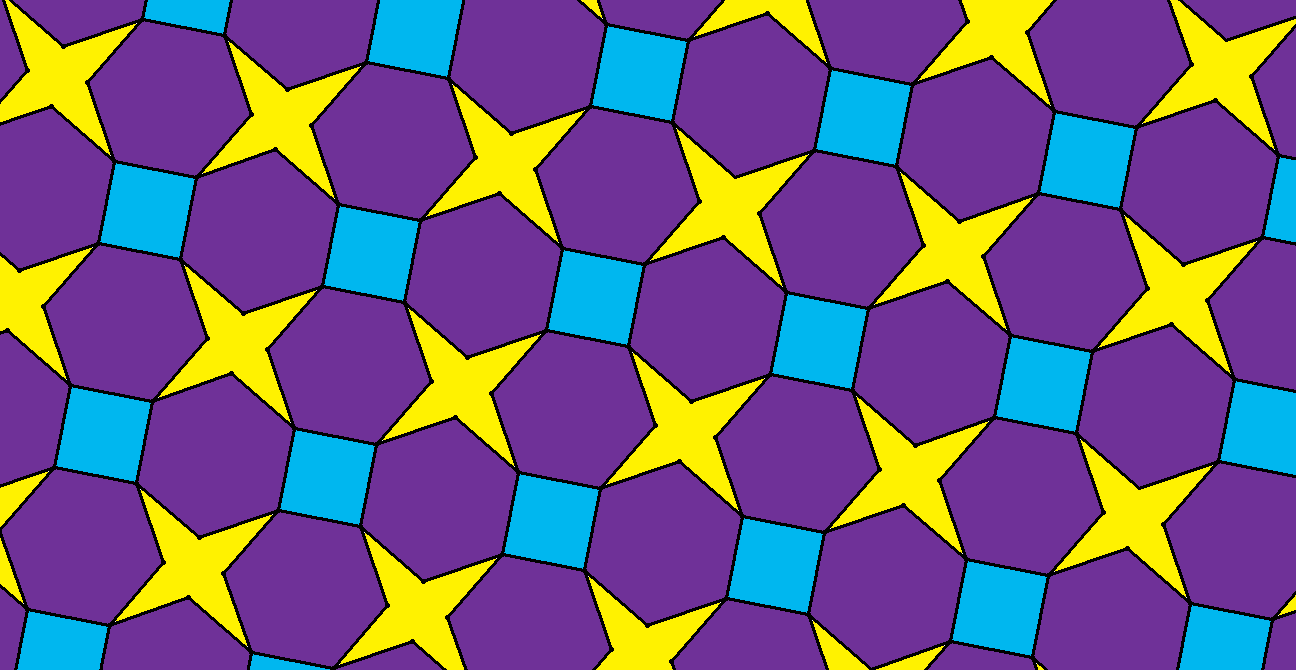
Tessellation of the Plane with Regular Hexagons, Squares, and Tetraconcave, Equilateral Octagons

If you’d like to see the second version of this tessellation, made over a decade later, simply click right here.

Four Views of a Tesseract, Rotating in Hyperspace

Image

Four Views of a Tesseract, Rotating in Hyperspace

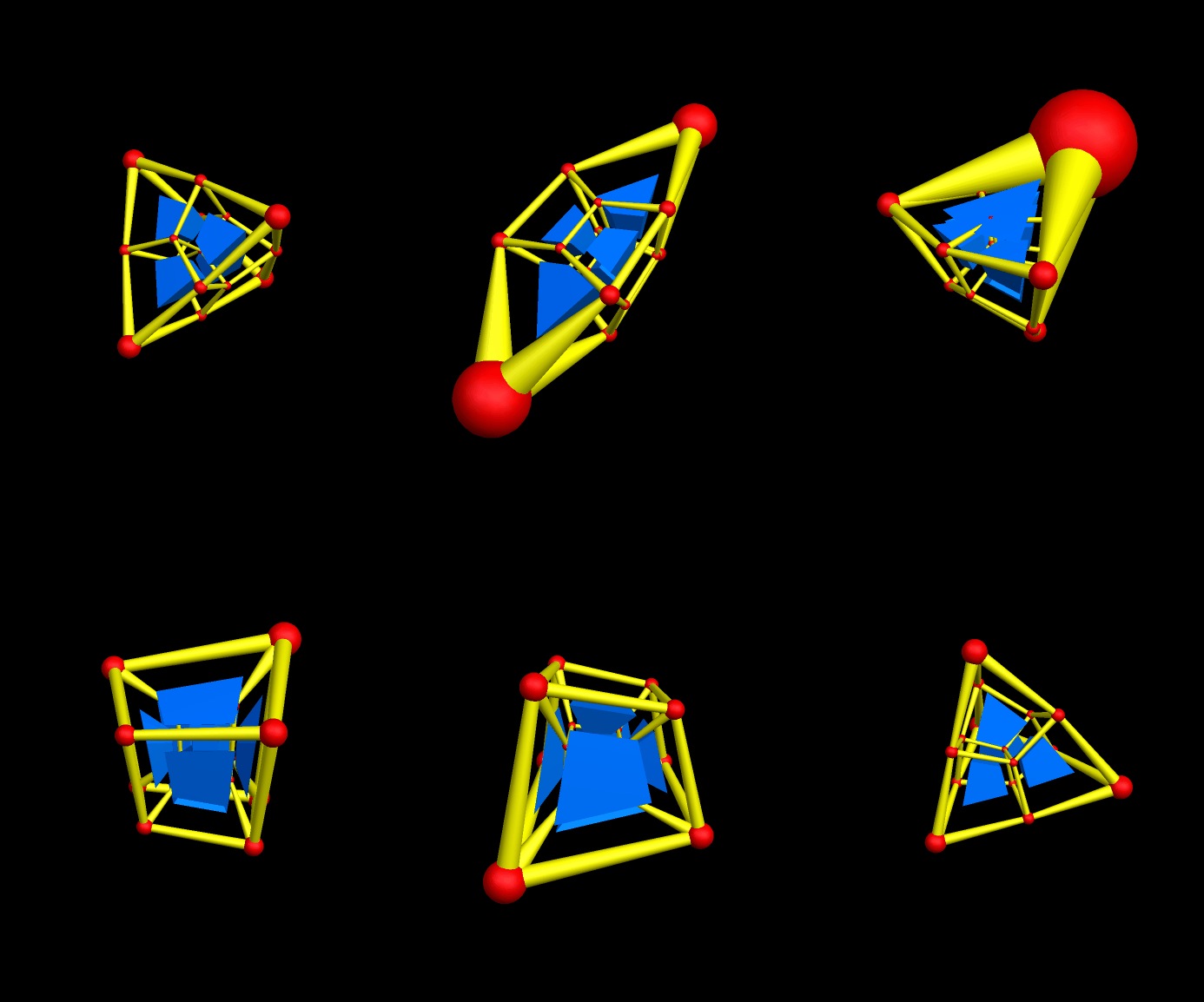
These tesseract views are all of the perspective projection-type, with the first one, above, being done in cell-first fashion.

The next one is projected edge-first.

persp edge 2-Tes, 8 -cell, Octachoron, Tesseract

The third one is projected vertex-first.

persp vertex 2-Tes, 8 -cell, Octachoron, Tesseract

Lastly, face-first:

persp face 2-Tes, 8 -cell, Octachoron, Tesseract

Although all of these are rotating in the same direction in hyperspace, the different projection-choices make the second and fourth images appear to be rotating in different directions. Why? I’m still trying to figure that out!

These animations were created with Stella 4d, software available at www.software3d.com/Stella.php.

Pulsating Cuboctahedron, Featuring Enneagrammic Mandalas

Image

Pulsating Cuboctahedron, Featuring Enneagrammic Mandalas

The enneagramic mandalas on the square faces of this cuboctahedron are from the last post, with inverted-color, smaller versions of the same image on the triangular faces. These mandalas were created using Geometer’s Sketchpad and MS-Paint. Projecting them onto the faces of the cuboctahedron, and then creating this rotating, pulsating .gif image, however, took a third program: Stella 4d, which you can buy, or try for free, at http://www.software3d.com/Stella.php.

Ten Enneagrams

Image

Ten Enneagrams

These enneagrams are of the {9/3} variety, which means each one is made of three concentric, equilateral triangles. One of these enneagrams is at the center; the other nine surround it.

Tessellation Using {8/3} Star Octagons and Squares

Image

Tessellation Using {8/3} Star Octagons and Squares

The tessellation of the plane which uses regular convex octagons and squares is well-known. This related tessellation, however, is not. I didn’t know it existed until I stumbled across it . . . although I very much doubt I am the first person to do so.