A Truncated Icosahedron with Sixty Extra Hexagons

Image

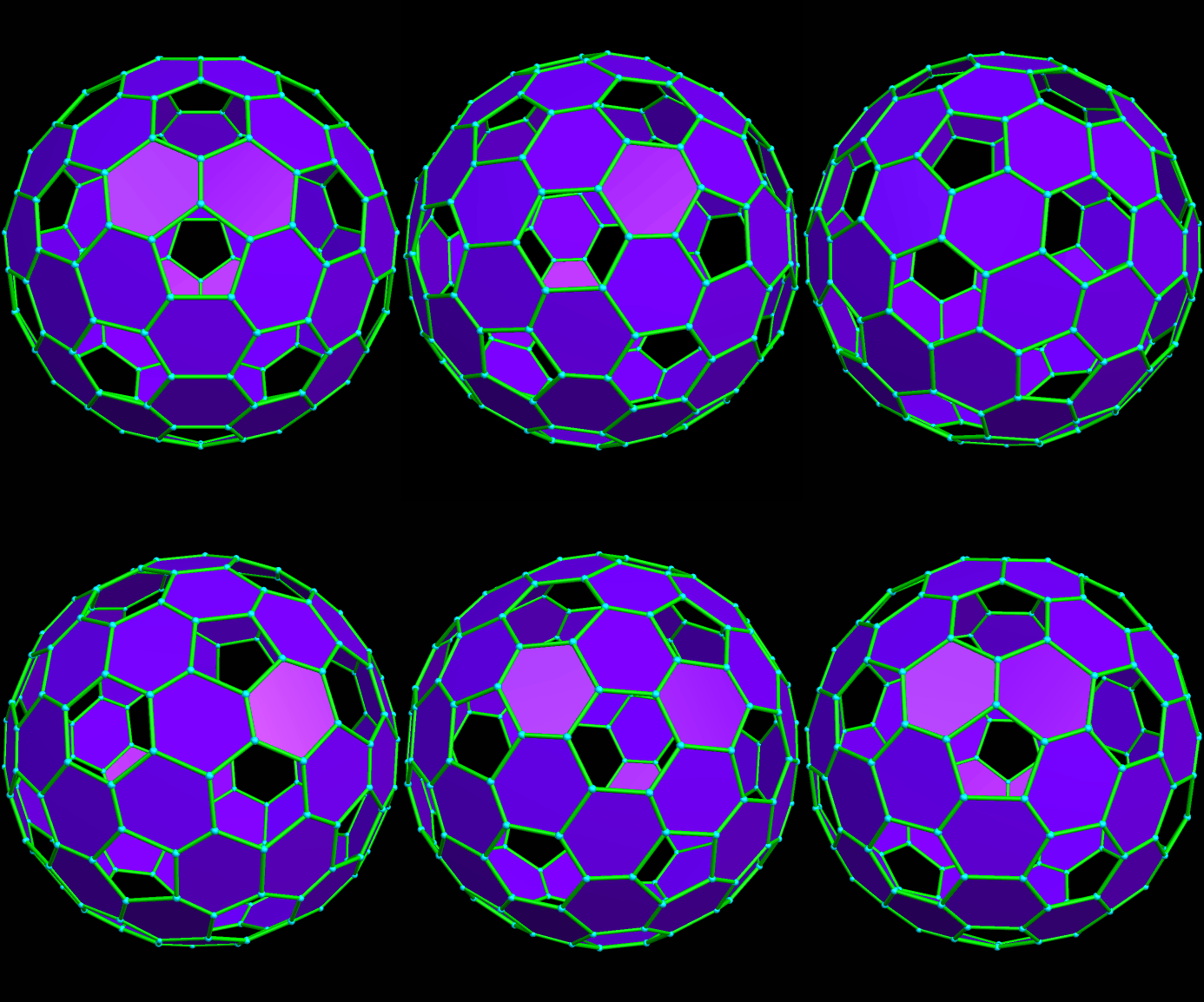
A Truncated Icosahedron with Sixty Extra Hexagons

I created this using Stella 4d, which is available (including a free trial download) at http://www.software3d.com/Stella.php. With adjustments in edge lengths to make the bond lengths correct, this would be the shape of a C180 fullerene molecule.

If the thirty-two faces of the truncated icosahedron are hidden, and only the sixty extra hexagons are visible, this polyhedron looks like this:

Dual of Geodesic Trunc Icosa

In “rainbow color mode,” it has an even more interesting appearance:

Dual of Geodesic Trunc Icosa

The Beauty of Uselessness

Image

The Beauty of Uselessness

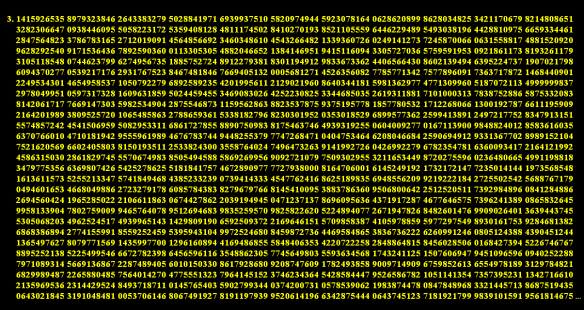
Given the name of this blog, and the familiarity of the number pictured above, I’m sure you recognize it as the beginning of my favorite number, pi. On various websites, you can find far more digits than are shown above. However, just the digits shown in the top row here are greater in number than that needed for any real-world, practical application. Is pi useful? Is mathematics itself useful? Of course they are . . . but those questions miss the point entirely.

Every teacher who has been in the field for long has heard the complaint, disguised as a question, “What are we ever going to use this for?” Unfortunately, most school systems, as well as teacher-training programs, have chosen to respond to this well-known complaint by repeatedly telling teachers, and teachers-in-training, that it is of extreme importance to show students how the curriculum is “relevant,” and adjust curricula to make them more so. This usually boils down, of course, to trying to convince students that learning is important because, supposedly, education = a better job in the future = more money. Sometime this “equation” works, and sometimes it does not, but it always misses a key point, one that should not be left out, but too often is.

It is a fallacy that learning has to have a practical application to be a worthwhile endeavor. There’s more to life than the fattening of bank accounts. Sadly, many of those making decisions in education do not realize this. Their attempts to reduce education to a strictly utilitarian approach are causing great harm.

This scenario has happened many times: a mathematician discovers an elegant proof to a surprising theorem, a physicist figures out something previously unknown about the nature of reality, or a researcher in another field does something comparable, and someone then asks them, “But what can this be used for?” On occasion, tired of hearing this utilitarian refrain, such researchers give unusually honest responses which surprise and confuse many people — such as, “Someone else might, at some point, find a practical application for this . . . but I sincerely hope that never happens.” Such a response is rarely understood, but it makes the person who says it feel better to vent some of their frustration with those who are obsessed with tawdry, real-world applications for everything.

Many humans — and this is a terrible shame — live almost their entire lives like rats in mazes, running down passages and around corners, chasing tangible rewards — cheese for the rats, or the ability to buy, say, a fancy new car, in the case of the people. People shouldn’t live like lab rats . . . and, unlike lab rats, we don’t have to. People are smart enough to find higher purposes in life. People can, in other words, find, understand, and appreciate beauty — in things which are useless, in the sense that they have no useful applications. We can appreciate things that transcend mere utility, if we choose to do so.

Much of life is utterly banal, for a great many people. They wake up each day, work themselves into exhaustion at horribly boring jobs, go home, numb themselves with television, massive alcohol consumption, or other hollow pursuits, fall asleep, and then get up and repeat the process the next day . . . and then they finally get old and die. Life can be so much more than that, though, and it should be.

The researchers I described earlier aren’t doing what they do for money, or even the potential for fame. Are such things as mathematics and physics useful? Yes, they are, but that isn’t why pure researchers do them. The same can be said for having sex: it’s useful because it produces replacement humans, but that isn’t why most people do it. People have sex, obviously, because they enjoy it. In simpler terms: it’s fun. Most people understand this concept as it relates to sex, but far fewer understand it when it relates to other aspects of life, particularly those of an academic nature.

Academic pursuits are of much greater value when the motivation involved is joy, and the fun involved, rather than avarice. As scrolling through this blog will show you, I enjoy searching for polyhedra which have not been seen before. I certainly don’t expect to get rich from any such discoveries I make in this esoteric branch of geometry, which is itself one subfield, among many, in mathematics. I do it because it is fun. It makes me happy.

Much of life is pure drudgery, but our lives can be enriched by finding joyous escapes from our routines. An excellent way to do that is to learn to appreciate the beauty of uselessness — uselessness of the type that elevates the human spirit, in a way that the pursuit of material goods never can.

This is the approach we should encourage students to have toward education. Learning is far too valuable an activity to be limited, in its purpose, to the pursuit of future wealth. It’s time to change our approach.

My Students’ Painting of the Periodic Table of the Elements

Image

My Students' Painting of the Periodic Table of the Elements

This is my last year teaching at my current school — I’ll be transferring to another school in the same district in the Fall. To create a farewell gift to the school where I have taught for the last three years, I brought a lot of paint and other art supplies from home, bought more when they ran out, and let my students (who are enrolled in Chemistry and Physical Science) paint a large painting of the periodic table on two large wooden boards, each measuring 4′ by 6′. In the Fall, the plan is for the painting to be mounted on the wall of the science wing of my current school, in a location to be chosen by my current department chair, a personal friend of mine.

I think my students did a very good job — better than this picture I took with my cell phone reveals, just due to camera-quality. I am proud of them.

You Must Obey the Speed Limit

Image

You Must Obey the Speed Limit

The Vacuum Cleaner Enigma

Image

The Vacuum Cleaner Enigma

A vacuum is, by definition, a region of space devoid of matter. While a perfect vacuum is a physical impossibility, very good approximations exist. Interplanetary space is good, especially far from the sun. Interstellar space is better, and intergalactic space is even better than that.

Along come humans, then, and they invent these things:

vacuum-cleaner-upright

. . . and call them “vacuum cleaners.”

Now, this makes absolutely no sense. There isn’t anything cleaner than a vacuum — and the closer to an ideal vacuum a real vacuum comes, the cleaner it gets. Since vacuums are the cleanest regions of space around already, why would anyone pay good money for a machine that supposedly cleans them? They’re already clean!

Even cleaning in general is a puzzle, without vacuums being involved at all. To attempt to clean something — anything — is, by definition, an attempt to fight the Second Law of Thermodynamics. Isn’t it obvious that any such effort is, in the long run, doomed from the outset?

—–

[Image note:  I didn’t create the images for this post, but found them using Google. I assume they are in the public domain.]

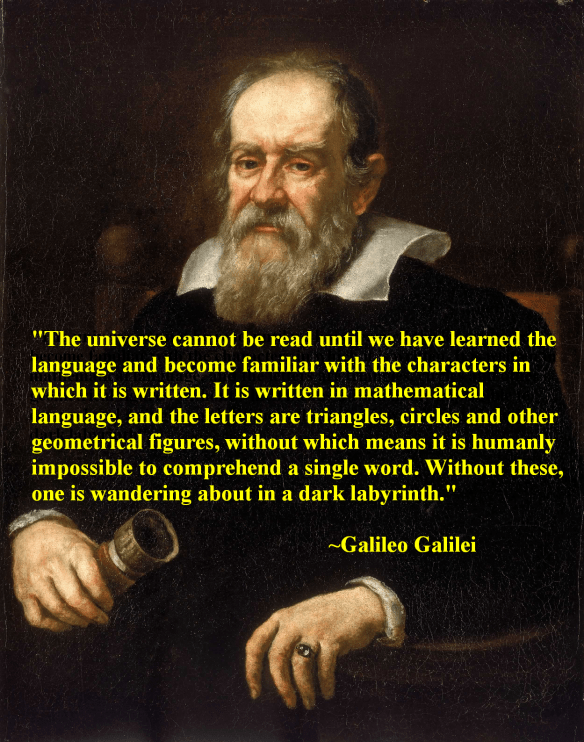
Galileo Galilei, on the Language of the Universe

Image

Galileo Galilei, On the Language of the Universe

Source for quote: https://en.wikipedia.org/wiki/Portal:Mathematics

On the Varieties of Water

Image

On the Varieties of Heavy Water

As many people know, there is more than one type of water. For example, the term “heavy water” often refers specifically to D2O, with “semi-heavy water” referring to DOH. Add tritium to the mix, and the new combinations possible — all radioactive — include HOT, DOT, and T2O. Along with diprotium oxide, plain old H2O, that’s six isotopic variants of this one simple compound.

However, that six needs to be multiplied by three. Why? Because there’s one set of six that includes an oxygen-16 atom (the usual kind), and another six for oxygen-17, and one more for oxygen-18, for a total of eighteen. So far. Both oxygen-17 and -18 are stable, and occur in nature, although they are both of very low abundance.

Eighteen kinds of water, half of them radioactive? No, that’s not quite enough. If the radioactive isotope of hydrogen is included, then so should be the radioisotopes of oxygen. That would include oxygen isotopes with mass numbers from 13 to 15 (add three more sets of six, or 18, which, when added to the original 18, gives a running total of 36), and 19 to 24 (add six more sets of six, or 36 more, to the 36 we just had, and we’re now at 72).

To leave it at 72 isotopic varieties of water is not necessary, but it is reasonable. Yes, there is oxygen-26, but with an estimated half-life of 40 nanoseconds, it isn’t reasonable to expect there to be time for it to form a water molecule. Could it happen? Possibly — but it’s extremely unlikely to ever be observed. For oxygen-12, the story is similar, but with an even shorter nuclide-lifetime than that of O-26.

Additional isotopes of hydrogen have also been detected, with mass numbers from 4 to 7, but they decay even more quickly than O-26 as well.

72 it is, then, counting nothing with a half-life under a millisecond. This is the sort of thing that happens when math compulsives think about chemistry a bit too long.

Can a Public School Student Read a Bible in Class?

Image

Can a public school student read a Bible in class?

Yes, but not loudly, waving it around, while I am explaining the safety protocols for laboratory use of silver nitrate in chemistry class.

It’s dangerous stuff, as you can see here: http://www.sciencelab.com/msds.php?msdsId=9927411.

Did this actually happen? Of course — I don’t think I could make up a story like that. It happened in a different class than the one I am teaching this year, though. The student’s name is being withheld, to protect his identity (and my job).

An Alphabetical Listing of Known Exotic Atoms

  • Antiprotonic helium:  an atom of helium, with one electron replaced by an antiproton.
  • Antiprotonic lithium:  an atom of lithium, with one electron replaced by an antiproton.
  • Exciton:  a bound state of an electron and an electron hole.
  • Hypernuclear atoms:  any of several observed atoms with a hypernucleus.  Hypernuclei are any nuclei which contain (in addition to protons and neutrons) at least one hyperon, a subclass of baryons which contain strange quarks. These atoms are studied primarily for their nuclear behavior, and so fall better into the subfield of nuclear physics, rather than atomic physics or chemistry.
  • Kaonic helium:  a helium atom, with one electron replaced by a negative kaon, which is a meson composed of a strange quark, and an antiup quark.
  • Kaonic hydrogen:  a hydrogen atom, with the electron replaced by a negative kaon, a meson composed of a strange quark and an antiup quark.
  • Kaonium:  a bound state of a positive and negative kaon. Positive kaons are mesons composed of up and antistrange quarks, while negative kaons are mesons composed of a strange quark, and an antiup quark.
  • Muonic helium:  an atom of helium, with one electron replaced by a muon.
  • Muonic hydrogen:  an atom of hydrogen, with the electron replaced by a muon.
  • Muonium:  a bound state of a positive muon (also known an an antimuon) and an electron. There is also predicted to exist what is called “true muonium,” a bound state of a muon on an antimuon, but it has yet to be observed.
  • Onium:  this is the general term for the bound state of a particle with its own antiparticle. Pionium and positronium are examples.
  • Pionic helium:  an atom of helium, with one electron replaced by a negative pion. Pions are mesons, and the negative pion is composed of an up and an antidown quark.
  • Pionic hydrogen:  an atom of hydrogen, with one electron replaced by a negative pion, a meson composed of an up and an antidown quark.
  • Pionium:  a bound state of two pions, one positive and one negative. The negative pion is described above, and the positive pion, also a meson, is composed of a down and an antiup quark.
  • Positronium:  a bound state of a positron and an electron. This exotic atom can form an exotic molecule, together with a hydrogen atom; such an exotic molecule is called positronium hydride, and has the formula PsH. Another exotic molecule involving positronium is a bound state of two positronium atoms; it is called di-positronium. Positronium also forms halides and a cyanide.
  • Protonium:  a bound state of a proton and an antiproton.
  • Quarkonium:  a term for a meson which is the bound state of any quark and its own antiquark.  While one can find examples in the literature where various forms of quarkonium are discussed as though they are exotic atoms, I prefer to view them simply as a subset of mesons, not a category of exotic atom.
  • Sigmaonic atoms are thought to be possible, via such methods as replacing an electron in a hydrogen or helium atoms with a negatively-charged sigma baryon. However, I have found no evidence of actual observation of such particles.
  • Tau-containing exotic atoms are predicted to occur, but have not been observed, yet, due to the short lifetime (less than a trillionth of a second) of the tau particle, a lepton. “Tauonium” is a term which has been used for these hypothetical exotic atoms.

M33, the Triangulum Galaxy, Adorning the Faces of a Pentagonal Icositetrahedron

Image

M33, the Triangulum Galaxy, Adorning the Faces of a Pentagonal Icositetrahedron

Evidence suggests that M33 is a satellite galaxy of the even better-known Andromeda Galaxy (M31), which happens to be on a collision course with our own Milky Way. In 1.5 billion years or so, Andromeda and the Milky Way will merge to form a giant elliptical galaxy already pre-named Milkomeda. At that point, the Triangulum Galaxy may become a satellite of Milkomeda (probably one of several), or be gravitationally ejected, or simply be absorbed into Milkomeda itself.

Here, it is projected on each face of the Catalan solid which is dual to the snub cube, using software you can try at http://www.software3d.com/Stella.php.