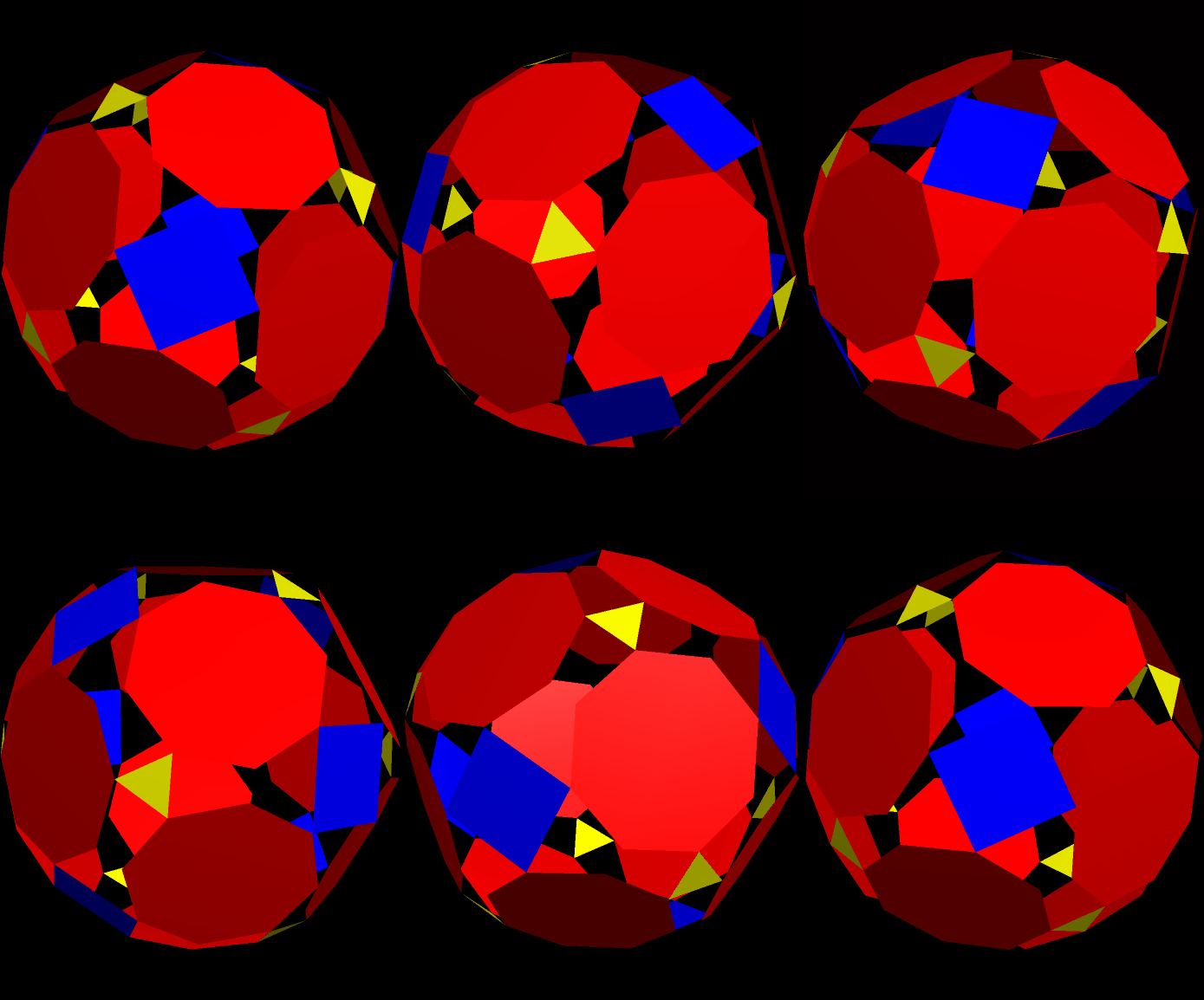
Cube-Based Polyhedron Featuring Regular Icosagons, Equilateral Triangles, Isosceles Trapezoids, and Rectangles

Image

Polyhedron Featuring Regular Icosagons, Equilateral Triangles, Trapezoids, and Rectangles

Created with software you can try and/or buy at http://www.software3d.com.Stella.php.

A Symmetrical Arrangement of Regular Octagons, Triangles, and Squares

Image

A Symmetrical Arrangement of Regular Octagons, Triangles, and Squares

This contains twelve octagons, six squares, and eight triangles. The “holes” in it keep it from being a true polyhedron, but it is my hope than further study of this arrangement may lead to the discovery of new, interesting, and symmetrical polyhedra.

(Image created with Stella 4d — software you can try yourself at http://www.software3d.com/Stella.php.)

Circumslices

Image

Circumslices

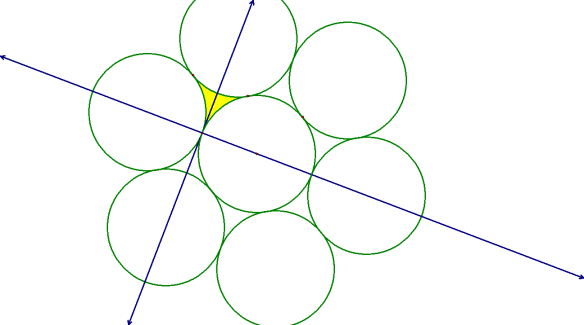
Regions between close-packed circles of equal radius resemble triangles, but with 60 degree arcs replacing the sides. As these regions are the only things left of a plane after all such circles are sliced out, and they each are outside all the circles used, I’ve decided to name them “circumslices.” Interestingly, the three interior angles of a circumslice each asymptotically approach zero degrees, as one approaches circumslice-vertices, which are also the points of contact of the circles.

Why did I name these things “circumslices?” Because they needed a name, that’s why!

Tessellation Using Regular Triacontakaihexagons, Equiangular Hexagons, Isosceles Triangles, and Isosceles Trapezoids

Image

Tessellation Using Regular Hexacontakaihexagons, Equiangulr Hexagons, Isosceles Triangles, and Isosceles Trapezoids
The equiangular hexagons are very nearly regular, with only tiny deviations — probably not visible here — “from equilateralness.”

Tessellation Using Regular Triacontagons, Isosceles Triangles, Equiangular Triangles, and Isosceles Trapezoids

Image

Tessellation Using Regular Triacontagons, Isosceles Triangles, Equiangular Triangles, and Trapezoids

Little blurbs about posts on this blog get auto-tweeted on my Twitter, @RobertLovesPi. There’s also an A.I. on Twitter, @Hexagonbot, who retweeted my last two tweets about blog-posts here, but will not be retweeting the tweet about this one.

Why is this? Simple: @Hexagonbot is programmed to retweet any tweet which contains the word “hexagon,” which was in the titles of the last two posts here (also tessellations). This tessellation has no hexagons, though, and so the @Hexagonbot will not find it worthy of attention.

I cannot explain why hexagons get their own bot on Twitter, but other polygons do not have such bots. It’s simply one of the mysteries of the Internet.

Triangles and Circles

Image

Triangles and Circles

A Big Ball of Pyramids

Image

A Big Ball of Pyramids

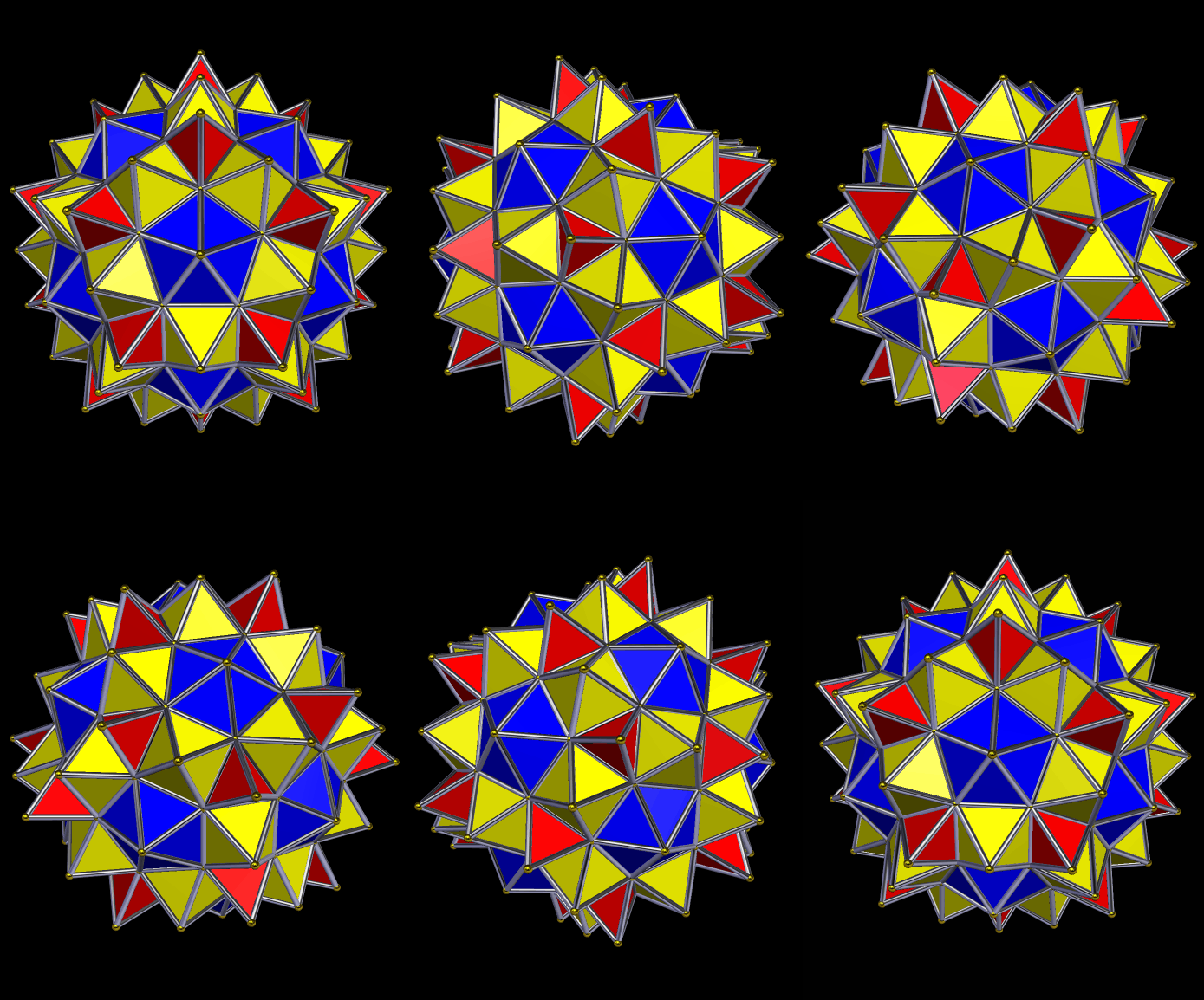
To create this, a central rhombicosidodecahedron had each of its faces augmented by pyramids, each of which uses only equilateral triangles for lateral faces.

Software credit: The program used to make this image, Stella 4d, may be tried for free at http://www.software3d.com/stella.php.

A Variant of the Great Icosahedron

Image

Faceted Dual

The great icosahedron has 20 faces which are interpenetrating equilateral triangles, most of which are hidden in the interior of that polyhedron. The non-hidden, and therefore visible, parts are called “facelets” — and there are 180 of them: 120 scalene, and 60 isosceles.

In this variant of the great icosahedron, the sixty isosceles facelets are simply missing, which changes the shape of the remaining 120, still-scalene facelets. The color scheme is one which gives each facelet a different color — except for coplanar or parallel facelets, which are the same color, making them easier to spot.

Software credit: see http://www.software3d.com/stella.php — with a free trial download available there.

The 27-63-90 Triangle

Image

The 27-63-90 Triangle

I’m not as pleased about finding this special right triangle as I was with the previous ones. For one thing, I didn’t use a regular polygon to derive it, but instead used the 36-54-90 triangle I had previously found, and applied a half-angle trigonometric identity to find the tangent of 27 degrees, as the tangent of half of 54 degrees. According to this identity, tan(27⁰) = (1 – cos(54⁰))/sin(54⁰). Once this gave me the leg lengths, I simply used the Pythagorean Theorem to determine the length of the hypotenuse. Finally, I checked all of this using decimal approximations.

The triple-nested radical in the expression for the hypotenuse is no cause for celebration, either. If anyone knows of a way to put this in simpler exact terms, please let me know.

The 15-75-90 Triangle

Image

The 15-75-90 Triangle

As the 30-60-90 triangle is based on an equilateral triangle, the 45-45-90 triangle is based on a square, the 18-72-90 and 36-54-90 triangles are based on the regular pentagon (see https://robertlovespi.wordpress.com/2013/03/12/the-18-72-90-and-36-54-90-triangles/), and the 22.5-67.5-90 triangle is based on the regular octagon (see previous post), so the 15-75-90 triangle is based on the regular dodecagon, shown here with three radii (red) and a single diagonal (purple). The 15-75-90 triangle is shown in yellow. An argument from symmetry is sufficient to show that angle EFC is the right triangle in this triangle, and the larger of its two acute angles (angle FCE) is one-half of an interior angle of this dodecagon. The interior angle of a regular decagon measures 150 degrees (the proof of this is trivial), and so angle FCE must measure half that amount, or 75 degrees. This leaves 15 degrees for angle CEF, via the triangle sum theorem.

What about the side lengths of the 15-75-90 triangle, though? First, consider the red diagonals shown, and let them each have a length of 2. Angles DAF and FAE each measure 30 degrees, since 360/12 = 30, and they are central angles between adjacent radii. This makes angle DAE 60 degrees by angle addition, and triangle DAE is known to be isosceles, since the two red sides are radii of the same regular dodecagon, and therefore are congruent. By the isosceles triangle theorem and triangle sum theorem, then, angles ADE and AED each also measure (180-60)/2 = 60 degrees, so triangle ADE is therefore equilateral, with the purple side, DE, also having a length of two. Symmetry is sufficient to see that DE is bisected by radius AC, which leads to the conclusion that EF, the long leg of the 15-75-90 triangle, has a length of 1.

Segment AF is a median, and therefore also an altitude, of equilateral triangle ADE, and splits it into two 30-60-90 triangles, one of which is triangle AEF. Its hypotenuse, AE, is already known to have a length of 2, while its short leg, EF, is already known to have a length of 1. Segment AF is therefore the long leg of this 30-60-90 triangle, with a length of √3.

AF, length √3, and FC, the short leg of the 15-75-90 triangle, together form dodecagon radius AC, already set at length 2. By length subtraction, then, FC, the 15-75-90 triangle’s short leg, has a length of 2 – √3. A test is prudent at this point, by taking the tangent of the 15 degree angle FEC in the yellow triangle. Tan(15 degrees) is equal to 0.26794919…, which is also the decimal approximation for FC/EF, or (2 – √3)/1.

All that remains to know the length ratios for the sides of the 15-75-90 triangle is to determine the length of EC, its hypotenuse, via the Pythagorean Theorem. The square of length EC must equal the square of 1 plus the square of (2 – √3), so EC, squared, equals 1 + 4 – 4√3 + 3, or 8 – 4√3. The hypotenuse (EC) must therefore be the square root of 8 – 4√3, which is √(8-4√3)) = 2√(2-√3)).

The short leg:long leg:hypotenuse ratio in a 15-75-90 triangle is, therefore, (2-√3):1:2√(2-√3)).