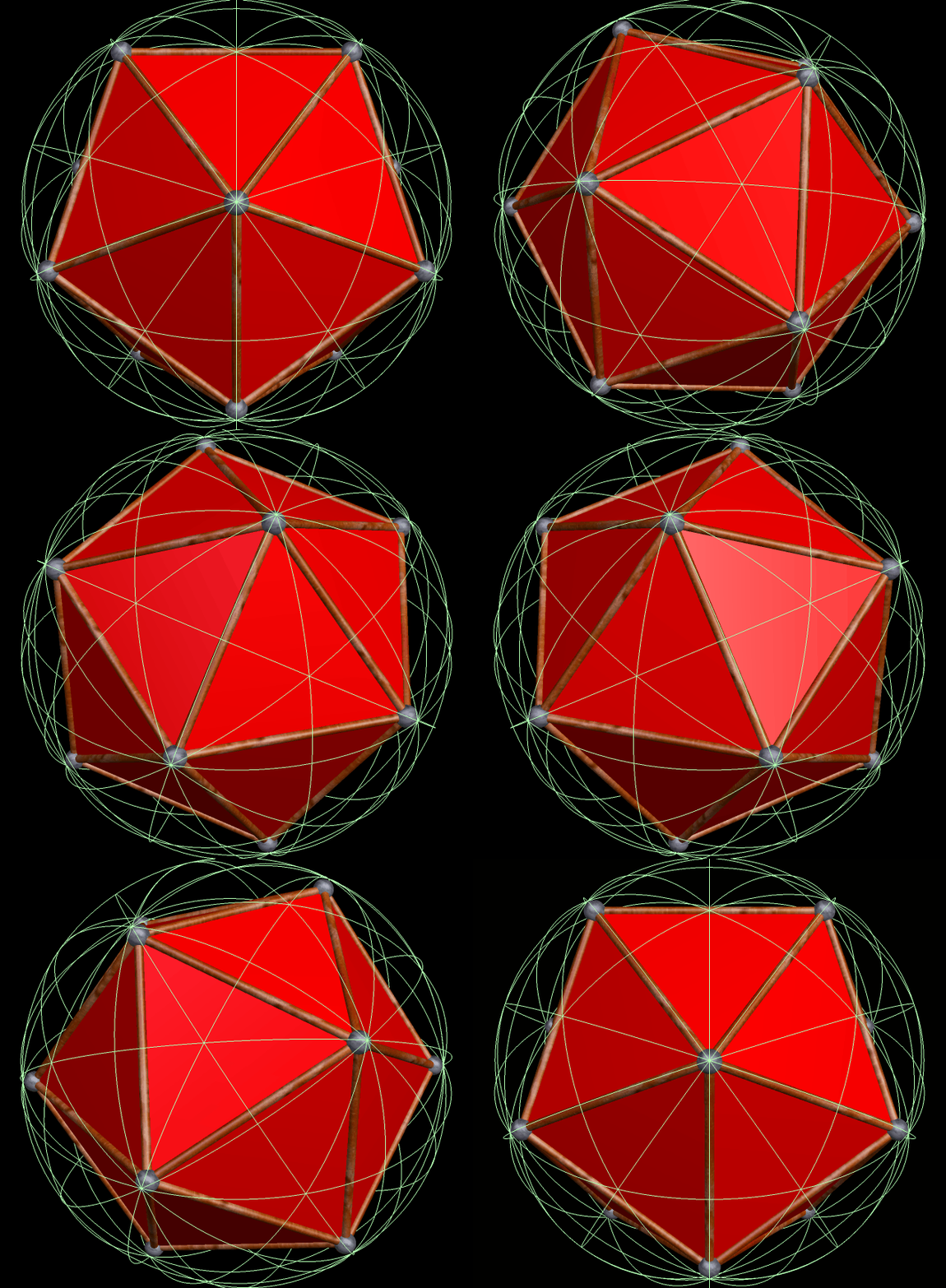
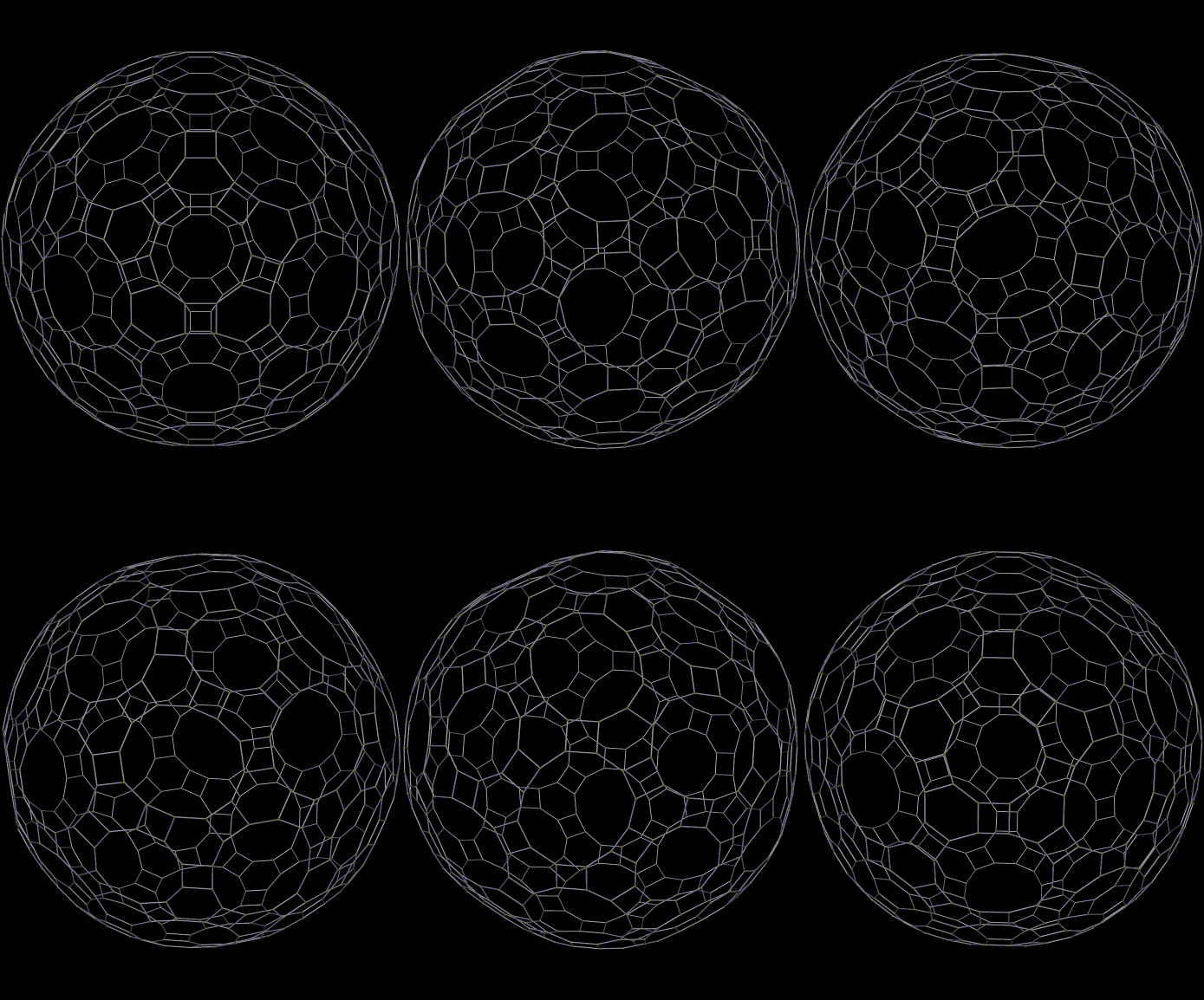
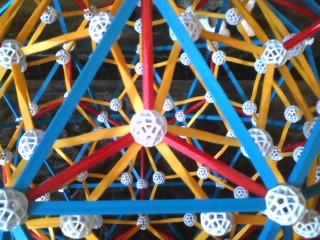
My Third Solution to the Zome Cryptocube Puzzle

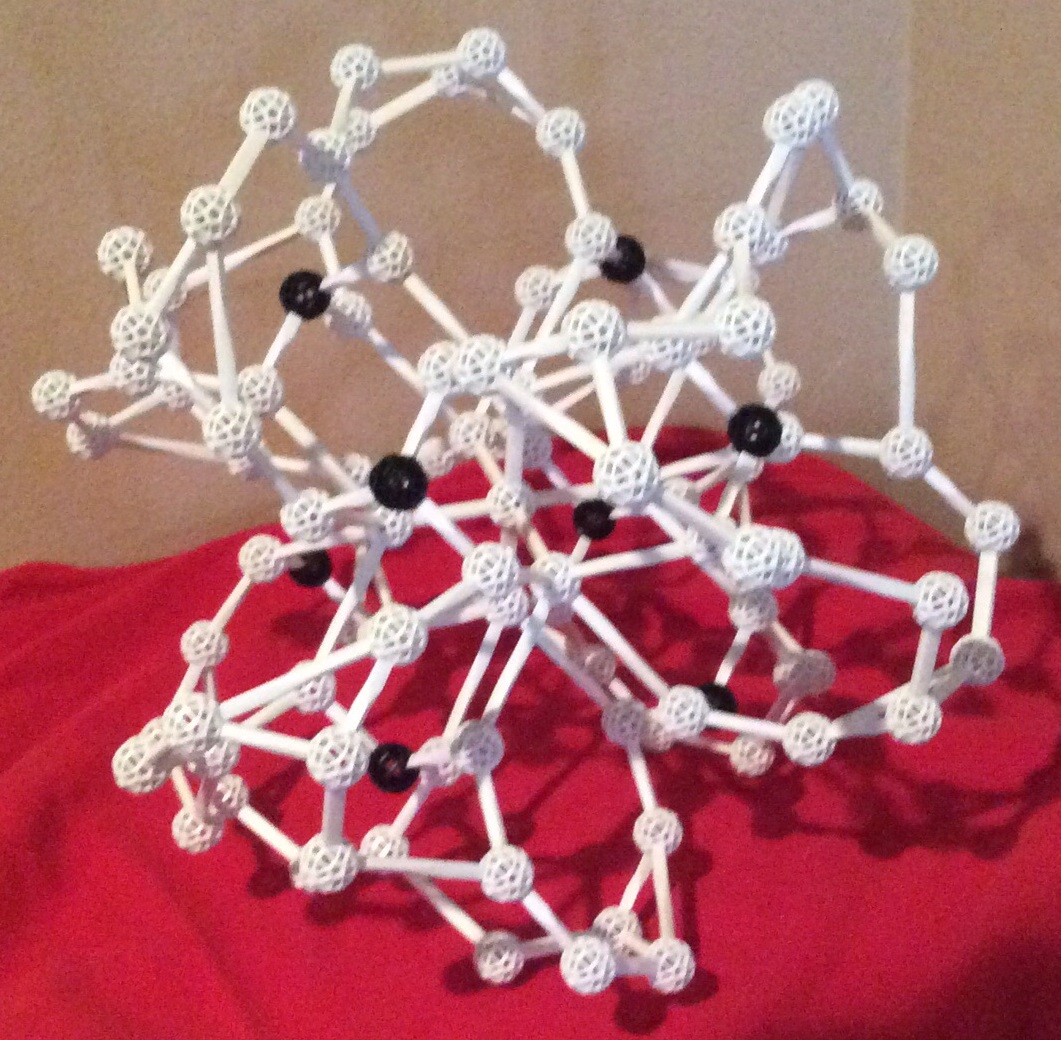
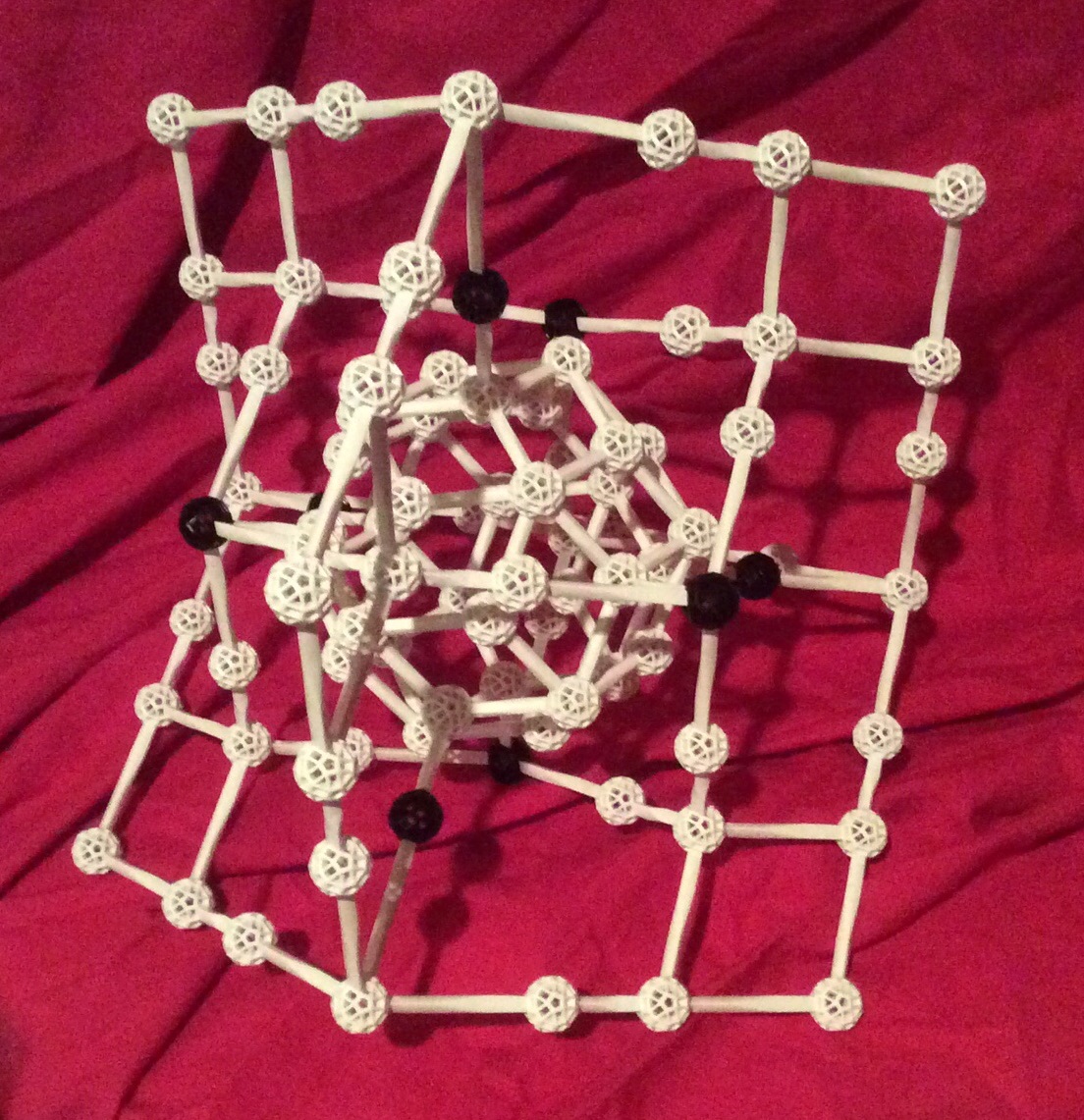
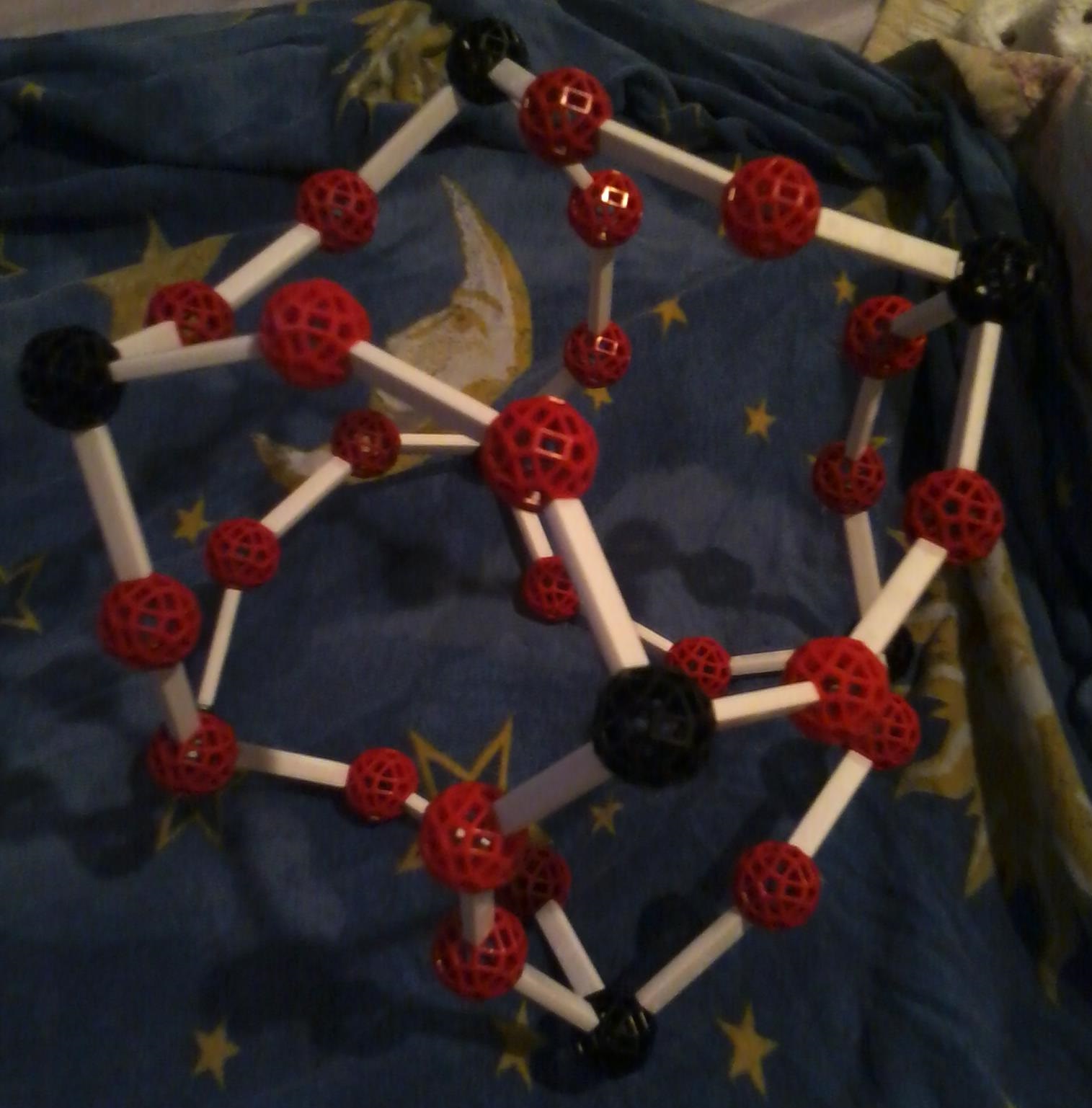
The President of the Zometool Corporation, Carlos Neumann, gave me a challenge, not long ago: find a solution to the Zome Cryptocube puzzle which uses only B0s, which I call “tiny blue struts.” For the Cryptocube puzzle, though, these “blue” struts actually appear white. Carlos knows me well, and knows I cannot resist a challenge involving Zome. Here is what I came up with, before the removal of the black cube, which is what the Zome Cryptocube puzzle starts with.

150923_0000

In a “pure” Crypocube solution, the red Zomeballs would also be white — not just the “blue” struts. However, when Carlos issued this challenge, I was at home, with all the white Zomeballs I own located at the school where I teach — so I used red Zomeballs, instead, since I had them at home, and did not wish to wait.

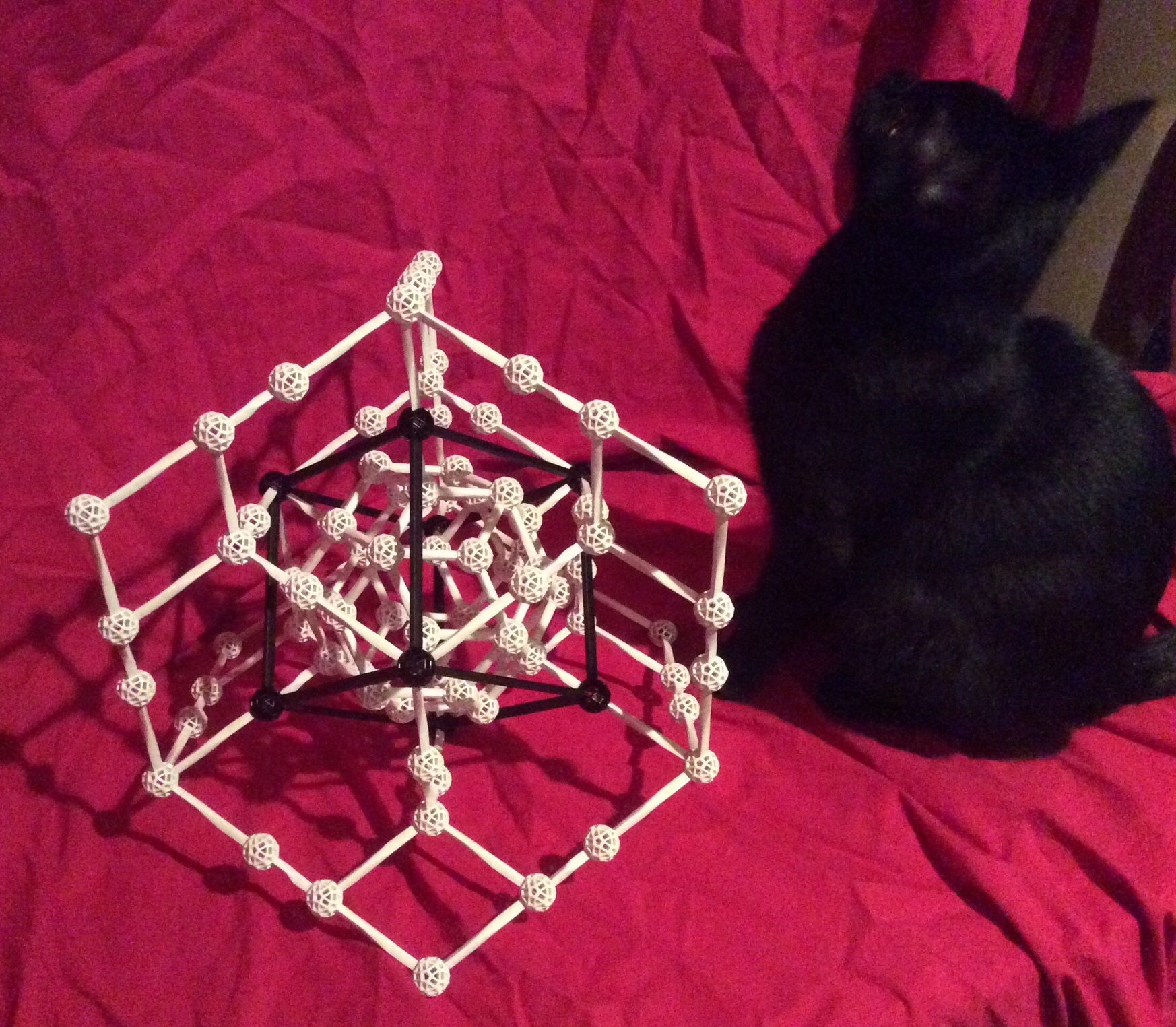
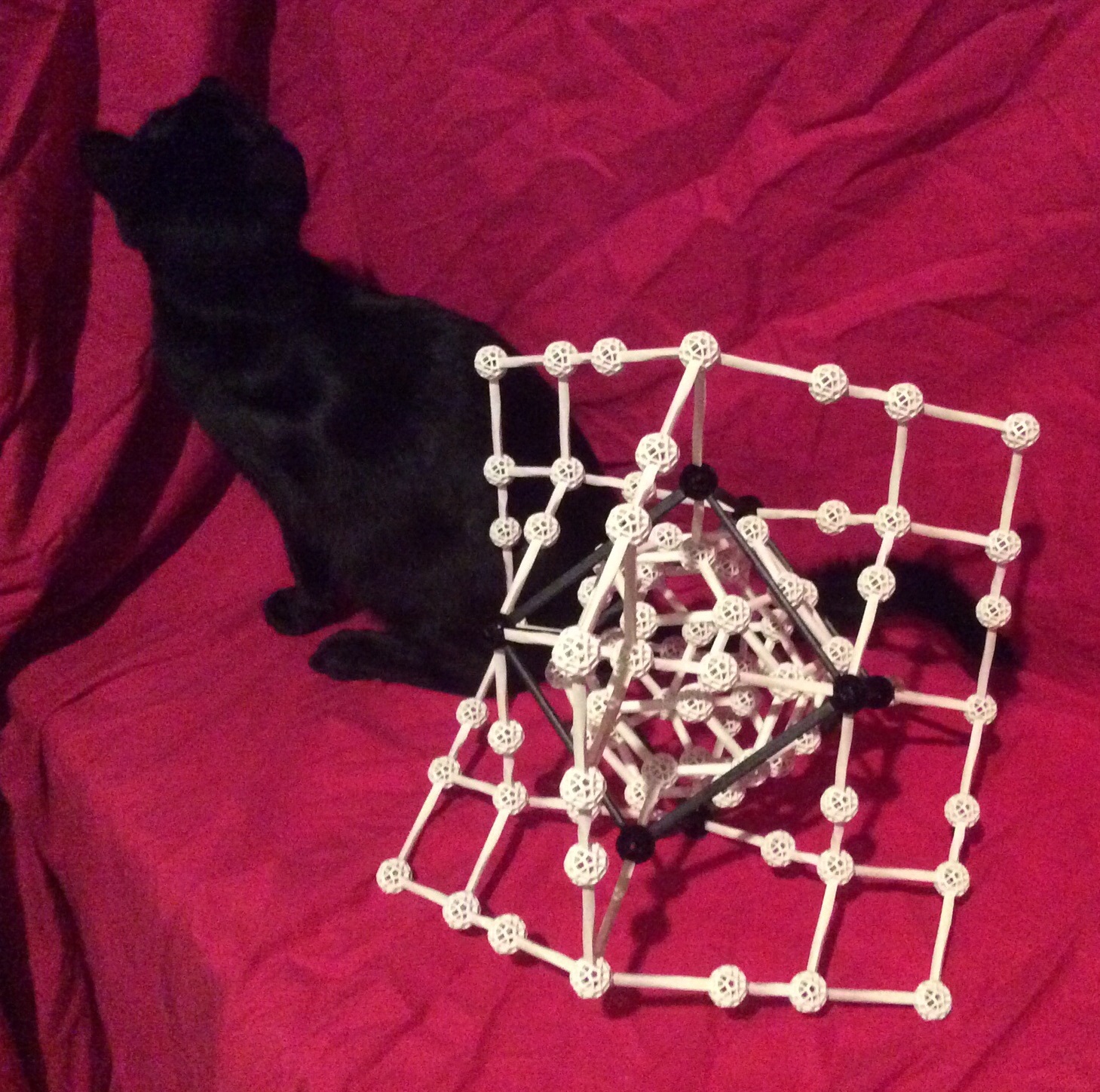
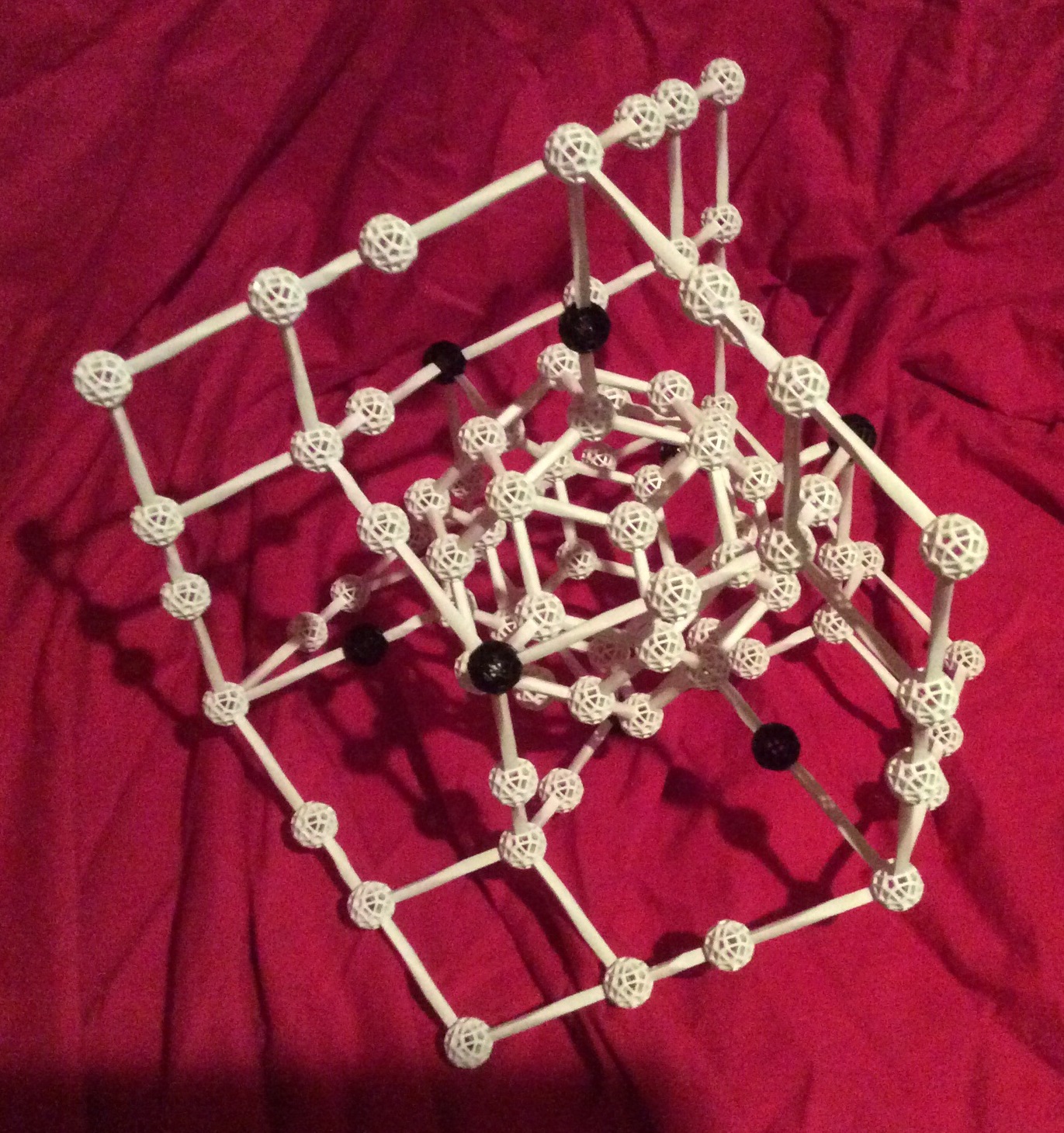
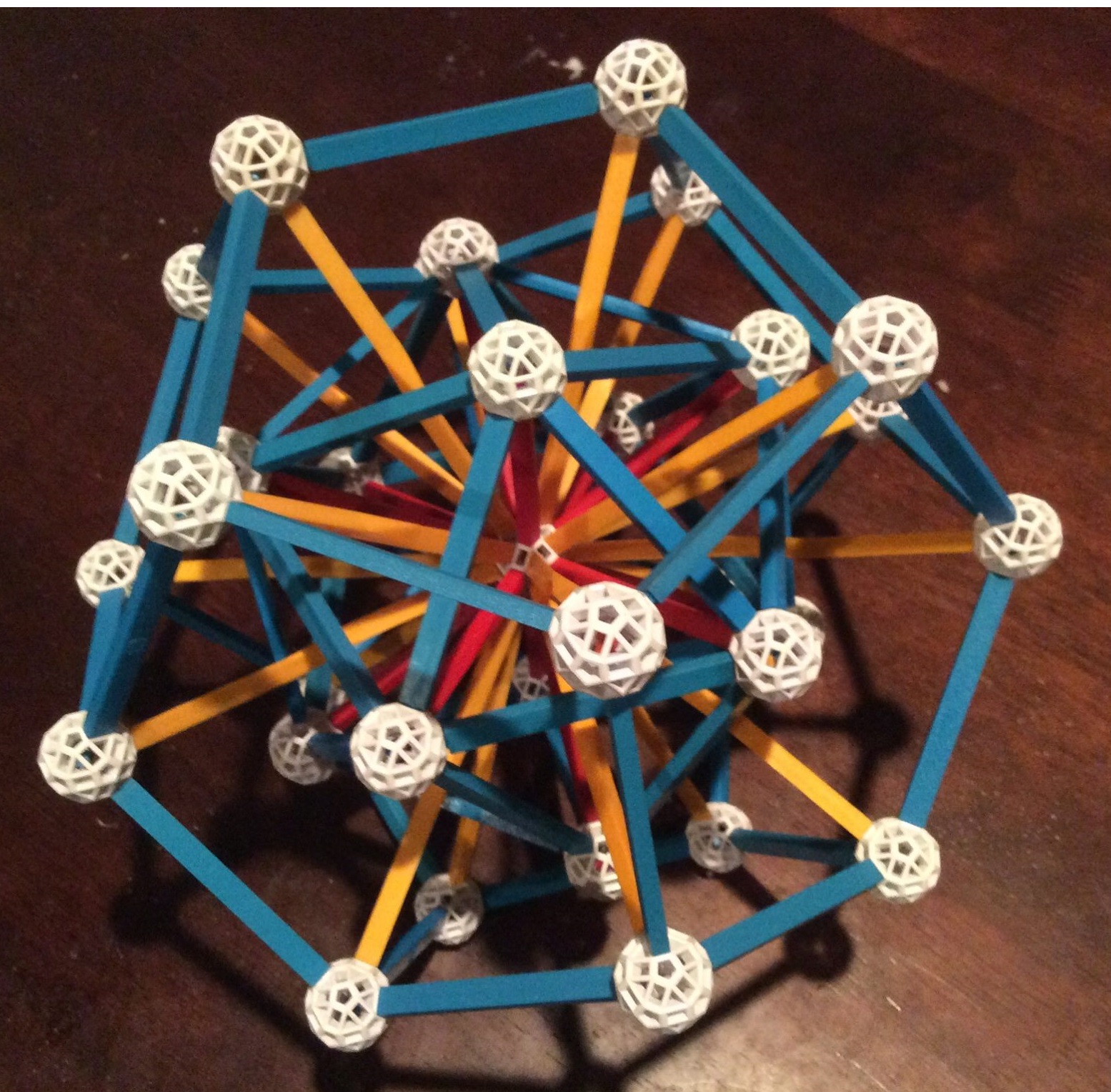
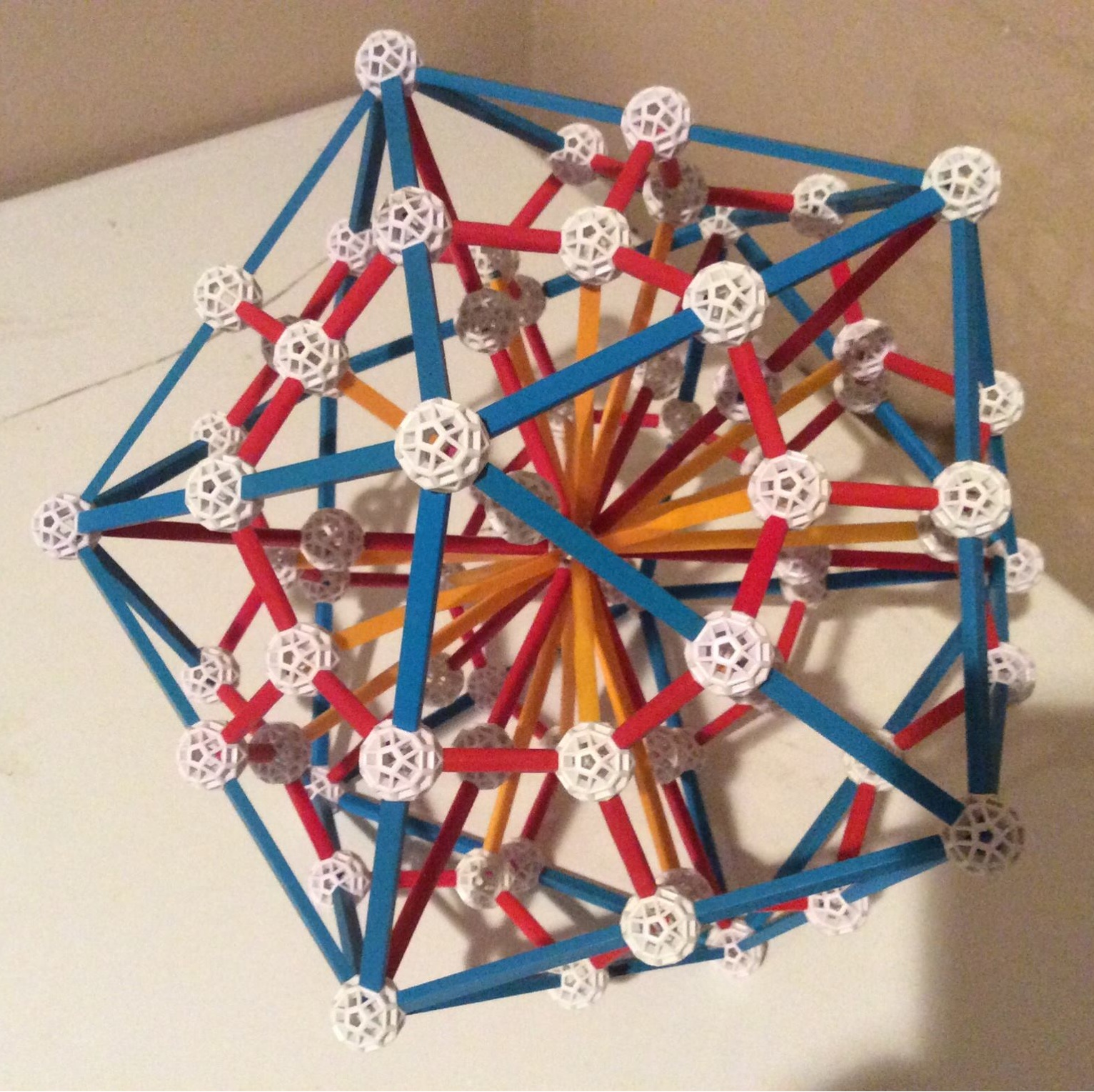
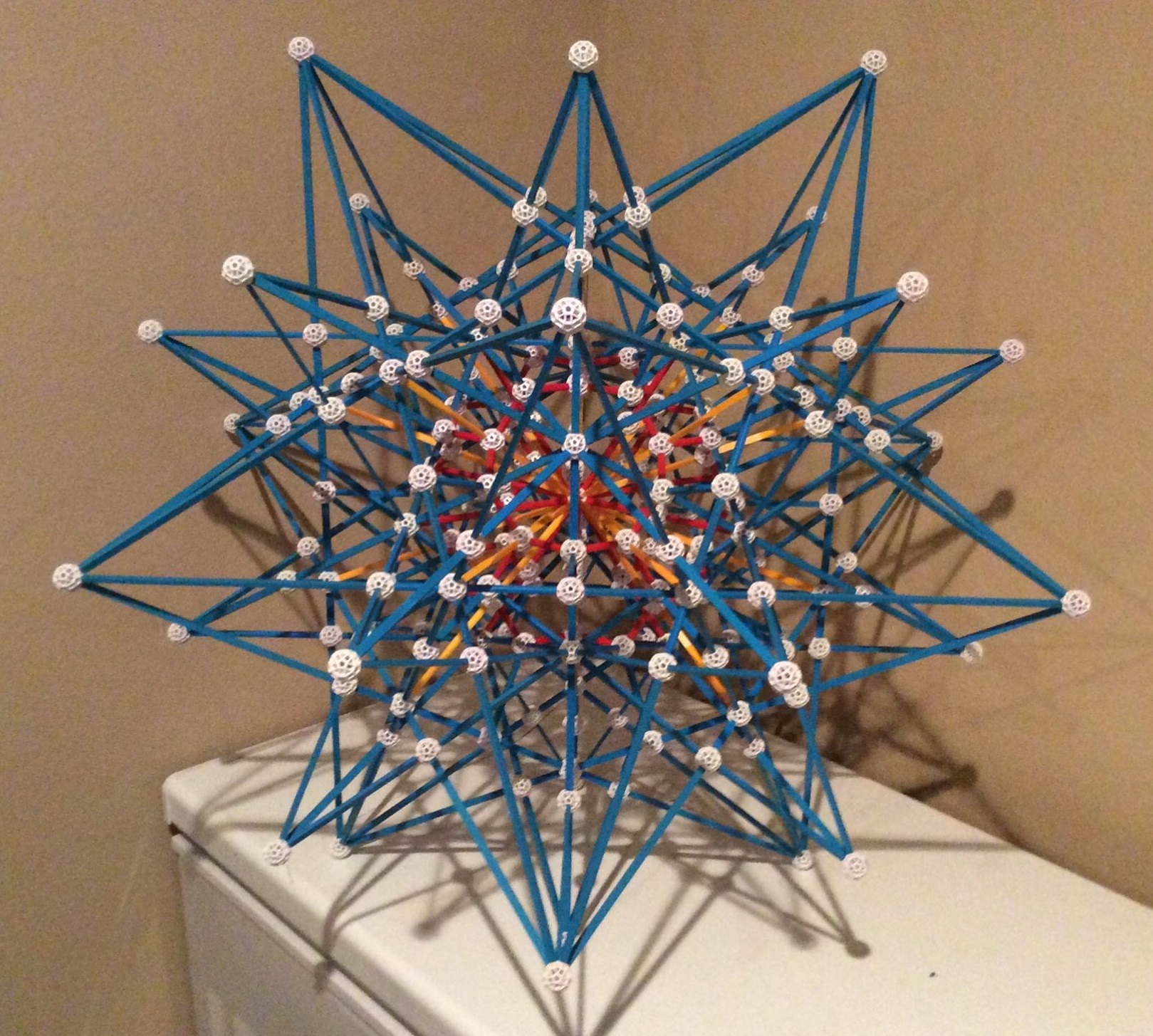
Here’s what this Cryptocube solution looks like, without the black cube’s black struts. You can still “see” the black cube, though, for the black Zomeballs which are the eight corners of the black cube are still present. As is happens, this particular Cryptocube solution has pyritohedral symmetry — better known as the symmetry of a standard volleyball.

150923_0001

While the Cryptocube puzzle is not currently available on the Zome website, http://www.zometool.com, it should be there soon — hopefully, in time for this excellent Zome kit to be bought as a Christmas present. Once a child is old enough so that small parts present no choking hazard, that child is old enough to start playing with Zome — and it is my firm belief that such play stimulates the intellectual growth of both children and adults. As far as a maximum age where Zome is an appropriate Christmas gift, the answer to that is simple: there isn’t one.

Also: while I do openly advertise Zome, I do not get paid to do so. I do this unpaid advertising for one reason: I firmly believe that Zome is a fantastic product, especially for those interested in mathematics, or for those who wish to develop an interest in mathematics — especially geometry. Also, Zome is fun!

A Chiral Solution to the Zome Cryptocube Puzzle

This is my second solution to the Zome Cryptocube puzzle. In this puzzle, you start with a black cube, build a white, symmetrical, aethetically-pleasing geometrical structure which incorporates it, and then, finally, remove the cube. In addition, I added a rule of my own, this time around: I wanted a solution which is chiral; that is, it exists in left- and right-handed forms.

image (34)

It took a long time, but I finally found such a chiral solution, one with tetrahedral symmetry. Above, it appears with the original black cube; below, you can see what it looks like without the black cube’s edges.

image (35)

My First Solution to the Zome Cryptocube Puzzle, with Special Guest Appearances by Jynx the Kitten

Last month, in a special Christmas promotion, the Zometool company (www.zometool.com) briefly sold a new kit (which will return later) — a fascinating game, or puzzle, called the “Cryptocube.” Zome usually comes in a variety of colors, with each color having mathematical significance, but the Cryptocube is produced in black and white, which actually (in my opinion) makes it a better puzzle. Here’s how the Crypocube challenge works:  you use the black parts to make a simple cube, and then use the smaller white parts to invent a structure which incorporates the cube, is symmetrical, is attractive, and can survive having the twelve black cube-edges removed, leaving only the cube’s eight black vertices in place. I had a lot of fun making my first Cryptocube, and photographed it from several angles.

imageIf this was built using standard Zome colors, the round white figure inside the cube, a rhombic triacontahedron, would be red, and the pieces outside the cube, as well as those joining the rhombic triacontahedron to the cube (from inside the cube), would be yellow.

It isn’t only humans who like Zome, by the way. Jynx the Kitten had to get in on this!

image (1)

Jynx quickly became distracted from the Cryptocube by another puzzle, though: he wanted to figure out how to pull down the red sheet I had attached to the wall, as a photographic backdrop for the Cryptocube. Jynx takes his feline duties as an agent of entropy quite seriously.

image (2)As usually happens, Jynx won (in his never-ending struggle to interfere with whatever I’m doing, in this case by pulling the sheet down) and it took me quite a while to get the red sheet back up, in order to take kitten-free pictures of my Cryptocube solution, after removal of the black cube’s edges.

image (3)

Here’s the view from another angle.

image (4)

The Cryptocube will be back, available on the Zometool website, later in 2015. In the meantime, I have advice for anyone not yet familiar with Zome, but who wants to try the Cryptocube when it returns: go ahead and get some Zome now, at the link above, in the standard colors (red, blue, and yellow, plus green in advanced kits), and have fun building things with it over the next few months. The reason to do this, before attempting to solve the Crypocube, is simple: the colors help you learn how the Zome system works, which is important before trying to solve a Zome puzzle without these colors visible. After gaining some familiarity with the differing shapes of the red, blue, yellow, and green pieces, working with them in white becomes much easier.

On a related note, Zome was recommended by Time magazine, using the words “Zometool will make your kids smarter,” as one of the 14 best toys of 2013. I give Zome my own strong, personal recommendation as well, and, as a teacher who uses my own Zome collection in class, for instructional purposes, I can attest that Time‘s 2013 statement about Zome is absolutely correct. Zome is definitely a winner!

A Special Type of Compound, Built with Zome, of the Great and Small Stellated Dodecahedra

For years, I have used Zometools (sold here:  http://www.zometool.com) to teach geometry. The constructions for the icosahedron and dodecahedron are easy to teach and learn, due to the use of short reds (R1s) and medium yellows (Y2s) for radii for the two of them, as shown below, with short blue (B1) struts as edges for both polyhedra.

10865862_10204218181029594_3308928268978197013_o

Unexpectedly, a student (name withheld for ethical and legal reasons) combined the two models, making this:

1401165_10204218146948742_4605456240300721240_oI saw it, and wondered if the two combined Platonic solids could be expanded along the edges, to stellate both polyhedra, with medium blues (B2s), to form the great and small stellated dodecahedron. By trying it, I found out that this would require intersecting blue struts — so a Zomeball needed to be there, at the intersection. Trying, however, only told me that no available combination would fit. After several more attempts, I doubled each edge length, and added some stabilizing tiny reds (R0s), and found a combination that would work, to form a compound of the great and small stellated dodecahedron in which both edge lengths would be equal. In the standard (non-stellated) compound of the icosahedron and dodecahedron, in which the edges are perpendicular, they are unequal in length, and in the golden ratio, which is how that compound differs from the figure shown directly above.

Here’s the stabilized icosahedral core, after the doubling of the edge length:

10865862_10204218180989593_3871605705756535601_oThis enabled stellation of each shape by edge-extension. Each edge had a length twice as long as a B2 added to each side — and it turns out, I discovered, that 2B2 in Zome equals B3 + B0, giving the golden ratio as one of three solutions solution to x² + 1/x = 2x (the others are one, and the golden ratio’s reciprocal). After edge-stellation to each component of the icosahedron/dodecahedron quasi-compound, this is what the end product looked like. This required assembling the model below at home, where all these pictures were taken, for one simple reason: this thing is too wide to fit through the door of my classroom, or into my car.

10847334_10204218153268900_1020271669763339706_o

Here’s a close-up of the central region, as well.

closeup

A Virtual Zomeball

zomeball

For physical modeling of polyhedra, I often use Zometools (available at http://www.zometool.com), which use Zomeballs as nodes for a ball-and-stick modeling system. To make virtual models such as the one above, though, I use Stella 4d: Polyhedron Navigator (available at http://www.software3d.com/Stella.php).

It occurred to me to try to make a virtual model of a Zomeball, which is one of two equally-symmetrical versions of a rhombicosidodecahedron, with its squares replaced by golden rectangles. If you visit the Zometools page, you can see the way they picture Zomeballs, and then let me know how good a simulation I created, above.

Zome: Strut-Length Chart and Product Review

This chart shows strut-lengths for all the Zomestruts available here (http://www.zometool.com/bulk-parts/), as well as the now-discontinued (and therefore shaded differently) B3, Y3, and R3 struts, which are still found in older Zome collections, such as my own, which has been at least 14 years in the making.

Zome

In my opinion, the best buy on the Zome website that’s under $200 is the “Hyperdo” kit, at http://www.zometool.com/the-hyperdo/, and the main page for the Zome company’s website is http://www.zometool.com/. I know of no other physical modeling system, both in mathematics and several sciences, which exceeds Zome — in either quality or usefulness. I’ve used it in the classroom, with great success, for many years.

An Unsolved Problem Involving the Icosahedron and the Dodecahedron, and Their Circumscribed Spheres

This is apparently a problem, posed by Gregory Galperin, which went unsolved at the Bay Area Math Olympiad in 2005. I haven’t solved it yet, but I’m going to try, as I work on this blog-post. My 2010 source is a paper about Zome which may be read, as a .pdf, at bact.mathcircles.org/files/Summer2010/zomes-6-2010.pdf. The problem involves a dodecahedron and an icosahedron, each inscribed inside the same sphere of radius r, and asks which has the greater volume. At the time the authors wrote this paper, they knew of no solution, and I know of none now, but I do like a challenge.

My idea for solving this begins with Zome (info on Zome:  see http://www.zometool.com, as well as other sites you can find by googling “Zome”). In the Zome geometry system, using B1 struts for the edges of both a dodecahedron and an icosahedron, R1 struts are the radii of the circumscribed sphere for the icosahedron,  and Y2 struts are the radii for the circumscribed sphere of the dodecahedron. Since volume formula for polyhedra are generally given in term of edge-length, I need to find B1 in terms of R1 for the icosahedron, and find B1 in terms of Y2 for the dodecahedron.

icosa

Icosahedron:  find B1, in terms of R1.

There exists a right triangle which can be built in Zome which has a hypotenuse equal to 2R1, and legs epqual to B1 and B2. B2 = φB1, so, by the Pythagorean Theorem, (2R1)^2 = (B1)^ + φ²(B1)², which simplifies to 4(R1)^2 = (1 + φ²)(B1)^2, which can then be solved for B1 as B1 = sqrt[4(R1)^2/(1 + φ²)]. B1 here is the icosahedron’s edge-length, while R1 is the radius of its circumscribed sphere.

dodecahedron

Dodecahedron:  find B1, in terms of Y2.

In the Zome system, Y2 = φY1, and Y1 = [sqrt(3)/2]B1. Rearrangement of the first of these equations yields Y1 = Y2/φ, and substitution then yields [sqrt(3)/2]B1 = Y2/φ, which then can be rearranged to yield B1 = 2Y2/[φsqrt(3)]. B1 here is the dodecahedron’s edge-length, while Y2 is the radius of its circumscribed sphere.

Next, find the volume of the icosahedron inscribed inside a sphere, in terms of that sphere’s radius.

According to http://mathworld.wolfram.com/Icosahedron.html, the volume of an icosahedron is given by V = (5/12)[3 + sqrt(5)]a³, where a is the edge length, or B1 in the first indented section, between the two images, above.  Then, by substitution, V = (5/12)[3 + sqrt(5)]{sqrt[4(R1)^2/(1 + φ²)]}³, which then becomes (with “r” being the radius of the circumscribed sphere) V = (5/12)[3 + sqrt(5)][2r/sqrt(1 + φ²)]³ = (40/12)[3 + sqrt(5)][1/sqrt(1 + φ²)]³r³ = (10/3)[3 + sqrt(5)][1/sqrt(1 + φ²)]³r³. Then, using the identity φ² = φ + 1, this can be further simplified to V = (10/3)[3 + sqrt(5)][1/sqrt(2 + φ)]³r³.

Next, find the volume of the dodecahedron inscribed inside the same sphere, in terms of that sphere’s radius, r.

According to https://en.wikipedia.org/wiki/Dodecahedron, the volume of an icosahedron is given by V = (1/4)[15 + 7sqrt(5)]a³, where a is the edge length, or B1 in the second indented section, below the second image, above.  Then, by substitution, V = (1/4)[15 + 7sqrt(5)]{2Y2/[φsqrt(3)]}³, which then becomes (with “r” being the radius of the circumscribed sphere) V = (8/4)[15 + 7sqrt(5)]{1/[φsqrt(3)]}³r³ = 2[15 + 7sqrt(5)]{1/[3sqrt(3)]}(1/φ³)r³ = (2/3)[15 + 7sqrt(5)][sqrt(3)/3](1/φ³)r³  = [2sqrt(3)/9][15 + 7sqrt(5)](1/φ³)r³.

So, with the “r” in each case being the same, the icosahedron is larger than the dodecahedron iff (10/3)[3 + sqrt(5)][1/sqrt(2 + φ)]³ > [2sqrt(3)/9][15 + 7sqrt(5)](1/φ³), which simplifies to (5)[3 + sqrt(5)][1/sqrt(2 + φ)]³ > [2sqrt(3)/3][15 + 7sqrt(5)](1/φ³), which simplifies further to {5/[sqrt(2 + φ)]³}[3 + sqrt(5)] > [2sqrt(3)/3φ³][15 + 7sqrt(5)], which is, as a decimal approximation, is (0.726542528)(5.2360679774998) > (3.464101615/12.708203932)(30.6524758), or 3.804226 > 8.355492, which is false, meaning that the dodecahedron is larger, not the icosahedron.

Now for the bad part:  I think I’m wrong, but I don’t know where the error lies. I’m also tired. If any of you see the mistake, please point it out in a comment, and I’ll try to fix this after I’ve rested.

Update:  if the websites http://rechneronline.de/pi/icosahedron.php and http://rechneronline.de/pi/dodecahedron.php work correctly, then the dodecahedron is larger. Evidence:

volume calculators

This does not, however, mean that I did the problem correctly. I merely stumbled upon the correct answer. How do I know this? Simple:  the ratio I obtained was too far off. Therefore, I would still welcome help clearing up the mystery of where my error(s) is/are, in the calculations shown above.

A Wire-Frame Zonohedron Based On the Faces, Edges, and Vertices of an Icosahedron

Image

A Wire-Frame Zonohedron Based On the Faces, Edges, and Vertices of an Icosahedron

This is the shape of the largest zonohedron one can make with red, yellow and blue Zome (see http://www.zometool.com for more on that product for 3-d real-world polyhedron modeling). This image was made using Stella 4d, which you can find at http://www.software3d.com/stella.php.

Zome Icosahedron Encasing a Rhombic Enneacontahedron

Image

Zome Icosahedron Encasing a Rhombic Enneacontahedron

Zome is a three-dimensional ball-and-stick geometrical modeling system based on the Golden Ratio. I have a large collection, and have used it for years, both as a teaching tool, and for my own investigations. Zome is available for sale at www.zometool.com.

Here is a close-up shot, so you can better see the interior of this figure:

Photo02160907_1