 This is my predicted electoral map for Tuesday’s presidential election. If you disagree with it, you can make your own version at http://www.270towin.com.
My 2016 Presidential Election Prediction Map
4
This is my predicted electoral map for Tuesday’s presidential election. If you disagree with it, you can make your own version at http://www.270towin.com.
I was born during wartime, and during the first decade of Bob Dylan’s long career. Later that same month, the Tet Offensive began — a major turning point in the Vietnam War. After Tet, the Americans who had been “on the fence” realized that the USA was not going to win that war, and these fence-sitters added their voices to the loud anti-war message already being voiced from the late 1960s counterculture. We took several more years to extricate ourselves from that war, and those years were my formative years.
Early in life, I developed a fascination with the decade of my 1968 birth. The first related thing I studied, in detail, was the music and history of the Beatles. Beatles’ music led me to books about that band, and this added to my reading vocabulary, although, in some cases, my speaking vocabulary lagged behind. This happened with Robert Zimmerman, better known as Bob Dylan, who pops up in many written accounts of the Beatles’ career. In my early teens, I had read many things about a musician with a name that looks like it should be pronounced “Die-lan,” and I had also heard talk about a person with a last name pronounced like that of the actor Matt Dillon. It’s funny now, but I was absolutely mortified when I first realized I had been mispronouncing Dylan’s name, and confusing him with Dillon, the actor. Determined not to repeat such a mistake, I broadened my studies of the counterculture, and educated myself about the real Bob Dylan.
Later, as a senior in high school, I encountered the work of Dylan in another context, when I took AP English. The song lyrics of “Subterranean Homesick Blues” were in our literature textbook. Via YouTube, here is Dylan himself presenting those same lyrics.
I graduated from high school in 1985. Because I read this song, presented as a poem, before actually hearing it, I was prepared to think of Dylan’s work as literature, and not merely as popular music from an earlier decade. When the Nobel Committee selected Dylan for this year’s Nobel Prize in Literature, I was both unsurprised, and pleased. Many have criticized this Nobel selection, but it makes perfect sense. The counterculture of the 1960s has a body of literature, and I’ve read quite a bit of it, such as books by Ken Kesey, John Lennon, and Abbie Hoffman, as well as many other writers. This period of astounding creativity produced a unique body of literature, and the time has definitely come to recognize the best of that literature with a Nobel Prize. I know of no one associated with the counterculture who deserves it more than Dylan.
Back in the pre-Google era, of course, we had to go to considerable trouble to get music — much more so than the few clicks of a mouse it takes today. The reason the Beatles came first, for me, is simply that Beatles albums were among the purchases previously made by my parents. Dylan’s music was not among this collection of records. The Dylan album I had read the most about was Highway 61 Revisited, and that led to a funny conversation with an old friend of mine — a guy named Max. Max was perhaps ten years older than me, and was a music aficionado who prized himself on his knowledge of all things Dylanesque. The first time some friends and I listened to music at Max’s house, I asked him to play Highway 61 Revisited, but that particular record was not in Max’s large music collection. Here’s the title track of that album.
You can now buy every track of this album, as a collection of .mp3 files, for a mere $5 on Amazon, but that was not the case back then.

Max ended up going to the local record store (as we called them in the 1980s), and telling the store owner (another old friend) that an 18-year-old kid had asked him to play Highway 61 Revisited, leaving him embarrassed that he didn’t have the requested music available already. The shop owner set him up with a copy, and I (finally!) got to hear it shortly thereafter, for the first time.
Since then, I’ve seen Dylan perform live twice, and I have many friends who are as into Dylan, or more so, than I am. Today, if I post a Facebook status that asks why “the pump don’t work,” one of my friends will answer — “‘Cuz the vandals took the handles” — within mere minutes.
Dylan’s career took many twists and turns, especially during the controversial period when he had been “born again,” as it was put, and he simply refused to perform or record any music which did not express his religious ideas. Many Dylan fans won’t even listen to his music from this period, but I like all the Dylan songs I’ve ever heard. This is my favorite of the songs from that period: “Gotta Serve Somebody.” One need not have any particular religious belief to appreciate a good song.
Dylan himself may not be interested in his Nobel Prize, any more than he knows that I appreciate his work. These things do not affect the fact that he deserves the Nobel, as well as my gratitude. Robert Zimmerman: thank you.
Upon closer inspection, even Gary Johnson and Jill Stein aren’t people I want to vote for. I have therefore decided I am not going to vote for president this year, at least not as myself.
My mother can no longer vote. She would want to vote for Hillary Clinton. I will, therefore, cast a vote for H.C. on her behalf.

[Note: the “Explaining China” series began here, and the source for the map above is given there as well.]
A persistent worry in the Western world, particularly among the political right, concerns a supposedly-coming-soon war with China, as if China were harboring ambitions to take over the world. Evidence for this idea’s existence can be easily obtained; simply enter “coming war with” into Google; it will supply China as the top choice with which to end the phrase.
People should stop worrying about a war with China. It isn’t hard to avoid one, and we have nothing to gain from such a war, anyway.
First, as with other nations, China will defend itself if attacked. Therefore, to avoid being at war with China, the first step is to refrain from attacking China.
The next step is to realize that China has a long history with invasion, particularly from neighboring countries, and tries to maintain a “buffer zone” of controlled (or at least influenced) territory surrounding China — for defensive reasons, and with a rationale not unlike the one for the Monroe Doctrine in the Americas.
Since Deng Xiaoping changed the direction of China’s economy (“To be rich is glorious” is one of his famous quotations) from Maoist Communism to nominal-Communism, Chinese leaders have also become concerned about staying rich, and getting richer. To do this, they need markets to sell their stuff. Politically, what the Chinese want is simple: stability. Why? Also simple: China has had more than its share of instability, and this has often been fatal for millions of people. The Chinese have no desire for more instability. Therefore, they aren’t looking for a fight. They’ve let Hong Kong and Macau do pretty much what they want, relative t0 the rest of China, and they’ve tolerated their situation regarding Taiwan for decades.
The only place where there has been outright war between the People’s Republic of China and the West has been the Korean peninsula, which is, of course, still a global “hot spot.” At the beginning of the Cold War, Korea was partitioned between the victors of World War II, as the USA and USSR, each with their allies, squared off against each other. This brought American troops into Korea. China did not become involved at first — not until Western forces were nearing the Yalu River, which separates North Korea from China. At that point, hundreds of thousands of Chinese “volunteers” crossed that river, pushing American forces back. Ultimately, a stalemate similar to the war’s starting point was reached, and is still there today, DMZ and all.
North Korea is dangerous, but that doesn’t mean China is seeking war there. Since the death of Mao, China has moved ever closer to the goal of political stability. The government of the Democratic People’s Republic of Korea (the DPRK, or North Korea’s absurd-but-official name) is a destabilizing force. If necessary, the governments in Beijing and Seoul can deal with Pyongyang. It would be best if the West did not get involved, unless (and this is unlikely) our assistance is requested.
It is a fact that we (the USA) have treaty obligations all over the place, and that is a problem we should fix. World War II is long over, as is the Cold War. Japan, Taiwan, and South Korea can now afford to pay for their own defenses. We should let them do this, and renegotiate the various treaties which would make it difficult for the United States to stay out of East Asian conflicts, on the grounds that these treaties (in present form) are no longer necessary.
The Chinese aren’t looking for a fight; they are quite busy, and have been for decades now, making lots of money by making things we need, and selling them to us. That might anger some people who bemoan the associated movement of jobs to China, but it is certainly no reason for war. The Chinese certainly won’t seek out war with us, for, without us, they can’t sell as much stuff, and would therefore make less money.
The people of China want stability, wealth, and more stability. They know, from their own history, that the opposite of these things often results in millions of deaths. Overt war is not on China’s agenda, nor should we put it there, by indulging in ill-considered American military (mis-)adventures in East Asia. There is no good reason for war with China to ever happen again. To avoid it, we must only do two things:
It would also help if the American political right would tone down the saber-rattling, but that’s probably not going to happen. On the other hand, as long as the rhetoric is not mixed with actual military actions, it can be safely tolerated. We have been doing that for decades, anyway, after all.
This is my 22nd year of teaching, but my first year using Google Classroom. We’re finding it to be a useful tool. This, for example, is the diagram for the Atwood’s machine lab we are doing in Pre-AP Physical Science, beginning today. My students will find this waiting for them in their virtual classroom (on Chromebooks my school district provides), with discussion-prompts to get us started:
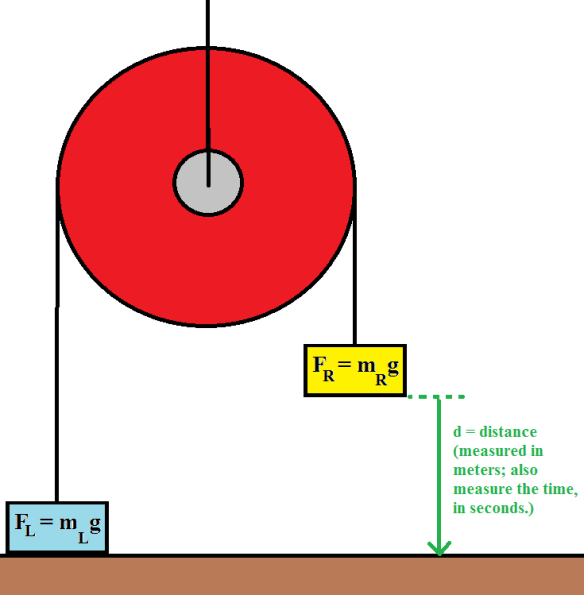
I had no idea that four years of blogging, here on WordPress, had been preparing me to use this teaching tool. However, active blogging does require one to develop some transferable skills, especially in fields (such as what I teach) which are similar to the topics of one’s blog, as is the case here.
“A song of great social and political import” from the 1960s, as well as a fun song for which to make a music video — or sing, a capella, in public, loudly and obnoxiously. =D

Never before have I deliberately tried to recall my earliest memories. This morning, however, simply to see what might happen, I tried it. In my imagination, I returned to further back than I ever had gone before, to a period before I learned to communicate. In this early period, I could visualize things, with the imagery which appeared being geometric in nature. Later, I had to learn English, as a second language, to express the mathematical ideas in my head. My first word, according to my parents, described one of the two shining round things in the sky: “Moon.” I have always preferred moonlight to sunlight, for the intensity of direct sunlight is painful to me.
At least, that’s how I remember these things; I could be wrong about the earliest parts. All I know is that the image above popped into my head, when I tried to recall my oldest accessible memory. I then made the image above, in a short period of time, using Stella 4d, Polyhedron Navigator, available to try for free at this website. (I’ve used the program for over a decade, and find it an indispensable tool for geometrical investigations, such as this recreation of what I found in this morning’s early-memory-search.)
This music video, for a Velvet Underground classic written by Lou Reed, John Cale, Sterling Morrison and Maureen Tucker, was made today — for a song originally recorded in 1969, the year after I was born. I used Windows Movie Maker to assemble it, and “painted” the preview-pic for the video, using MS-Paint. Other programs I used, for other images in the video, include Geometer’s Sketchpad, MS-Paint (again) and Stella 4d: Polyhedron Navigator. Of all these computer programs, my favorite is Stella 4d, which you may try for free at http://www.software3d.com/Stella.php.

During the Cold War, the usual way nations compete (direct warfare) was taken off the table by the invention of the hydrogen bomb. With the alternative being mutually-assured destruction, the two sides, led by the USA and the USSR, had to find other ways to compete. Some of those ways were harmful, such as proxy wars, as happened in Vietnam. Others, however, were helpful, such as the space race. The United States put men on the Moon in order to beat the Soviet Union there, as this iconic 1969 photograph makes evident (source: NASA).

We are all still reaping the benefits of the technological and scientific advances made during this period, and for this purpose. The most obvious example of such a benefit is the computer you are using to read this blog-post, for computer technology had to be advanced dramatically, on both sides, in order to escape the tremendously-challenging gravity-well of the Earth.
Wouldn’t it be wonderful if other conflicts in society took beneficial forms, as happened in this historical example?
This could happen in many ways, but the one that gave me the idea for this post is the conflict between teachers’ unions and school districts’ administrators, now taking place in school districts all over the place. I think it would be awesome if this previously-harmful competition changed, to take a helpful form: book drives, to help school libraries.
Please do not misunderstand, though: I’m not talking about taxpayer money, nor union dues. My idea need not, and should not, affect the budget of any school district, nor union budget. All that need happen is for individual people — teachers and administrators — to go home, look at their own bookshelves, and help students directly, by donating some of their already-paid-for books to school libraries.
While I make no claim to represent any organization, I am a teacher, and a member of the NEA (the National Education Association) in the United States, as well as my state and local NEA affiliates. In an effort to start this new, helpful way to compete, I will give books to the school library where I teach, next week, which is the second week of the new school year. That’s a lot easier than, well, putting men on the Moon.
This is something we can all do. All of us in the education profession, after all, already agree that we want students reading . . . and this is something we can easily do, to work together towards that goal. School libraries need hardcover books which are student-friendly, meaning that they appeal to a young audience, on a wide variety of subjects. Both fiction and non-fiction books are helpful.
Lastly, in the hope that this idea catches on, I will simply point out one fact: helping turn this idea into a reality is as easy as sharing a link to this blog-post.
 RobertLovesPi.net