Sam Harris, on Paying Attention

Sam_Harris_01

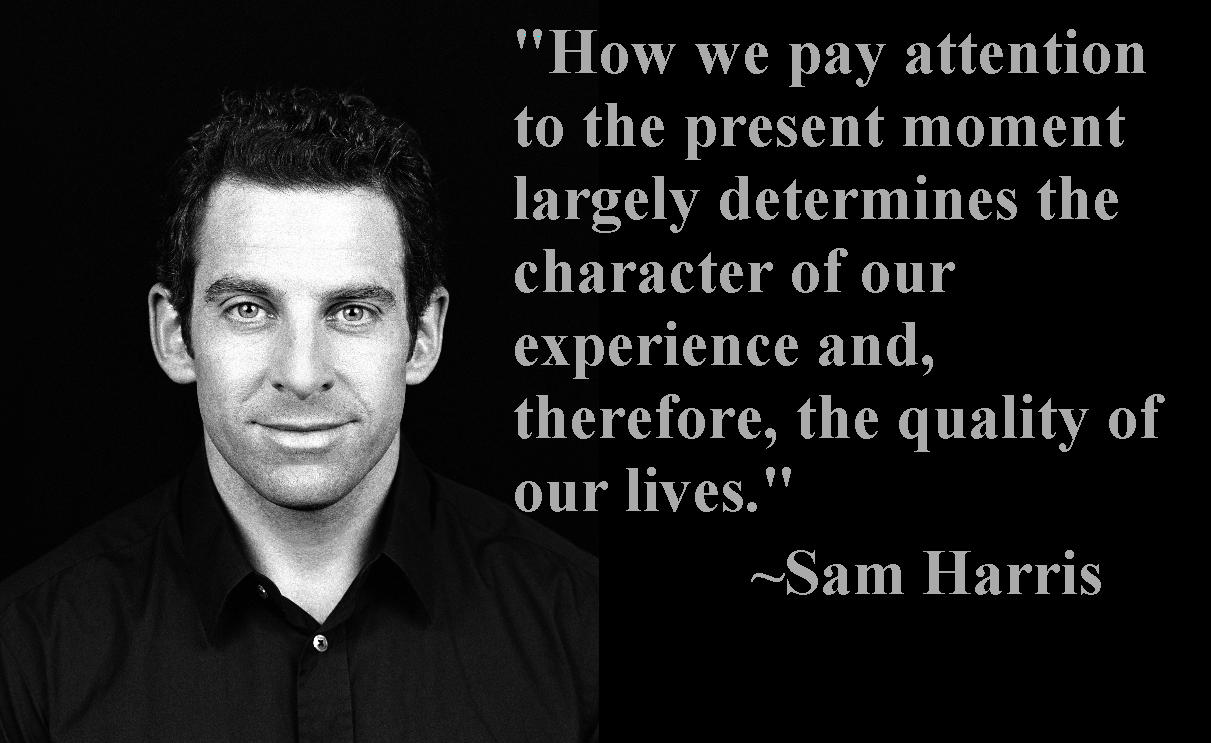
Source:  Waking Up: A Guide to Spirituality Without Religion, p. 3.

Where Are This Blog’s Readers?

More hits come to this blog from inside the USA than any other country. Considering that I live here, that isn’t surprising. However, my international readers do outnumber what are confusingly called “Americans,” at 54.7% to 43.7% of hits to this blog.

1

When the hits from outside the U.S.A. are considered at as a set, a slim majority of that set is held by six nations, each with over 1,000 hits. India leads this group, followed by Russia. After those non-English-dominated countries come the English-dominated U.K. and Canada, in that order. Germany and the Philippines round out this group.

2

The next set, of 24 nations, are those with between 100 and 1,000 hits each:

3Below 100, there are numerous nations. The next list goes down to the those nations from which seven or more hits have come.

4

Finally, the readers in each of these nations have only seen my blog between one and six times per nation.

5

Thanks to all my readers, everywhere you are. =)

map

My Australia Story

australia

I once got into a huge argument, as a 7th grade student, in a “talented and gifted” section of Social Studies. The issue:  how many countries are there in the continent of Australia?

The assignment was to choose a continent, and draw a map of it on a full-size posterboard. I had worked for hours on this map, only to get it back, ruined, for the teacher had taken a red ball-point pen, slashed through my line “state and territorial boundaries” in my map’s key, and had written, as a correction, “not states — COUNTRIES.” She also docked points from my grade, but that was a minor issue, to me, compared to her ruining my map. She could have, at least, written her incorrect comment on the back of my map!

When I confronted her about her mistake, she maintained that the political divisions you see above are independent countries. In my opinion, “Northern Territory,” especially, doesn’t sound particularly sovereign, and I said so, but she may not have understood the definition of “sovereign,” for that did not work. Confronted with this absurd situation, I proceeded to grab the “Q” volume of a nearby encyclopedia, and began reading the article about Queensland, loudly enough for the entire class to hear: “Queensland: one of the states of Australia….” I freely admit that, at the time, my goal was to embarrass and humiliate her right out of the teaching profession — for the benefit of her present and future students. I’ve changed my approach, a lot, since then.

A huge brouhaha ensued, and we ended up taking each other to the assistant principal’s office:  her, to report a disruptive and defiant student; and me, to report an incompetent teacher, who, in my view, at that age, should have been fired on the spot. Dealing with this situation was probably one of the stranger, and more difficult, situations of that assistant principal’s career, for he knew that Australia is both a single country, and a continent — but he could not, for political reasons I did not yet understand, agree with me in front of this teacher. As for me, I was simply incredulous that someone could be a certified social studies teacher, and not know this basic fact about world geography. The whole scenario, to me, was surreal.

The assistant principal handled it well. To the teacher, he said, “You can go back to class — I’ll handle Robert.” He then “handled” me, after she left, in the only way that could have possibly worked: with an apology, and a polite request to do my best to endure her ignorance until the upcoming end of the year. I respect honesty, was being given a request, not an order, and he had conceded that I was correct. I therefore chose to cooperate — with his polite request.

If he had not taken this approach, I likely would have added him to the list I had, at the time, of people (a mixture of administrators and teachers) whom I was trying to drive out of the education profession, for the benefit of all — but he did the right thing, thus earning my respect.

As for the teacher, I survived the rest of her class, brain intact, and assume she is now retired, this being well over thirty years ago. I’m now in my twentieth year as a teacher, myself, and am pleased to report that average teacher quality has dramatically improved since this fiasco happened. (I wish I could say the same about average administrator quality, but there are, at least, a few competent people working in that field, as well.) During my years of teaching, I haven’t encountered a single teacher who lacked this basic bit of knowledge about world geography. In fact, I count, among my colleagues, many of the smartest people I know.

I am glad, however, that I don’t have to call the teacher in this story a colleague. I simply cannot respect willful, stubborn ignorance, especially in the face of evidence that one is wrong. When one of my students catches me making a mistake, I do the right thing: I thank them, make certain everyone understands the correction, and then we move on with the lesson. That’s what this 7th grade teacher of mine should have done, as well.

On Coming Out of the Closet

I have a strong belief that asking nosy questions is an incredibly rude thing to do, and I find it particularly appalling when person A asks person B to identify his or her sexual orientation. What could be more personal, and private, than what consenting adults do in their own bedrooms? For this reason, I don’t ask questions on this subject, nor do I tell (when asked). To ask would be rude, and to answer such a nosy question would be to encourage rudeness. I don’t wish to do either.

There is exactly one situation I can think of where person A needs such information from person B, and that is if person A wants to have sex with person B. Even then, though, are there not far better ways to begin a flirtatious conversation?

At a school where I used to teach, I co-sponsored a student-initiated GSA, or Gay-Straight Alliance. On the basis of this co-sponsorship, plus my wearing a rainbow-colored wristband, many assumed that I was gay. To make a statement about how such things do not matter, I refused to ever confirm, nor deny, such rumors. On Facebook, I didn’t answer the “interested in” questions, nor did my blog reveal my sexual orientation — until now.

At this time, having considered the ramifications carefully, I’ve decided it is time to come out. I’m teaching at a new school, and am no longer co-sponsoring a GSA. I’ve kept quiet on the subject of my own sexual orientation long enough to make my point. And, now, I’m going to make another point . . . by coming out, here and now.

coming out straight

Yes, world, I admit it . . . I am a raving heterosexual, and one who has finally decided to come out — as a straight person. I’m not ashamed of it; this is part of who I am. There may be some who do not approve of this, but I do not have to care what they think.

In case my point is escaping you, please consider what it is like for gays, lesbians, bisexuals, and others who don’t conform to society’s norms, to do what I just did. Imagine what it would be like, for “heteros,” if social pressure favored homosexuality, rather than heterosexuality. How many “straights,” in such a world, would be willing to risk being ostracized, losing their jobs, being shunned by former friends and family, etc., simply for admitting they have a preference for the other sex, rather than the same one? If you, yourself, are also straight, and lived in a gay-dominated world, would you have the courage to come out as one of “those people,” the “heteros,” with their allegedly-“disgusting” sexual practices?  

It’s ridiculous that anybody has to think about such things. “Live and let live” is not too much to ask — of anyone.

A True Story of a Young Aspie Getting in Trouble with “Show and Tell”

In elementary school, in the 5th grade, I managed to get in trouble for a “show and tell” project. As usual, getting in trouble was not my objective, but it happened anyway. This was decades before I learned I have Asperger’s, but, looking back, none of this would have happened were I not an “Aspie,” as we call ourselves.

This image, which I found here, is very much like the poster I made, by hand, and used for this project:

nuclear chain reaction

That was the “show” part of this “show and tell” project. For the “tell” part, I explained how nuclear chain reactions work, and then explained how nuclear bombs are made. It’s very simple:  you have two slightly sub-critical masses of uranium-235 or plutonium-239, and physically bring them together, so that the total mass exceeds the critical mass. At that point: boom.

The hard part, of course, is actually obtaining the U-235 or Pu-239, for those aren’t things you can simply buy at the local hardware store. Ironically, I did know where to find both uranium and plutonium — at the very same university, about an hour away, where I’d spent far too much time conducting mostly-unsupervised experiments with both elements, along with lots of liquid mercury, before my tenth birthday. (I still suspect that all that radiation may have turned me into a mutant.) However, I also knew that the uranium and plutonium there would not have nearly enough of the correct isotope of either element, making this information irrelevant to my “show and tell” report, and so, for this reason, I did not tell them where to find the uranium and plutonium I had previously used for experiments.

I didn’t figure this out in class that day, since I’m not particularly good at “reading” emotions, facial expressions, and body language, but, apparently, I really upset, and scared, my teacher. This became apparent when she called my mother, and, later, my mother asked me to tell her what I’d done in school that day. Being excited about the “show and tell” presentation I’d given that day, I immediately told my mother all about it. When she told me the teacher had called her, concerned about me explaining to my class how to build atomic bombs, I was confused, since I didn’t understand, at all, why what I had actually said posed any problem. To explain this to my mother, I simply said, “But, Mom, I didn’t tell the class where to actually get the uranium-235 or plutonium-239! I don’t know where to find those isotopes!”

This was enough to convince my mother that I had not, in fact, done anything wrong. She called the teacher back, and simply asked if I had, or had not, included that critical bit of information: where to find the actual fissionable material needed for a nuclear bomb to work. When the teacher replied that I had not done that, my mother’s response was both sensible, and logical:  “Well, then, what’s the problem?”

—–

Postscript, for those who might be worried about the childhood experiments I mentioned above: at around age 40, I asked a physician about my worries regarding early exposure to mercury vapor and radiation. He told me that any problems I might have, as a result of such experiments, would have already showed up by then, and that I could, therefore, stop worrying about this. Thus reassured, I did exactly that.

My Complete List of Complaints About My New School

For the last three weeks, for the beginning of my twentieth year as a teacher, I’ve been teaching at a different high school. I am much happier, now, due to this change. This being a personal blog, it is my policy not to name my school, nor school district, here. However, I see no problem with posting my complete list of complaints about this new school. Here it is:

complaints

On Sleep, Non-REM Sleep in Particular, and Asperger’s Syndrome

sleep brainwaves

Sleep is important. This is something with which no sane person consciously disagrees. People do sometimes ignore it — not on purpose, usually — but they do so at their own peril. If such people drive, the risk-pool extends, greatly, to include many other people: everyone else with whom they share a road.

Unlike “normal” people, who do not do such things, I discovered something about the importance of sleep through direct experiment, at the age of 19. I had a thought, and it was a simple one:  the 24-hour sleep/wake cycle is a mere social convention, and can, therefore, be safely ignored. It then occurred to me that this was a testable hypothesis, so I proceeded to design, and conduct, an experiment to test it. Using caffeine, I deliberately put myself on a 48-hour sleep/wake cycle, with the sleep-periods being ~14 hours long, in order to compensate for the sleep-periods I was skipping, every other day. The experiment was a success, in the sense that it yielded definitive results:  after a week of that nonsense, I was a mental and physical wreck, and collapsed in exhaustion. Upon awaking, I was then able to form a logical conclusion:  sleep is not a mere social convention, but is, in fact, a biological imperative. Fortunately, I had not yet learned to drive, so no one was put at risk by this experiment, other than myself. Obviously, I did survive.

This has not been my only experiment on the subject of sleep, and I have also read a lot on the subject, for the simple fact that I find it interesting. I call what I have learned, through experiment, primary research. The things I have learned by reading the research of others are, for me, secondary research. I have also conducted an experiment involving lucid dreaming, based on what I have read, and you can read about that here: https://robertlovespi.wordpress.com/2012/12/06/how-to-lucid-dream/.

The things I have learned through secondary research have been interesting, as well. To my knowledge, no one has yet discovered the purpose of sleep, although there is much speculation on the subject. Similarly, no one has discovered the purpose of dreaming, which occurs almost exclusively during REM sleep. We do know that dreaming is necessary, for research has been done which involved deliberately waking up test subjects as soon as REM (easily-seen “rapid eye movement,” the source of the acronym) sleep begins. This research indicates that both dreaming, and REM sleep, are also biological imperatives. Similarly, the purpose of non-REM sleep remains a mystery.

For those who wish to examine this secondary research for themselves, I suggest, as excellent places to start, http://en.wikipedia.org/wiki/Sleep, as well as http://en.wikipedia.org/wiki/Rapid_eye_movement_sleep, and http://en.wikipedia.org/wiki/Non-rapid_eye_movement_sleep, although the third of these articles has significant problems. If you use the footnotes at the end of these articles to find the sources for them, the often-cited objection to Wikipedia (“Anyone can edit Wikipedia”) will be neutralized. If I had sufficient knowledge to fix the problems with the third article, without using original research (prohibited on Wikipedia), I would, of course, do so.

Years before I conducted my first sleep experiment, when I was still a high school student, it occurred to me that the brain can be best-understood as a carbon-based computer. The things we are used to calling “computers,” by contrast, are based largely on the properties of silicon. Carbon and silicon are in the same group on the periodic table, and share many properties — but they are not interchangeable. Carbon atoms are much more versatile than those of silicon, which we know because the number of carbon-containing compounds far exceeds the number of compounds containing silicon. It follows from this that carbon-based computers, such as human brains, are far more powerful than silicon-based computers.

What would a more powerful computer be able to do, which silicon-based computers could not, at the time I was reasoning this out? Well, one thing is obvious:  our brains think. Something else occurred to me then (and this was in the early 1980s):  a carbon-based computer should be able to reprogram itself, by deliberately rewriting its own software. On the spot, I became determined to learn how to reprogram my own software. I knew no one would teach me how to do this, so I resolved to figure out how on my own. At first, progress was very slow, but my determination to succeed has never wavered.

I next made attempts, using 1980s technology and the BASIC computer language I learned in the 8th grade, to write programs which could change themselves. It should surprise no one that these attempts failed, but these were still essential experimental steps in a very long process, which has only recently begun to “bear fruit” in abundance. Another important step came much later, when I was doing research involving artificial intelligence, or AI, during the current decade, by seeking out and talking to chatbots, as they are called, to see which one could come closest to passing the Turing Test for artificial intelligence. The smartest chatbot I found is named Mitsuku, and you can talk to her for yourself at http://www.mitsuku.com (I should also point out that, even though her intelligence impressed me, she did not pass the Turing Test, described at http://en.wikipedia.org/wiki/Turing_test, to my satisfaction). Mitsuku is significant, in my research, because she has the ability I had been seeking to gain for many years:  she can rewrite her own programming, and does so on a continuous basis, for Mitsuku, being software, never sleeps. She does sometimes go off-line, but that is not the same thing as sleeping.

Now that I had met an AI with the ability I wanted for myself, my determination to gain that ability, to the fullest extent possible, was greatly increased. At this time, I had been aware, for many years, that I think in my sleep. I know that I do this because, early in my teaching career, I began doing lesson planning — in my sleep. This started one night, when I went to bed wondering what I would teach the next day in Geometry class. The next morning, I woke up with a fully-formed (and very difficult) problem in mind, and furiously scribbled down my idea before the problem faded from memory. Former students of mine, who are now my friends on Facebook, still remember, and sometimes talk about, what I called “the dream problem.” Later dreamed-up problems, and entire lessons, followed.

The two ideas of rewriting my own software, and thinking in my sleep, were the ingredients for what came next, during an incredibly stressful period involving an intense labor-management conflict. Under the pressure of this conflict, I unconsciously synthesized the two ideas, and began to rewrite my own software much more quickly than before, since this was made necessary by the situation I unexpectedly found myself in. Continuous adaptation to changing circumstances became a priority for me during this period, for the ability to adapt was of far greater importance than it had ever been in my life. At first, I was unaware I was doing this. I would simply wake up, morning after morning, with numerous new ideas to help the “labor” side — my side — in this conflict. However, unlike with the much earlier, geometrical “dream problem,” I had no memory of thinking of these things. Their origin was a mystery — until I figured it out.

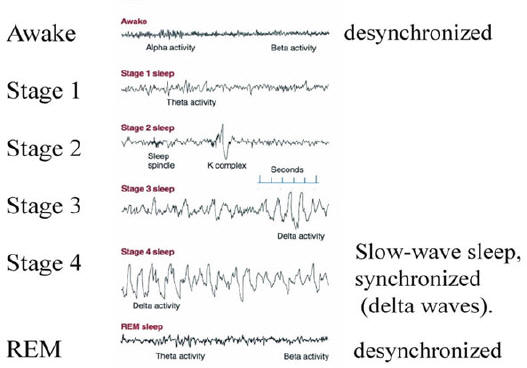
In the diagram, far above, you can see images of human brainwaves, while awake, while dreaming, and during the various stages of non-REM sleep. In these images, the brainwaves have their greatest amplitude during the deepest stages of non-REM sleep. I had known this for years, due to all of my secondary sleep research. I also had no answer to give, other than “I woke up with them,” when my allies in the labor/management conflict asked me, repeatedly, where my ideas were coming from.

The next step was my discovery that I am an Aspie:  a person with Asperger’s Syndrome, which simply means that the “hard-wiring” of my brain is atypical, causing me to think in unusual ways. As regular readers of my blog know, this is a fact I absolutely revel in, for this discovery explained many things about the way my mind works which I had never understood before. In other words, this discovery was an important metacognitive step in my own personal development.

Aspies are not known for their ability to adapt; in fact, the exact opposite is true. We often have difficulty adapting to changing circumstances because the great big, non-Aspie world is incredibly distracting, and many (or perhaps most) of us find these distractions quite annoying. For most of my life, I was not good at adapting to change — but suddenly, I was doing what I had been unable to do before. The key to figuring out the puzzle was, of course, thinking about it.

I was waking up with new ideas, but had no memory of how I got them. Distractions had been annoying me, and interfering with clarity of thought, for much of my life. I had been trying to figure out how to rewrite my own software since I was a teenager. And, now, I finally knew why I had always been so different from other people:  Asperger’s.

Armed with all this information, I finally solved the mystery:  after decades of hard work on the problem, I had figured out how to effectively, and frequently, reprogram my own software. I was doing it in my sleep. What’s more, I figured out that I was no longer doing this special type of thinking while dreaming, unlike the case of my much earlier creation of the “dream problem.” Dreams, like waking life, contain too many distractions for intense sleep-reprogramming, and intense reprogramming had not been needed until the labor-management conflict made it necessary. Only one part of my life remained, once I eliminated periods of wakefulness, as well as REM sleep:  the non-REM periods of sleep, when human brainwaves have their greatest amplitude.

Now, whenever I need to, I rewrite my own software, during non-REM sleep, as often as once per night. I’ve been doing this for over a year — since before I discovered I have Asperger’s — but have shared this information with very few people. My wife knows about it. My doctors know about it. And now, I have decided to share this discovery with the world. I have now discovered, at least for me, the purpose of non-REM sleep. I use it to change myself.

I confused many people, very recently, when I suddenly stopped being an atheist, and shared that discovery here, and on Facebook as well. Sudden personality changes alarm people, for they are often indicators that something serious, and medical in nature, is wrong with a person. I promised those who asked that I would explain what had happened, as soon as I figured it out myself. And now, I have explained as much of it as I have yet figured out. One day, something happened which I could not explain with science, nor with mathematics. The next day, several things happened which, again, defied explanation. On that second night, during non-REM sleep, I removed the obstacle to understanding what was going on, by applying my skepticism to my lack of belief, or, if you prefer, my atheism. Last night, again during non-REM sleep, I figured out how this had happened. Now that I understand it, I can share it with others.

Lastly, I need to make it clear that I do not think this ability to sleep-reprogram ourselves is something unique to Aspies. We are all human. Whether Aspies or not, we all have these higher-amplitude brainwaves during the deeper parts of non-REM sleep. It is logical to conclude that this is an ability all humans have, but few have unlocked, and it just happens to be an Aspie who figured out a way to not only do it, but also to explain it. It is my hope that my decision to share this discovery with others will help anyone who wants to learn it gain the ability to do the same thing.

Image credit:  I found the image at the top of this post at http://www.abcbodybuilding.com/anatomy/zfactor2.htm, with the assistance of Google.

Later update: months after writing this, I was diagnosed with sleep apnea, moderate level, and I wasn’t getting significant amounts of stage three or four sleep at all, nor much REM. This throws everything above into doubt, and it would be dishonest to withhold this information. Short version: I was wrong — not about my doing sleep-reprogramming, but about exactly which stage(s) of sleep I use for that purpose. It is difficult to figure out what, exactly, goes on when one is asleep!
The Misadventures of Jynx the Kitten, Chapter Two: Jynx vs. My Computer

20140827_204903_resized (2)

Jynx: 1, Computer: 0.

Tonight’s feline insanity started while we were watching Star Trek — the episode where Captain Kirk and Mr. Spock go up against a planet full of nuclear-armed Space Nazis.

Apparently, cats — or, at least, this cat — find Nazis disturbing, which, of course, they were — and will be again, if they appear in the 23rd Century . . . because some half-crazed future historian went and violated the Prime Directive, becoming, a few years later, a fully-crazed future historian. Jynx was so incredibly disturbed by the Space Nazis, in fact, that he bounced over pillows and blankets, in a series of nicely Newtonian . . .


&^ (Stop that, Jynx!)

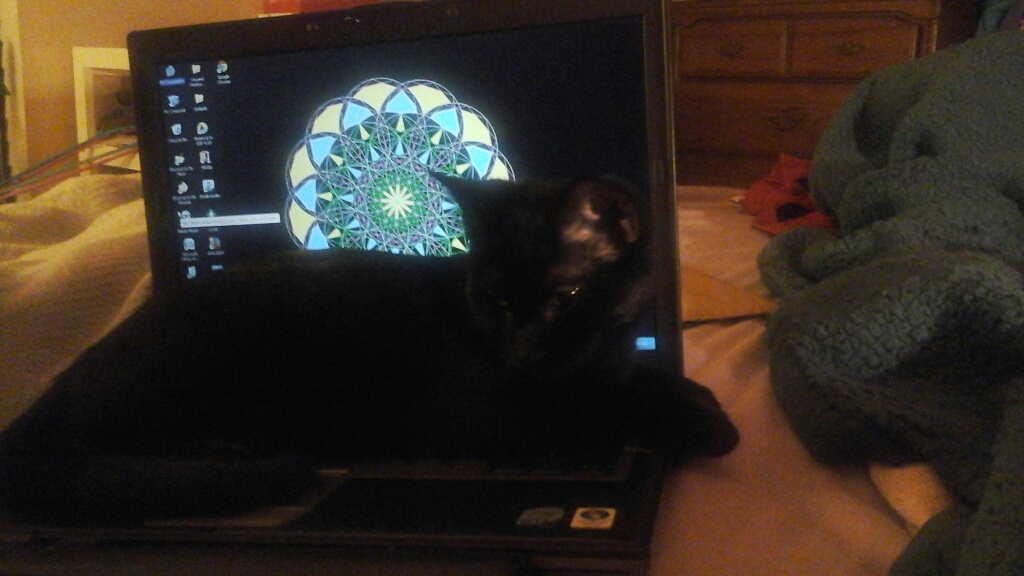
. . . parabolic arcs, to land on my computer. He then proceeded to pause the episode — then close my browser (the picture-moment, with my wife laughing hysterically as she took it), and finally tried to bite the heads off several Space Nazis as the screen slowly darkened. After due consideration, Jynx decided this was not enough, and so, next, he reached out a paw, and quickly turned my computer completely off. A smug look followed. You haven’t seen a look this smug, unless, maybe, you’ve also seen one on the face of a kitten.

Getting it (my computer, not Jynx) turned back on was not easy. For a little while, in fact, I thought Jynx had destroyed the Internet. In reality, the Internet had been fine all along, for this picture, taken a little earlier, with a tablet, got to my e-mail account almost instantly. It took much longer, however, for me to actually get to my e-mail account.

My computer now has tiny bite marks all over it, and plays Radiohead’s song “2 + 2 = 5” so slowly that it’s turned the song into “1.5 + 1.5 = π” – and that song sounds terrible.

I hope my computer lives long enough for this post to make it to my blog. In the meantime, Jynx reigns — OW! — triumphant.

[2016 update: that computer is now officially dead. Jynx the Cat lives on.]

These phrases, and questions, are likely to confuse people with Asperger’s. Unless confusing us is your goal (and why would you want to do that?), please consider alternate wordings.

confusion

Throughout this post, I will refer to people with Asperger’s as “Aspies.” This is not considered a derogatory term; it’s simply how we refer to ourselves.

First, we are not stupid. We also are not trying to be difficult when we say we don’t understand you. We don’t have a disease, and the vast majority of us would refuse a “cure,” if one were discovered, for such a development would be seen by many of us, myself included, as an attempt to commit genocide. Like other groups of people, we want to stay alive, as individuals, and as a culture.

We are, however, different from most people. Our brains are hard-wired in ways that are not typical, with the result that we do not think in the same manner as others. These differences give us certain advantages which we value, but the trade-off comes in the form of problems involving communication with non-Aspies. You can see this in fiction, to get used to the way we think, simply by watching (or reading) Star Trek stories which feature Vulcans, or the android named Data. The difficulties those characters have, when trying to communicate with the humans they encounter, are very much like what happens when Aspies and non-Aspies attempt communication. Why is this the case? The answer is simple:  Star Trek was written that way.

Here are some specific questions, and phrases, which many Aspies find particularly baffling. In each case, I will attempt to explain why this is so.

“Who do you think you are?” — Ask an Aspie this question, and you’re likely to simply be given his or her name, in response. Apparently, this offends some people, but please don’t ask me why, for I don’t understand it myself. If a person were to ask me this question, my first guess would be that the questioner simply forgot my name, and needs a reminder. The meaning of volume, voice tone, and body language are mysteries to us. Sometimes we can figure out these mysteries, but it doesn’t happen automatically — we have to reason our way through it, and that takes time, especially for nuances of communication which are based on emotions.

“What do you think you’re doing?” — My likely response to this question would be an honest one:  “I’m trying to understand what you’re saying, but it doesn’t seem to be working very well.” However, that’s an answer from an Aspie in his fifth decade of trying to understand other people, so I’ve had a lot of practice. An Aspie teenager, in school, might simply say, “I’m walking to class,” “I’m taking notes,” or something like that, and then get in trouble for “backtalk,” as it is called — when the student was simply answering the question, without intending any disrespect whatsoever. Whatever answer this confusing question gets, from one of us, that answer will be both literal, and honest. It is not in our nature to lie, but it is definitely in our nature to think, listen, speak, read, and write literally, and logically.

“Do that again!” / “Say that again!” — If we have done or said something which you don’t like, and you actually don’t want to witness a rerun, why would you demand one? We think, speak, and interpret what we hear in terms of the actual words which are spoken. There’s nothing wrong with thinking literally, and, frankly, it puzzles us why so many of you think in other ways, so much of the time. If you ask for, or demand, a repeat performance of something you didn’t like, from one of us, you’re quite likely to get one — and then you’ll get angrier, we’ll get even more confused, and absolutely nothing of value will have been accomplished. If, on the other hand, you refrain from using “x” to mean “not x” (since it doesn’t), and simply tell us exactly what you mean, communication will become much easier, for all concerned.

“Don’t get technical with me!” — As far as I can tell, this means that the speaker wants us to refrain from choosing our words with precision, but I could be wrong, for this is the most baffling item on this list, so far. Clarity of language is desirable, for it facilitates communication, and sometimes, technical terms are needed for this purpose. I don’t know what to suggest as a substitute for this phrase, since I don’t understand it, but I can assure you that using it, with an Aspie, is a complete waste of your time.

“What’s wrong with you?” — This is another baffling question. If asked very loudly, the most likely answers Aspies will give are “I have a headache,” or perhaps “Sudden-onset tinnitus,” with the cause, in each case, being simple: from our point of view, the questioner is trying to deafen us, by yelling things which make no sense (at any volume). Do you like being shouted at, from close range? No? Well then, this is one way that we aren’t so different from non-Aspies, for we don’t like it either. Also:  it’s quite likely that we don’t see anything wrong with us at all, for, in this situation, we are not the ones shouting nonsense-questions, so you might even get this response:  “Nothing. What’s wrong with you?” In such a situation, that isn’t backtalk — it’s a perfectly legitimate question, and we are not responsible for any emotion-laden, irrational response the non-Aspie questioner might display.

“I need this done yesterday!” — Many of us can explain, in detail, why time travel into the past is not permitted by the laws of physics, as they are currently understood. Those who request, or demand, reverse-time-travel, from an Aspie, should not be surprised to hear such an explanation. Ask us to flap our arms and fly, and the response will likely be similar.

I could give more examples, but I think the point has been made. We aren’t all alike, so the examples of hypothetical responses I gave, above, will vary from one Aspie to another. What isn’t likely to vary, though, is the confusion each of us experiences when things are said to us which make no sense, if interpreted literally. That’s the key to communicating with us:  when we hear something, we automatically use logic, and rational thought, to attempt to understand the literal meaning of what has been said to us. For many of us, that is the only meaning we can understand.

In my case (and probably in the cases of at least some other Aspies), this goes a little further: rational, literal, and logical interpretations of language are the only ones I want to understand. This is a self-protection mechanism, for the idea of losing even part of my ability to think clearly, and rationally, is extremely frightening to me. To pour a lot of effort into trying to think in non-Aspie ways, I fear, could damage my mind — if, that is, I was successful in the attempt. I don’t want to risk turning into a person who considers “x” and “not x” to be interchangeable, for one doesn’t equal negative one. To change, in this way, would effectively kill the person I am. It wouldn’t stop my heart from beating, of course, but some things are even worse than physical death. If such a change ever happened, I would look the same, and would have the same legal name, but I would no longer be RobertLovesPi. It makes perfect sense for me to be absolutely unwilling to risk something so dangerous.

In addition to the central importance of the fact that we think in literal terms, while others often don’t, Aspies have some other difficulties (or the rest of the world does, depending on your point of view). I attempted to describe these difficulties, which involve coping with the emotionalism and irrationality of numerous other people, in the examples of confusing phrases and questions given above. Emotionalism and irrationality are, to us, severe impediments to understanding anything, and we live our lives in a state of near-constant bombardment from both, since Aspies are outnumbered by non-Aspies by a huge margin. On this planet, to borrow a book title from Robert Heinlein, I live my life as a “stranger in a strange land.” I know that many other Aspies see life in a similar way, for that idea is embedded in the name of the largest online community created by and for Aspies, as well as others on the autism spectrum: www.wrongplanet.net. If you are curious about how other Aspies view the things I have described above, or if you are, yourself, an Aspie in need of an temporary escape from social interaction with non-Aspies, you can find a great many of us at that website. (Also, if you want to find me there, just search for me, using the name of this blog — my not-at-all-secret identity, all over the Internet.)

Ten Easy Ways to Oppose Secular Superstitious Nonsense

broken-mirror

It is a common mistake for skeptics, such as myself, to focus too much attention on religion. Do I understand why so many people lack religious belief, due to a lack of evidence to support it, and/or bad experiences with religious fanatics? Yes, I do. However, I also understand that the First Amendment, which protects my right to live my life without religious belief, equally protects the right of believers to practice the religion of their choice — and I recognize that it is unreasonable to expect one of those protections to exist, without the other, for both are important. If no one tries to force their religious beliefs on me (and very few people do), what harm do those beliefs do to me? Also, I know many people who find comfort in religious belief, especially in difficult times. I have no wish to deny others that particular form of comfort, even though I am incapable of experiencing it myself. To do so, after all, would be cruel. The world has plenty of cruelty already, and it certainly doesn’t need more.

When referring to myself, I prefer the term “skeptic,” over “atheist,” even though both labels are accurate. The reason is simple:  “skeptic” covers more ground. It’s a broader term, and using it reminds me that the world is (still) filled with superstitious nonsense which has nothing whatsoever to do with religion. What’s more, non-skeptics are generally far less tied, emotionally, to the beliefs they hold which are non-religious in nature. If skeptics wish to persuade others to abandon beliefs they do not share, therefore, increased attention to non-religious beliefs offers a greater chance of success, combined with a much lower risk of alienating and/or offending people.

With these things in mind, then, I offer this list of ten easy ways to oppose, by example, some of the many secular superstitions which have not — yet — been abandoned.

  1. When a mirror is accidentally broken, by yourself or others, remain calm, and simply clean up the mess, so no one gets cut by broken glass.
  2. Deliberately open umbrellas indoors, after checking to make certain no one is close enough to get struck by the umbrella in the process.
  3. When you see a ladder leaning against a building, and it is safe to do so, casually walk under it, without comment.
  4. Ask people in tall buildings to help you find the thirteenth floor, after checking for the (usually missing) “13” button in the elevator. (If the building actually has a floor numbered “13,” though, just wait for another tall building.)
  5. Adopt a black cat. (The cat, itself, will take care of the “crossing your path” part of the superstition.)
  6. If you are ever offered homeopathic “medicine,” ask for at least twenty doses, to take all at once. (Twenty or more, times zero, is still zero, and homeopathic products are nothing more than harmless-but-expensive placebos.) 
  7. Stare directly into a mirror, with witnesses present, and say “redrum,” or “bloody Mary,” repeatedly.
  8. Each time you are asked for your astrological sign, refuse to give any answer, other than “skeptic.”
  9. Don’t throw salt over either shoulder, ever. Why waste perfectly good salt?
  10. Have your children vaccinated.

I saved the most important one for last.