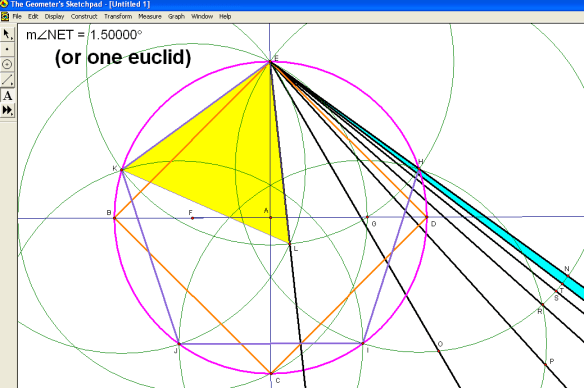
Some angles are constructible, in the Euclidean sense that they may be constructed with the traditional geometricians’ construction-tools: a compass, and an unmarked straightedge. Examples include every angle shown above, such as the 108° interior angles of the purple regular pentagon, or the 60° angles of the yellow triangle. Angle LEN is constructible as well, and measures 48° — but to construct it, one must use compass-and-straightedge subtraction (the 108° pentagon angle HEK, minus the 60° triangle angle KEL). After constructing this 48° angle, I bisected it repeatedly, to show that angles measuring 24, 12, 6, and 3, and 1.5 degrees may be constructed as well. The 1.5° angle NET is shown with a blue interior.
Many other angles are non-constructible. For example, the angle between two adjacent radii of a regular enneagon (also called a nonagon) measures 40°, and so, because it has been proven that the regular enneagon cannot be constructed with the traditional Euclidean tools, it follows that 40° angles are non-constructible. If they were constructible, however, the subtraction-trick I used earlier to construct a 48° angle could be used, again, to construct an 8° angle (48° – 40°) — so 8° angles, therefore, are also non-constructible. Since repeatedly bisecting an 8° angle would yield angles measuring 4, 2, 1, 0.5, o.25, etc. degrees, all of these angle-measures are for non-constructible angles.
With the one degree angle on the non-constructible list, that throws into question the practice of using degrees to measure angles. As for other established units of angle measure, they have the same problem. It is not possible to construct an angle measuring one radian — nor one gradian, either. (Gradians are little-known angle-measuring units; a right angle measures 100 gradians.)
If an angle-measurement system is to be based on units which correspond to the measure of constructible angles, the blue angle above, measuring 1.5°, is ideal . . . and I am, therefore, using this angle as the definition for a new unit of angle measure: the euclid. If an angle measures a whole number of euclids, it is constructible, and this cannot be said for the degree, radian, nor gradian. (By the way, leaving “euclid” uncapitalized, in this context, is deliberate, for I am using it as a unit. This follows the convention set by other units named after people. For example, “Newton” refers to Sir Isaac Newton, but “newton” refers to a unit of force.)
One full rotation would be a rotation of 240 euclids. A right angle is one-fourth of that, or sixty euclids. The interior angles of equilateral triangles measure forty euclids, and the interior regular-pentagon-angle of 108° becomes 72 euclids, in this new, proposed system.
360 has been used as the basis of the degree for reasons both historical and mathematical. Sixty, and its multiple 360, appear as important numbers in several ancient cultures, and 360 also has many whole-number divisors, having a prime-number factorization of (2)(2)(2)(3)(3)(5).
However, 240 has similar properties. As I have shown, it is based on the Euclidean construction-rules from ancient Greece. The number 240 also has many whole-number divisors, since its prime-number factorization is (2)(2)(2)(2)(3)(5).
Just in case this catches on, I have created a symbol for the euclid, to be used in superscript form, as the degree symbol is used:

A simple “e,” by itself, would not do, for that would cause confusion with the important number e — the base of natural logarithms, among other things. That is why I included a circle, surrounding the letter “e,” for this symbol. In superscript form, this symbol for the euclid would resemble the well-known copyright symbol — but, fortunately, the copyright symbol is not, itself, copyrighted.









 RobertLovesPi.net