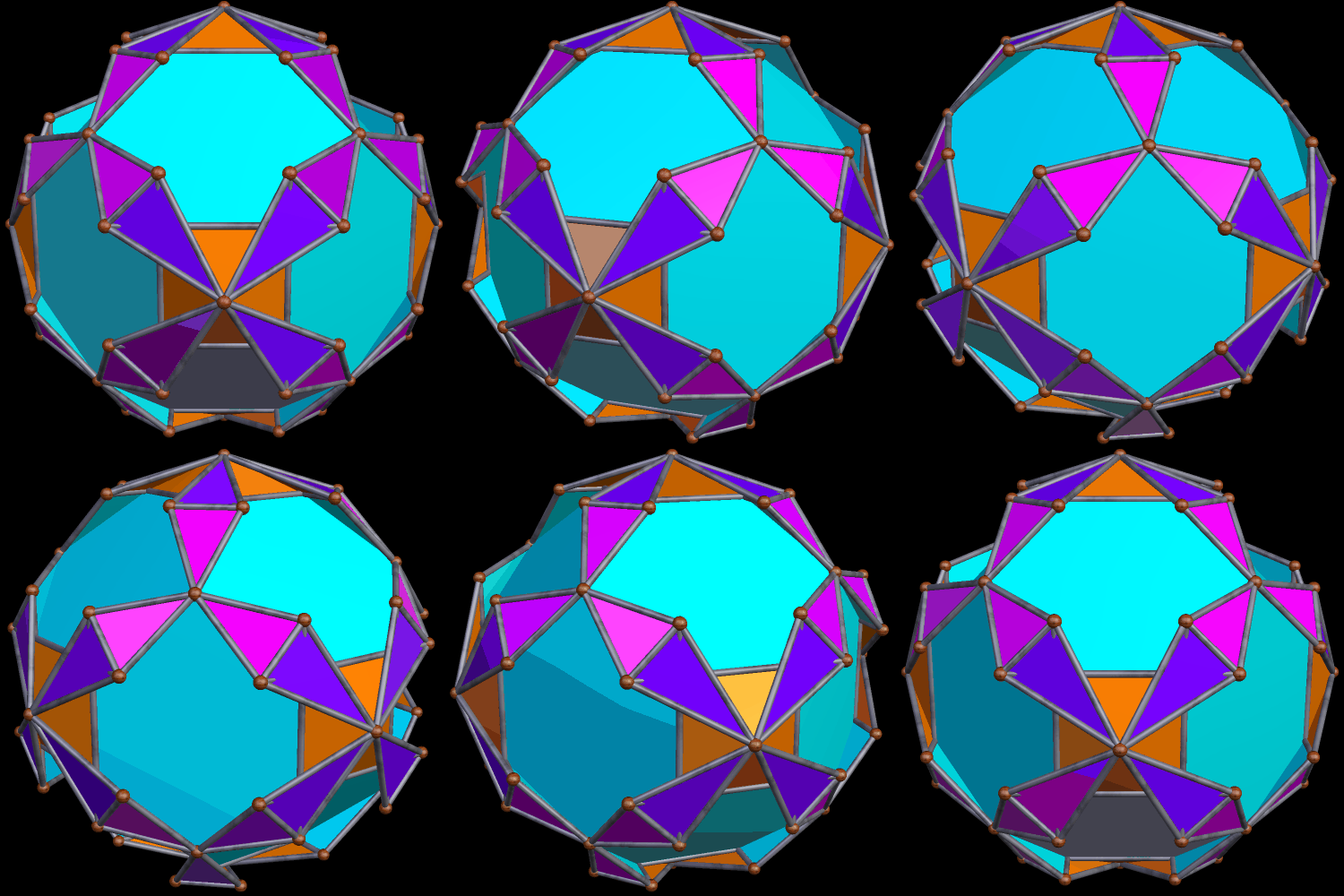
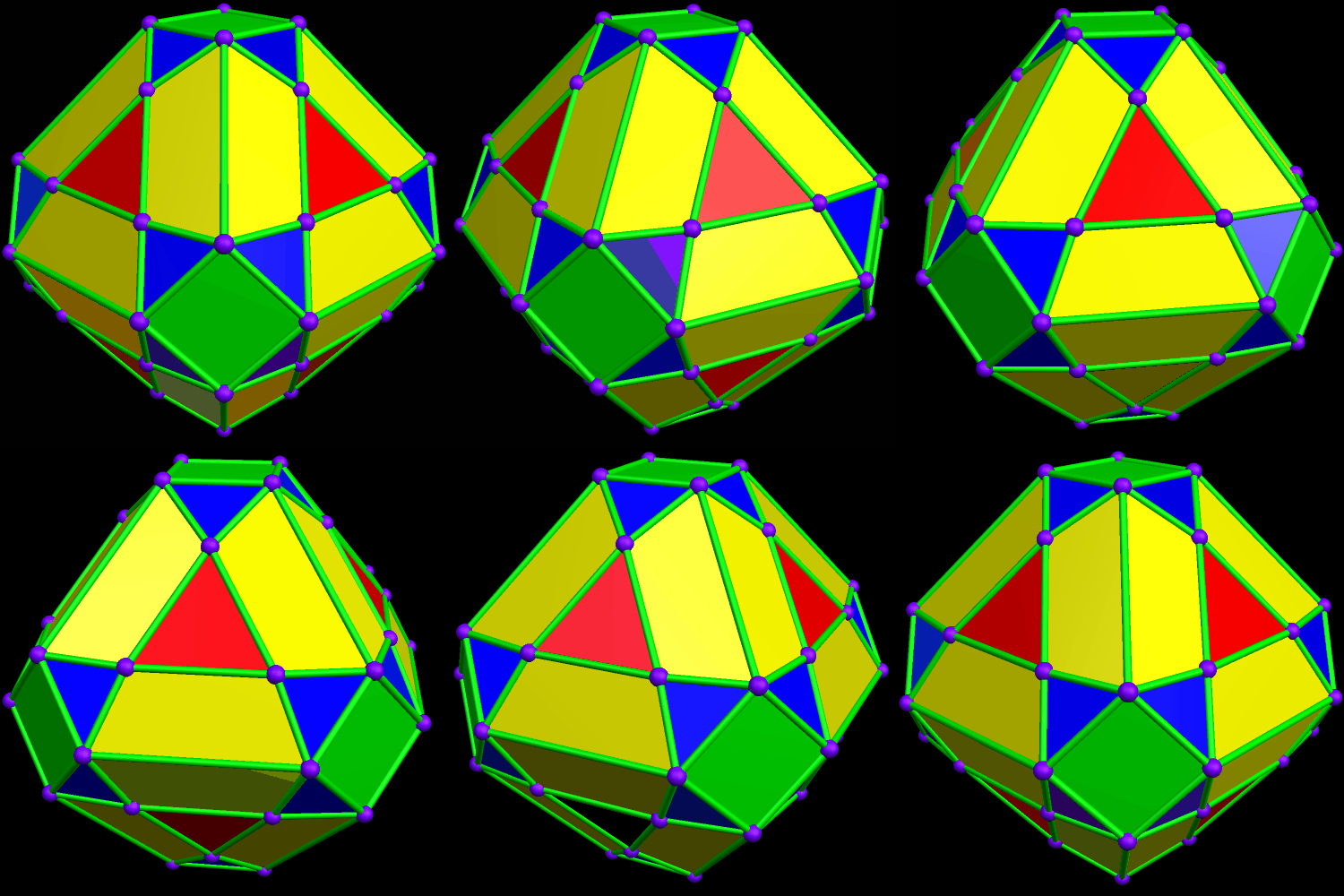
Combining Octahedral and Icosahedral Symmetry to Form Pyritohedral Symmetry

Compound of Octa and Icosa

Pyritohedral symmetry, seen by example both above and below, is most often described at the symmetry of a volleyball:

volleyball-306791_640

[Image of volleyball found here.]

To make the rotating polyhedral compound at the top, from an octahedron and an icosahedron, I simply combined these two polyhedra, using Stella 4d, which may be purchased (or tried for free) here.

In the process, I demonstrated that it is possible to combine a figure with octahedral (sometimes called cuboctahedral) symmetry, with a figure with icosahedral (sometimes called icosidodecahedral) symmetry, to produce a figure with pyritohedral symmetry.

Now I can continue with the rest of my day. No matter what happens, I’ll at least know I accomplished something.

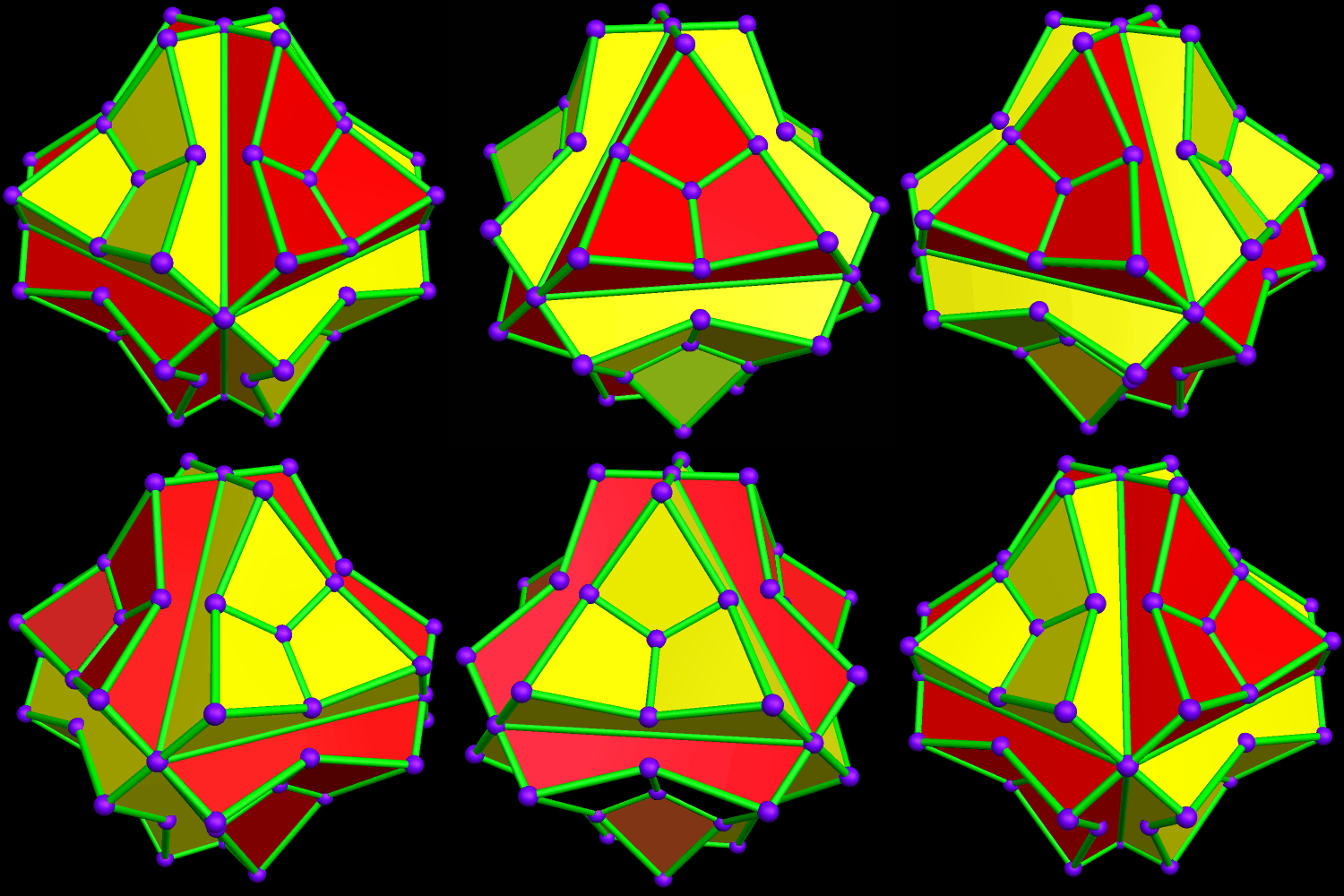
A Compound of Three Square Dipyramids

The reason I am not calling this a compound of three octahedra is that the faces of the dipyramids aren’t quite equilateral. They are, however, isosceles.

compound of three square dipyramids

This was created with Stella 4d, which you can buy, or try for free, right here.

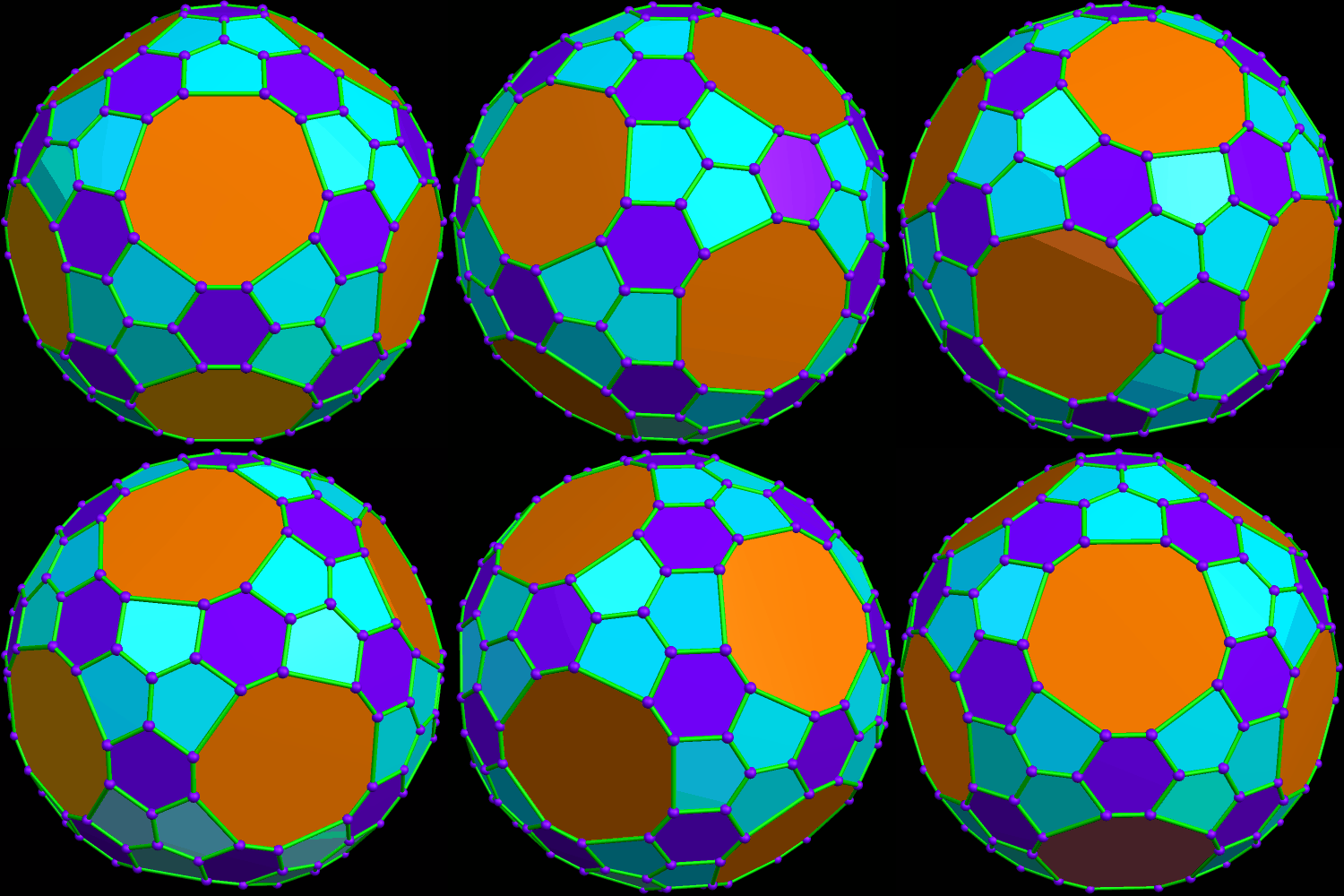
Compounds of Enantiamorphic Archimedean Solid Duals

An enantiomorphic-pair compound requires a chiral polyhedron, for it is a compound of a polyhedron and its mirror image. Among the Archimedeans, only the snub cube and snub dodecahedron are chiral. For this reason, only threir duals are chiral, among the Archimedean duals, also known as the Catalan solids.

Compound of enantiomorphic pair snub cube duals

That’s a compound of two mirror-image snub cube duals (pentagonal icositetrahedra) above; the similar compound for the snub dodecahedron duals (pentagonal hexacontahedra) is below.

Compound of enantiomorphic pair

Both these compounds were made with Stella 4d, which is available at http://www.software3d.com/Stella.php.

A Special Type of Compound, Built with Zome, of the Great and Small Stellated Dodecahedra

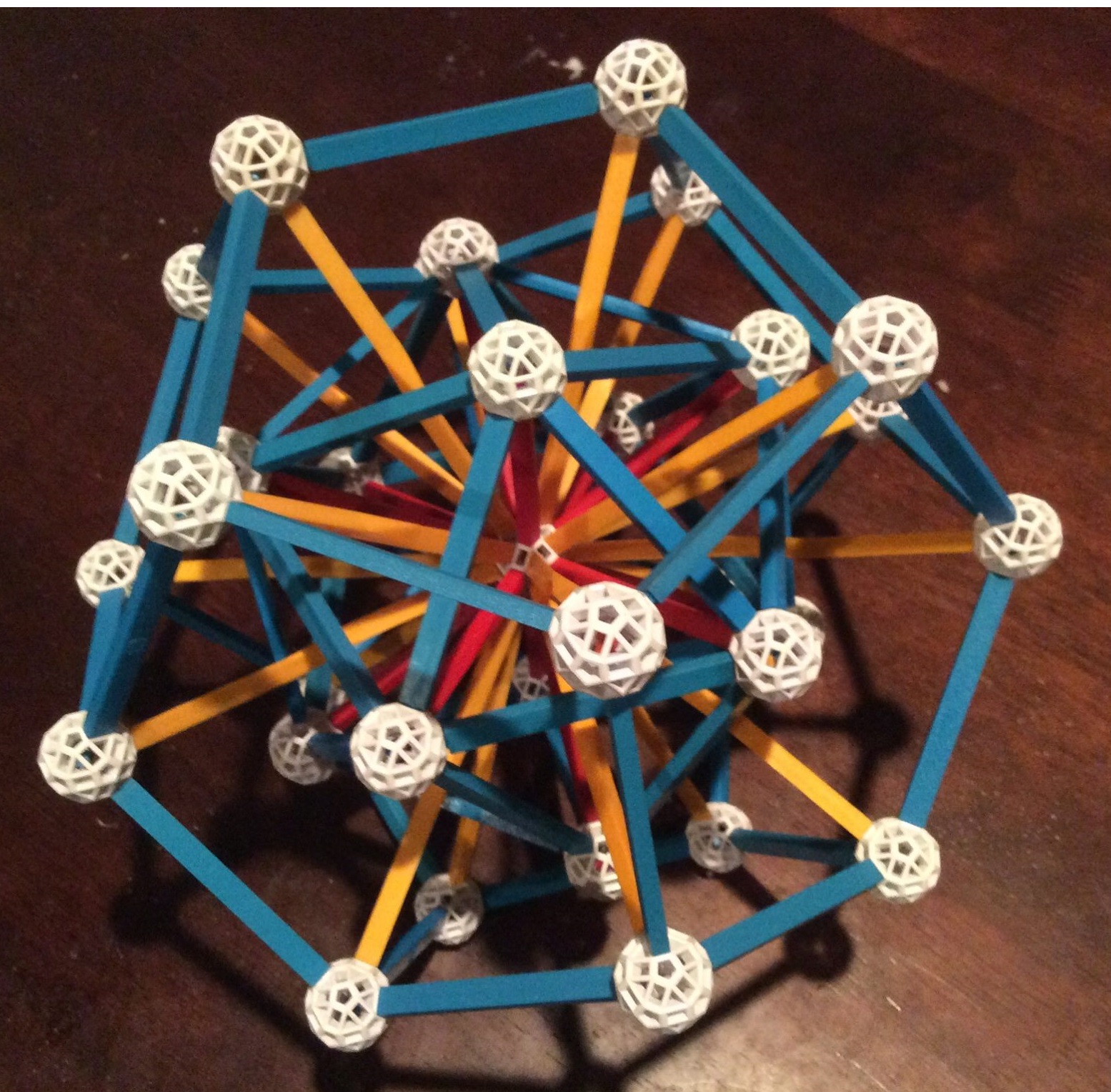
For years, I have used Zometools (sold here:  http://www.zometool.com) to teach geometry. The constructions for the icosahedron and dodecahedron are easy to teach and learn, due to the use of short reds (R1s) and medium yellows (Y2s) for radii for the two of them, as shown below, with short blue (B1) struts as edges for both polyhedra.

10865862_10204218181029594_3308928268978197013_o

Unexpectedly, a student (name withheld for ethical and legal reasons) combined the two models, making this:

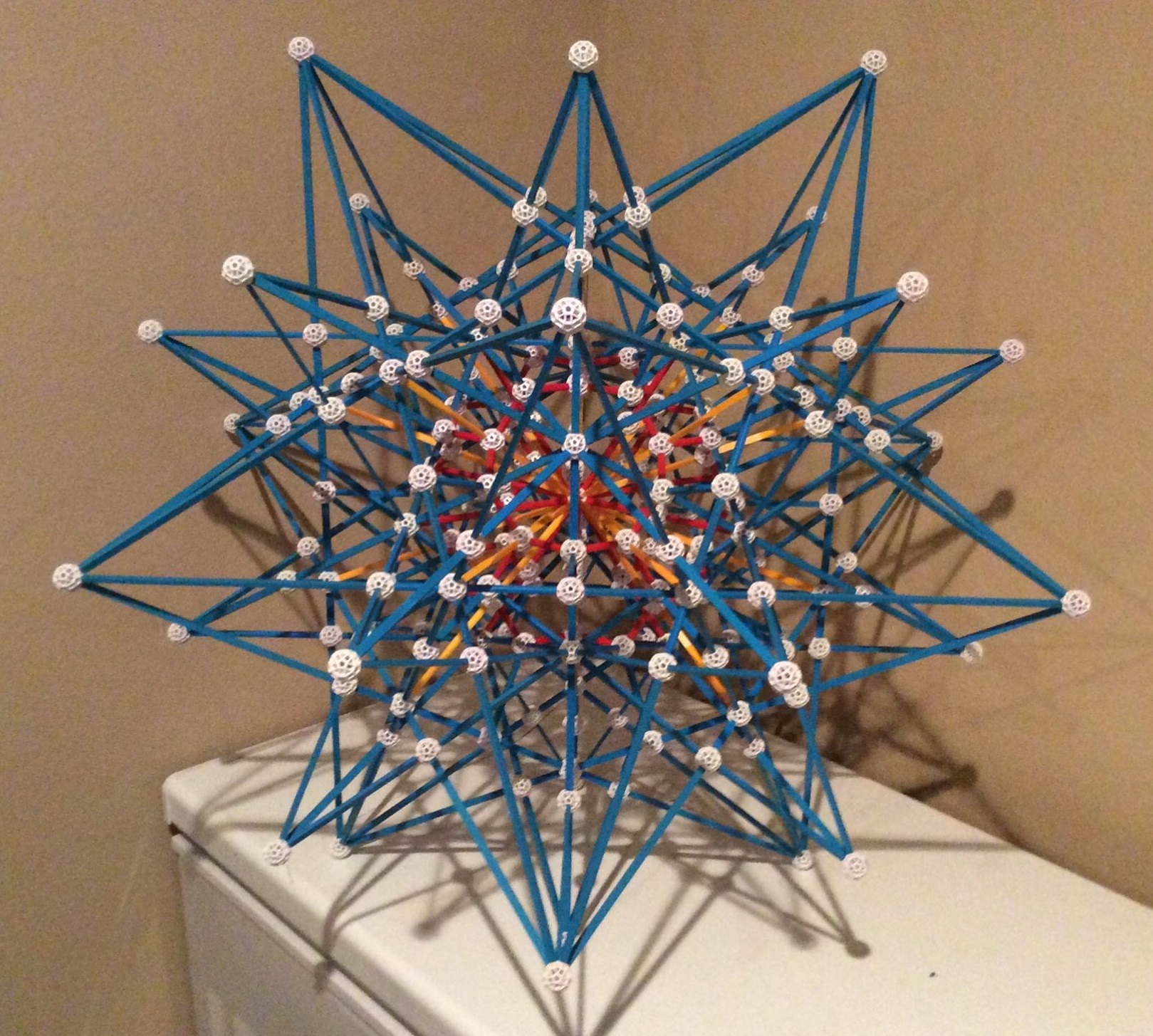
1401165_10204218146948742_4605456240300721240_oI saw it, and wondered if the two combined Platonic solids could be expanded along the edges, to stellate both polyhedra, with medium blues (B2s), to form the great and small stellated dodecahedron. By trying it, I found out that this would require intersecting blue struts — so a Zomeball needed to be there, at the intersection. Trying, however, only told me that no available combination would fit. After several more attempts, I doubled each edge length, and added some stabilizing tiny reds (R0s), and found a combination that would work, to form a compound of the great and small stellated dodecahedron in which both edge lengths would be equal. In the standard (non-stellated) compound of the icosahedron and dodecahedron, in which the edges are perpendicular, they are unequal in length, and in the golden ratio, which is how that compound differs from the figure shown directly above.

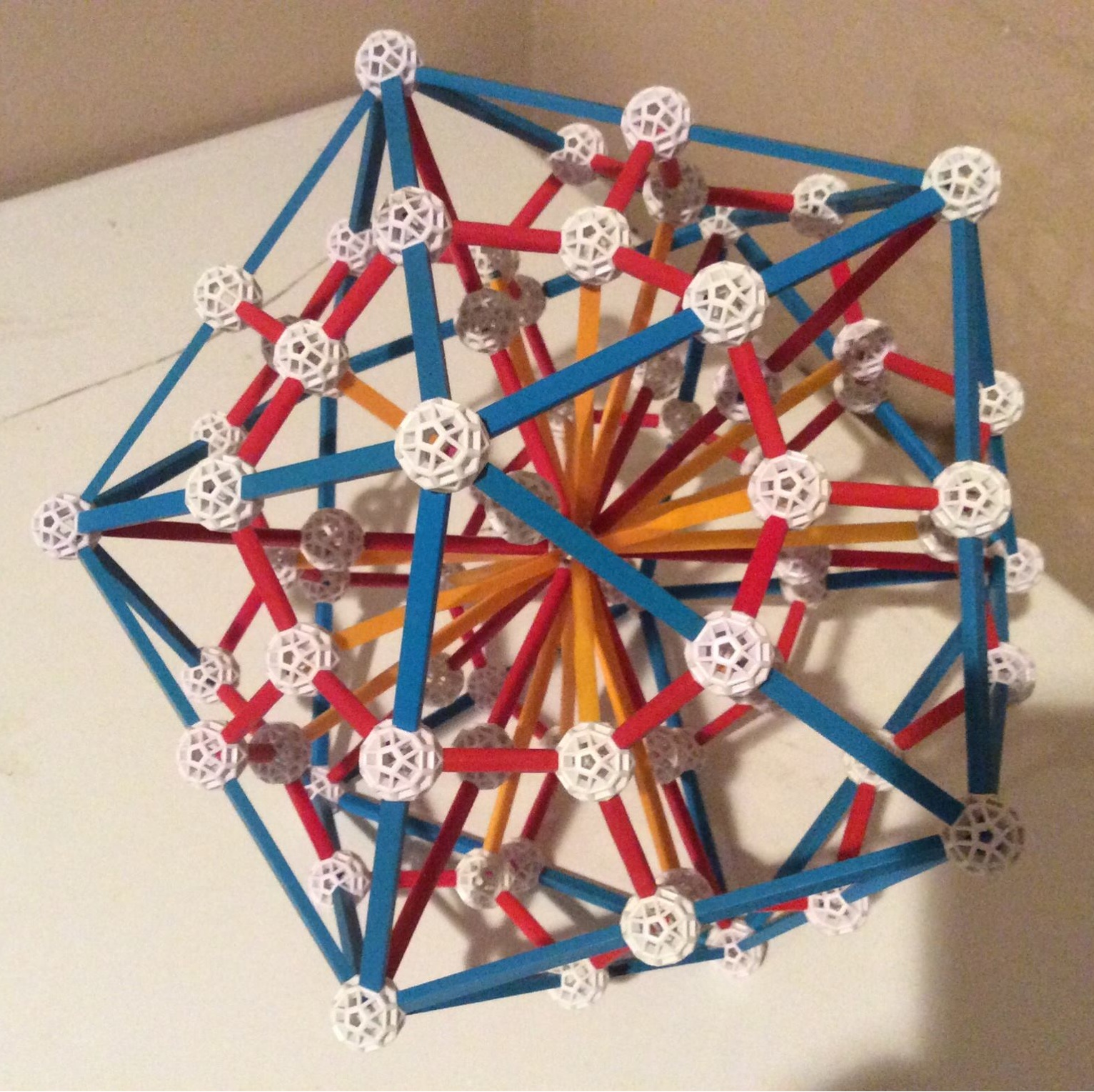
Here’s the stabilized icosahedral core, after the doubling of the edge length:

10865862_10204218180989593_3871605705756535601_oThis enabled stellation of each shape by edge-extension. Each edge had a length twice as long as a B2 added to each side — and it turns out, I discovered, that 2B2 in Zome equals B3 + B0, giving the golden ratio as one of three solutions solution to x² + 1/x = 2x (the others are one, and the golden ratio’s reciprocal). After edge-stellation to each component of the icosahedron/dodecahedron quasi-compound, this is what the end product looked like. This required assembling the model below at home, where all these pictures were taken, for one simple reason: this thing is too wide to fit through the door of my classroom, or into my car.

10847334_10204218153268900_1020271669763339706_o

Here’s a close-up of the central region, as well.

closeup

A Polyhedral Journey, Beginning with the Snub Cube / Pentagonal Isositetrahedron Base/Dual Compound

The snub cube and its dual make an attractive compound. Since the snub cube is chiral, its chirality is preserved in this compound.

Penta Icositetra & snub cube compound

If you examine the convex hull of this compound, you will find it to be chiral as well.

Convex hull of snub cube& dual compound

Here is the mirror image of that convex hull:

Convex hull mirror image

These two convex hulls, of course, have twin, chiral, duals:

dual of Convex hull of snub cube& dual compound

Dual of Convex hull mirror image

The two chiral convex hulls above (the red, blue, and yellow ones), made an interesting compound, as well.

Compound of enantiomorphic pair not dual

This is also true of their chiral duals:

Compound of enantiomorphic pair

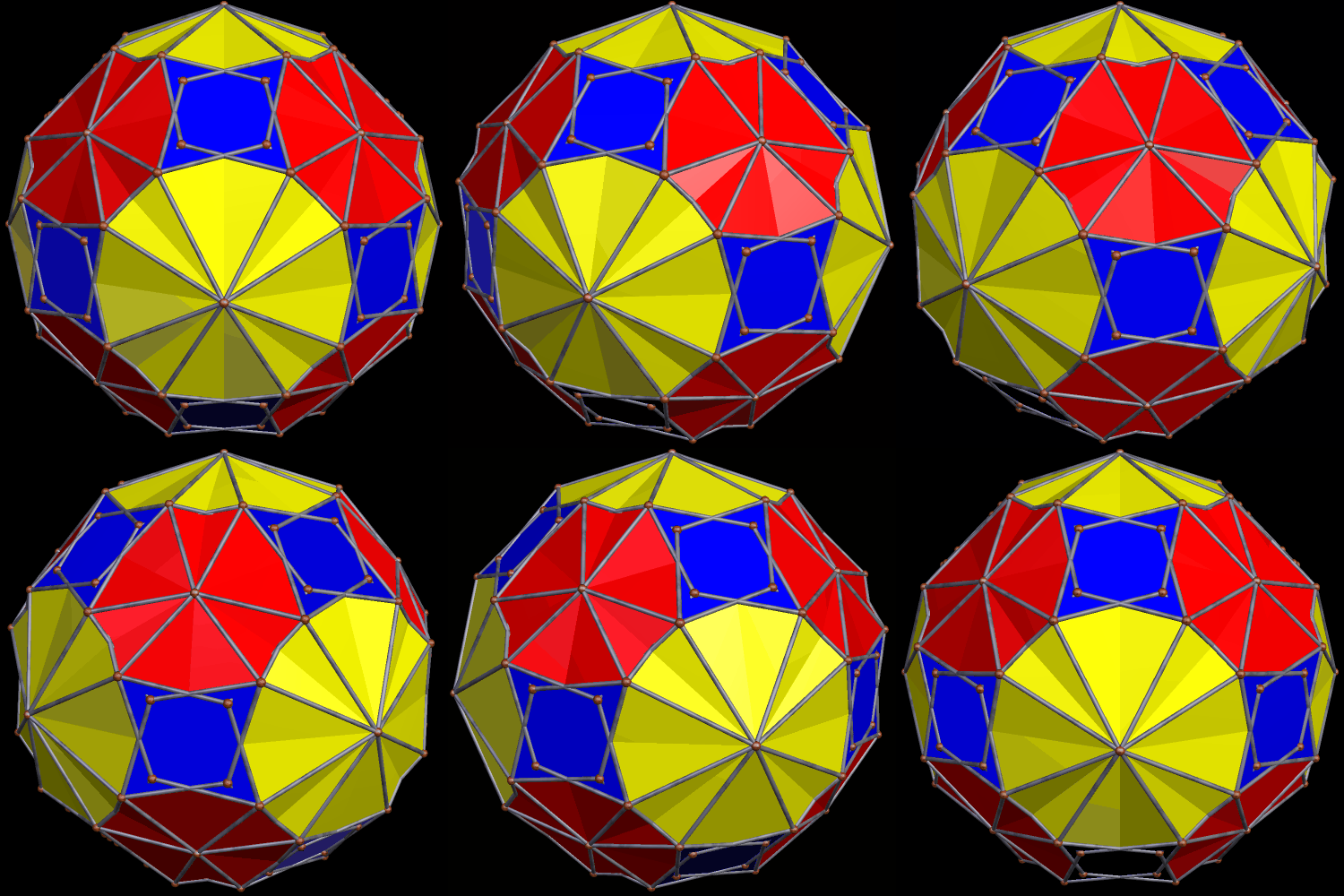
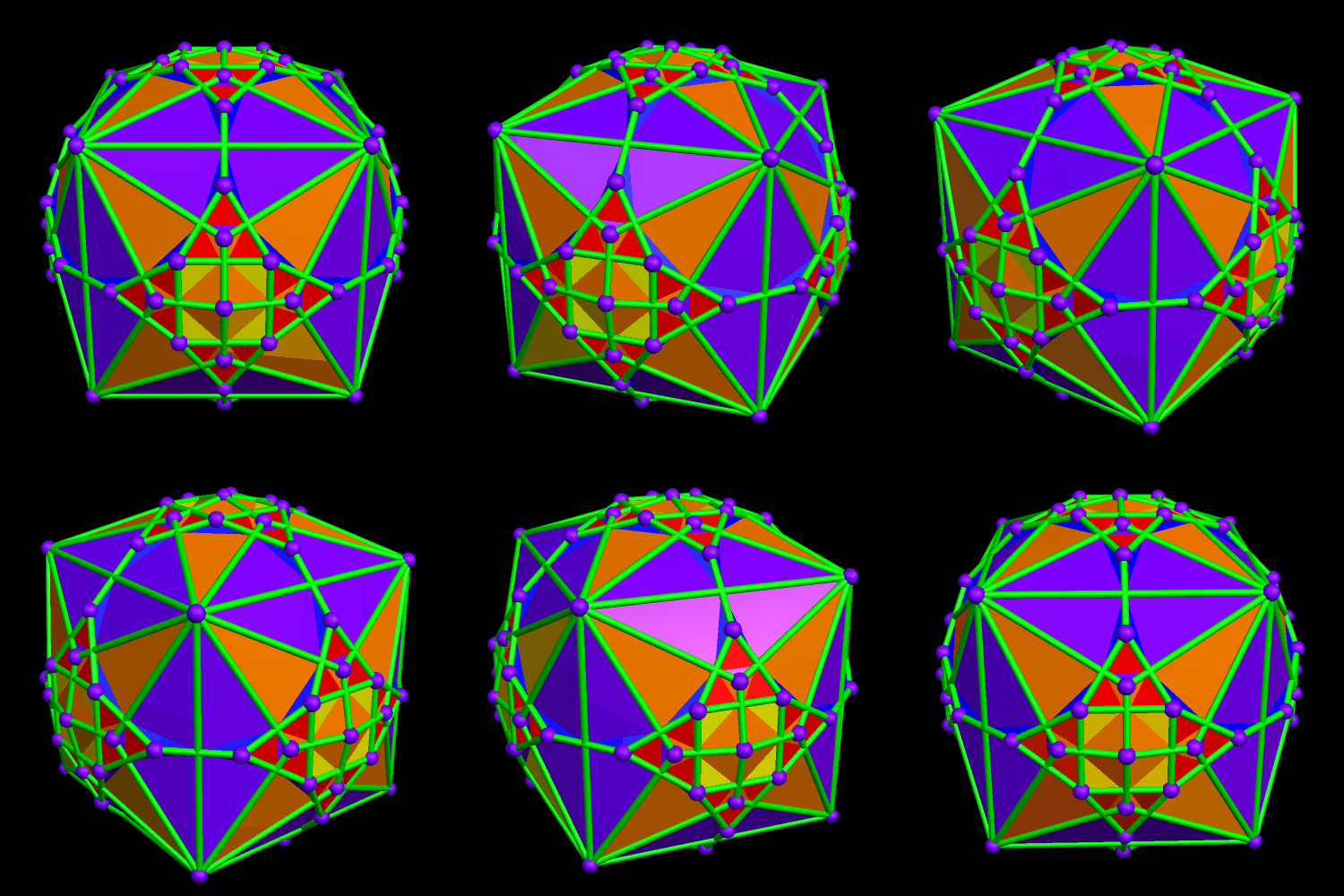
I next stellated this last figure numerous times (I stopped counting at ~200), to obtain this polyhedron:

Stellated Compound of enantiomorphic pair dual

After seeing this, I wanted to know what its dual would look like — and it was a nice polyhedron on which to end this particular polyhedral journey.

dual of Stellated Compound of enantiomorphic pair dual

I  make these transformations of polyhedra, and create these virtual models, using a program called Stella 4d. It may be purchased, or tried for free, at http://www.software3d.com/Stella.php.

An Unusual Presentation of the Icosahedron/Dodecahedron Base/Dual Compound

Leonardo Icosahedron

In this model, the usual presentation of the icosahedron/dodecahedron dual compound has been altered somewhat. The “arms” of star pentagons have been removed from the dodecahedron’s faces, and the icosahedron is rendered “Leonardo-style,” with smaller triangles removed from each of the faces of the icosahedron, with both these alterations made to enable you to see the model’s interior structure. Also, the dodecahedron is slightly larger than usual, so that its edges no longer intersect those of the icosahedron.

This model was made using Stella 4d, software you can obtain for yourself, with a free trial download available, at http://www.software3d.com/Stella.php.

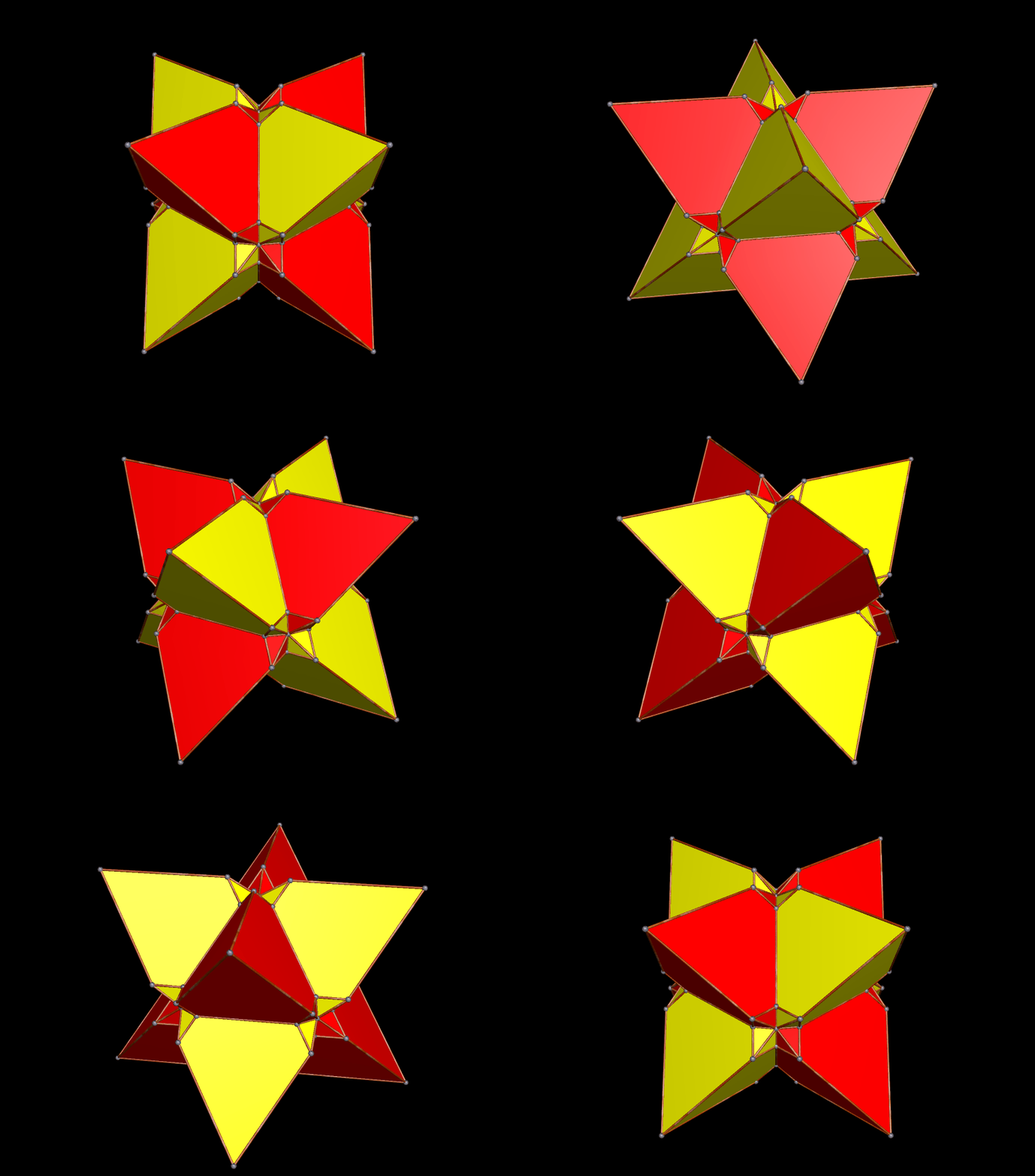
Three Variations of Kepler’s Stella Octangula

The Stella Octangula was the name Johannes Kepler gave, centuries ago, to the compound of two tetrahedra. Here are three variations on it, all created using Stella 4d, a program you may try at http://www.software3d.com/Stella.php.

stella octangular variantstella octangular variant anotherstella octangular variant third

An Alteration of the Icosahedron/Dodecahedron Compound

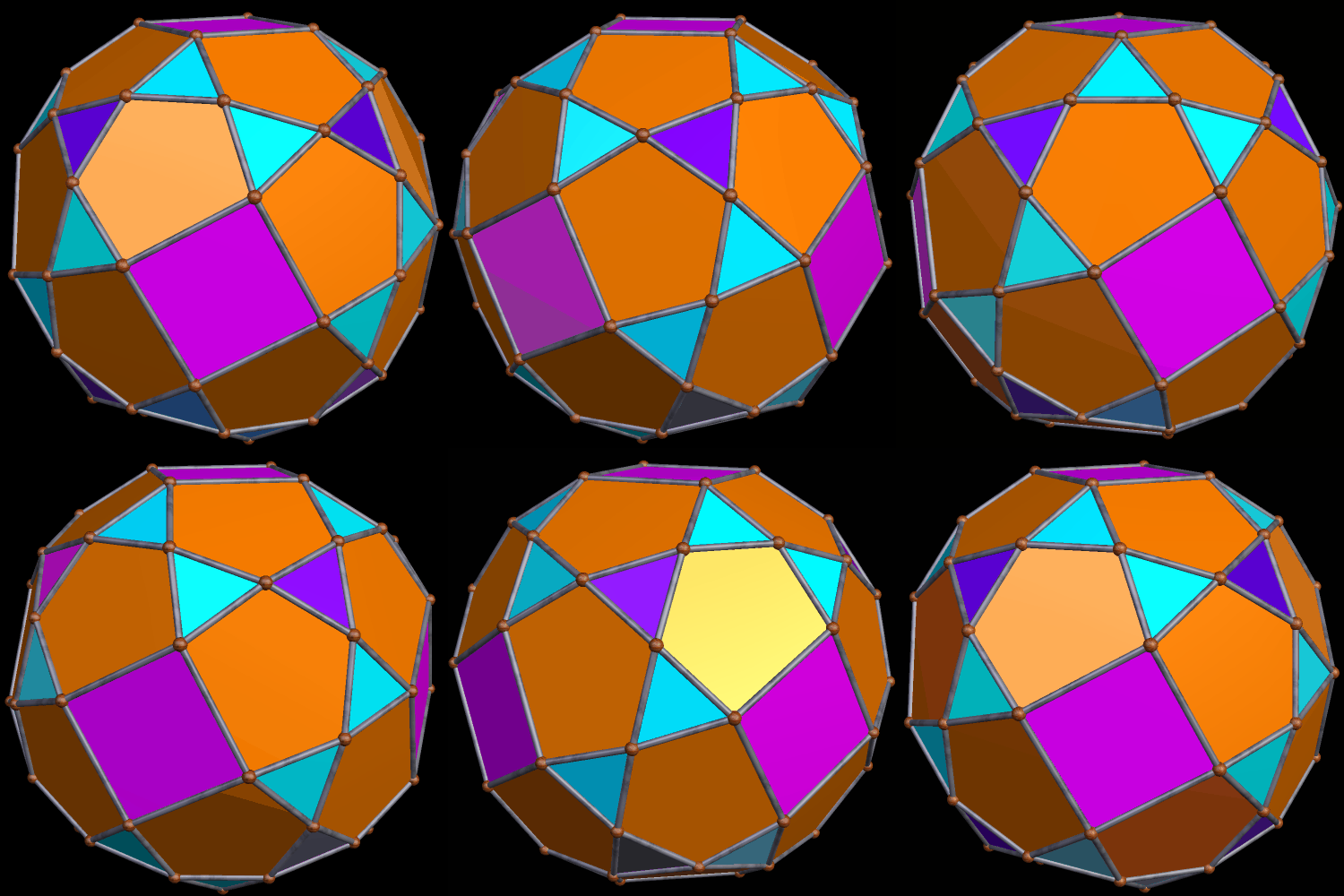
Dual of Convex hull

The dual of the icosahedron is the dodecahedron, and a compound can be made of those two solids. If one then takes the convex hull of this solid, the result is a rhombic triacontahedron. One can then made a compound of the rhombic triacontahedron and its dual, the icosidodecahedron — and then take the convex hull of that compound. If one then makes another compound of that convex hull and its dual, and then makes a convex hull of that compound, the dual of this latest convex hull is the polyhedron you see above.

I did try to make the faces of this solid regular, but that attempt did not succeed.

All of these polyhedral manipulations were were performed with Stella 4d:  Polyhedron Navigator, available at http://www.software3d.com/Stella.php.

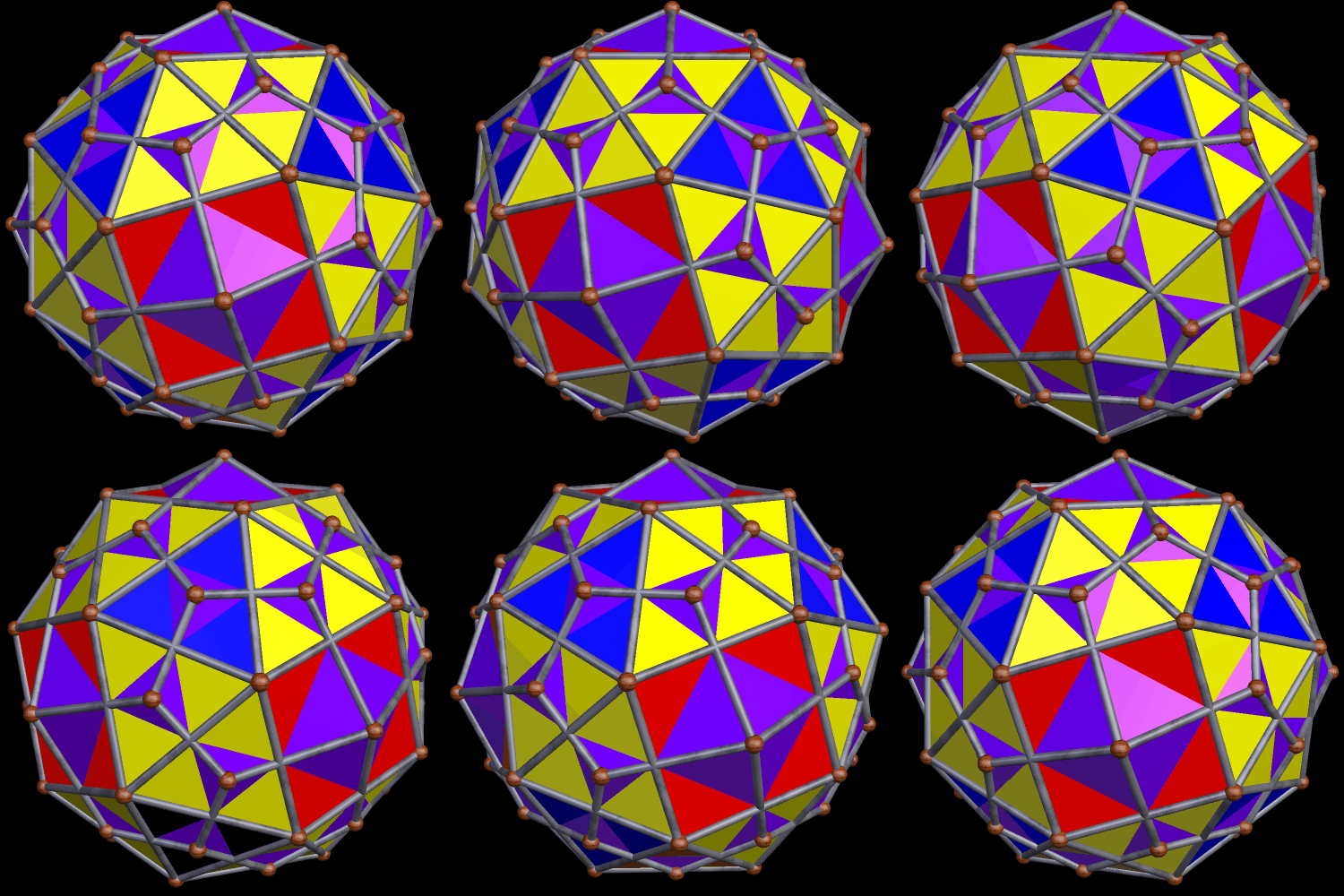
A Polyhedral Journey, Beginning with a Near-Miss Johnson Solid Featuring Enneagons

When Norman Johnson first found, and named, all the Johnson solids in the latter 1960s, he came across a number of “near-misses” — polyhedra which are almost Johnson solids. If you aren’t familiar with the Johnson solids, you can find a definition of them here. The “near-miss” which is most well-known features regular enneagons (nine-sided polygons):
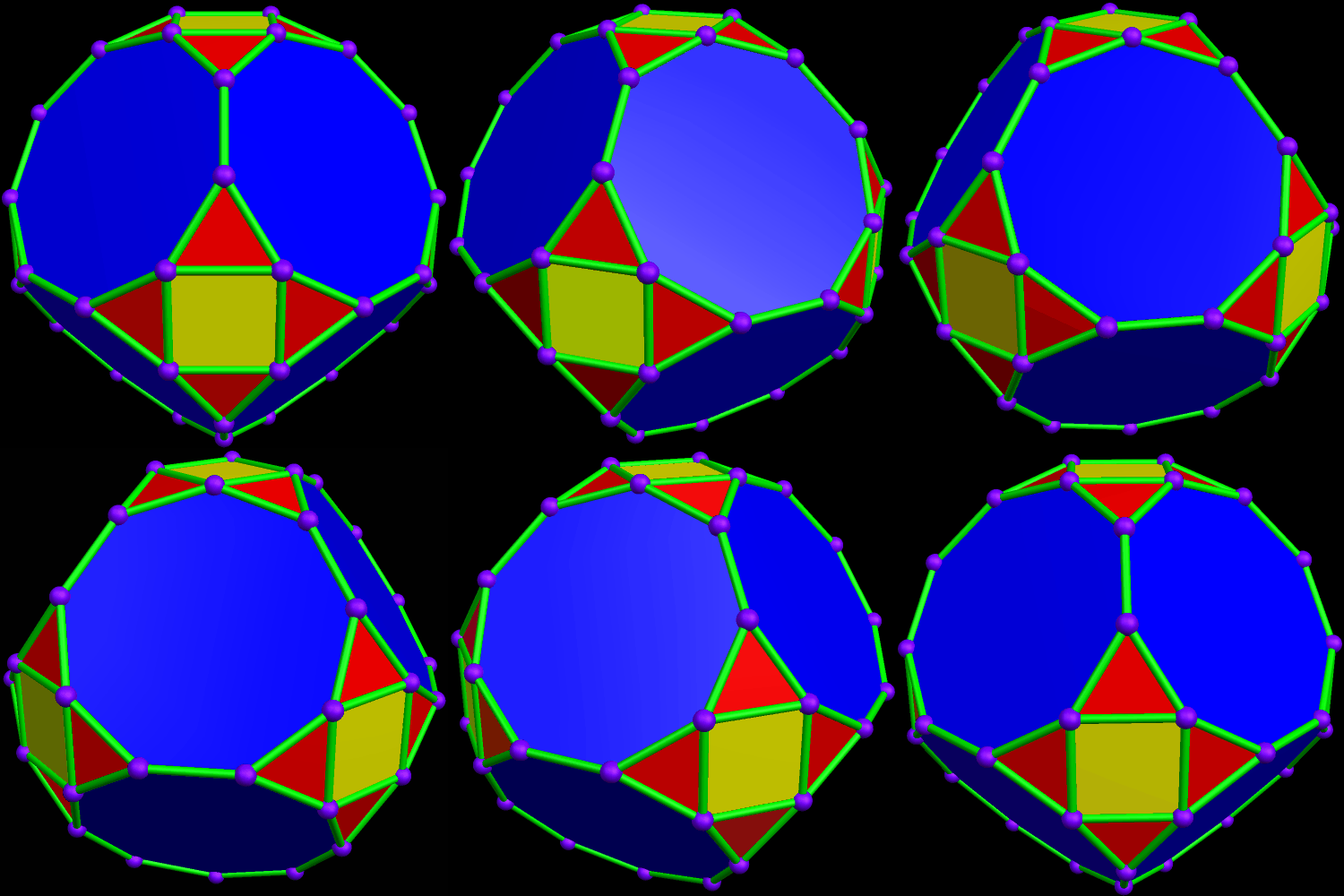
ennneagonal-faced near-miss

This is the dual of the above polyhedron:

ennneagonal-faced near-miss dual

As with all polyhedra and their duals, a compound can be made of these two polyhedra, and here it is:

ennneagonal-faced near-miss base=dual compound

Finding this polyhedron interesting, I proceeded to use Stella 4d (polyhedron-manipulation software, available at http://www.software3d.com/Stella.php) to make its convex hull.
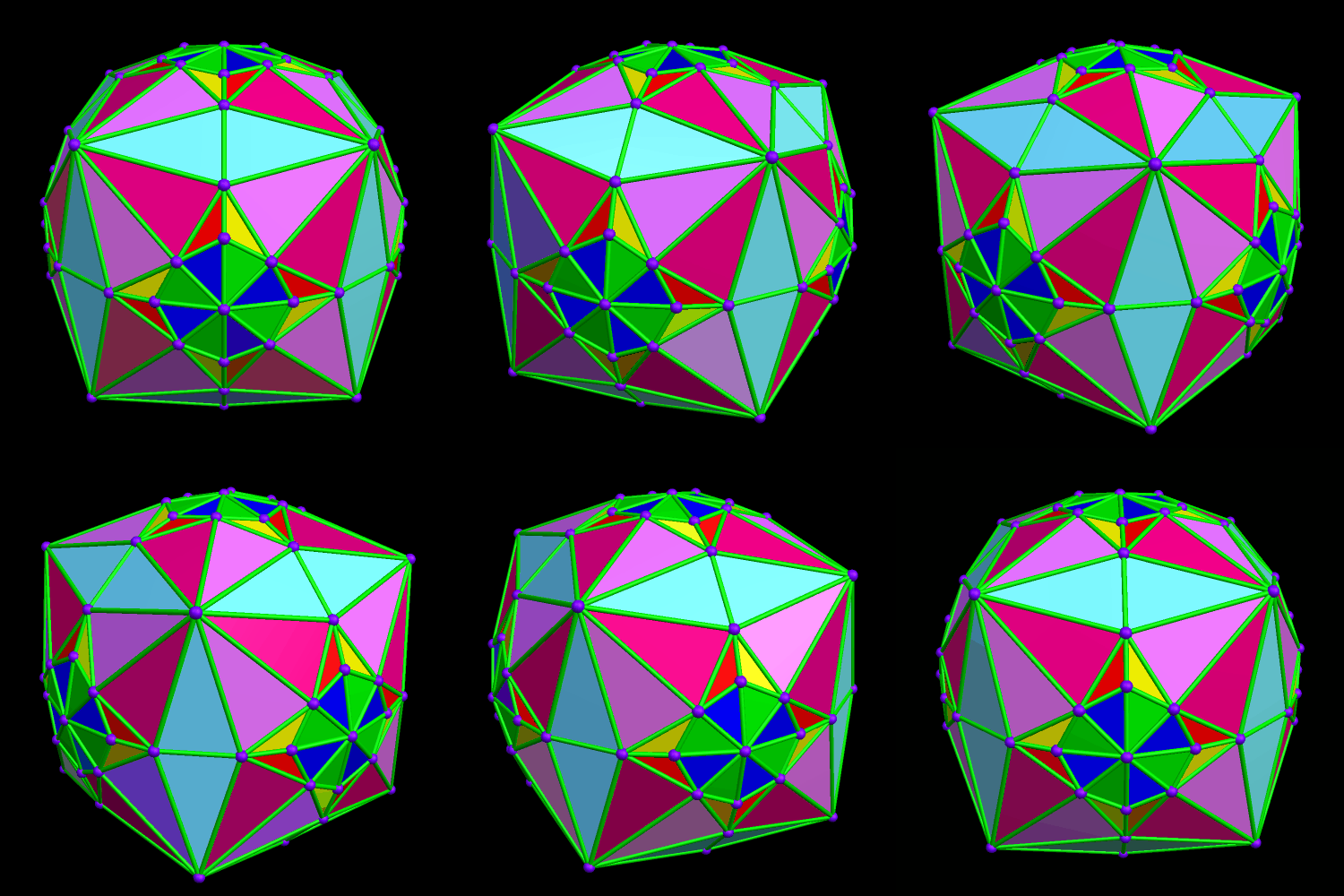
Convex hull of near-miss base-dual compound

Here, then, is the dual of this convex hull:
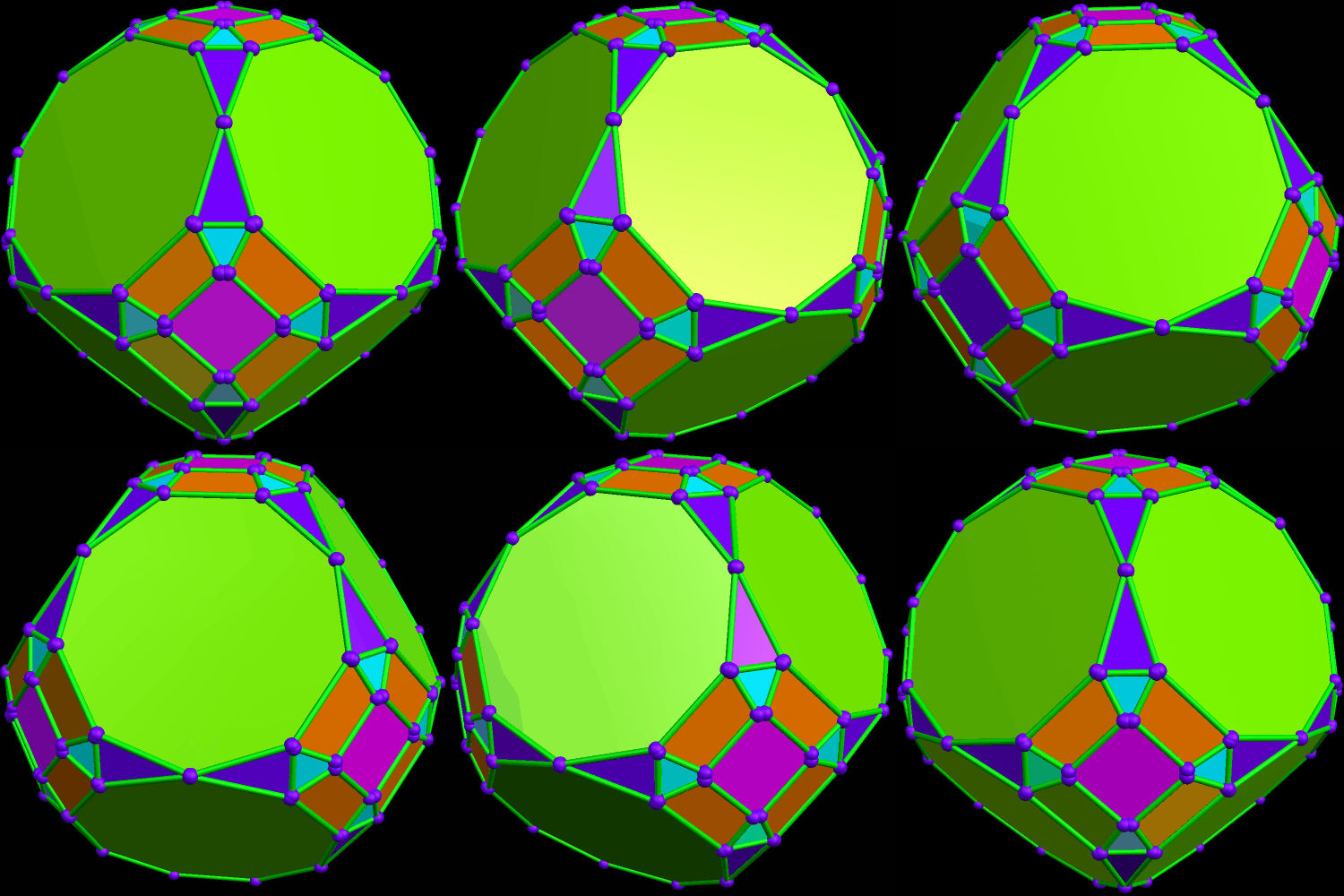
dual of Convex hull of near-miss base-dual compound

Stella 4d has a “try to make faces regular” function, and I next used it on the polyhedron immediately above. If this function cannot work, though — because making the faces regular is mathematically impossible — one sometimes gets completely unexpected, and interesting, results. Such was the case here.
attempt no make latest polyhedron have regular faces

Next, I found the dual of this latest polyhedron.
attempt no make latest polyhedron have regular faces's dual

The above polyhedron’s “wrinkled” appearance completely surprised me. The next thing I did to change it, once more, was to create this wrinkled polyhedron’s convex hull. A convex hull of a non-convex polyhedron is simply the smallest convex polyhedron which can contain the non-convex polyhedron, and this process often has interesting results.

Convex hull of wrinkled dual

Next, I created this latest polyhedron’s dual:
dual of Convex hull of wrinkled dual

I then attempted “try to make faces regular” again, and, once more, had unexpected and interesting results:
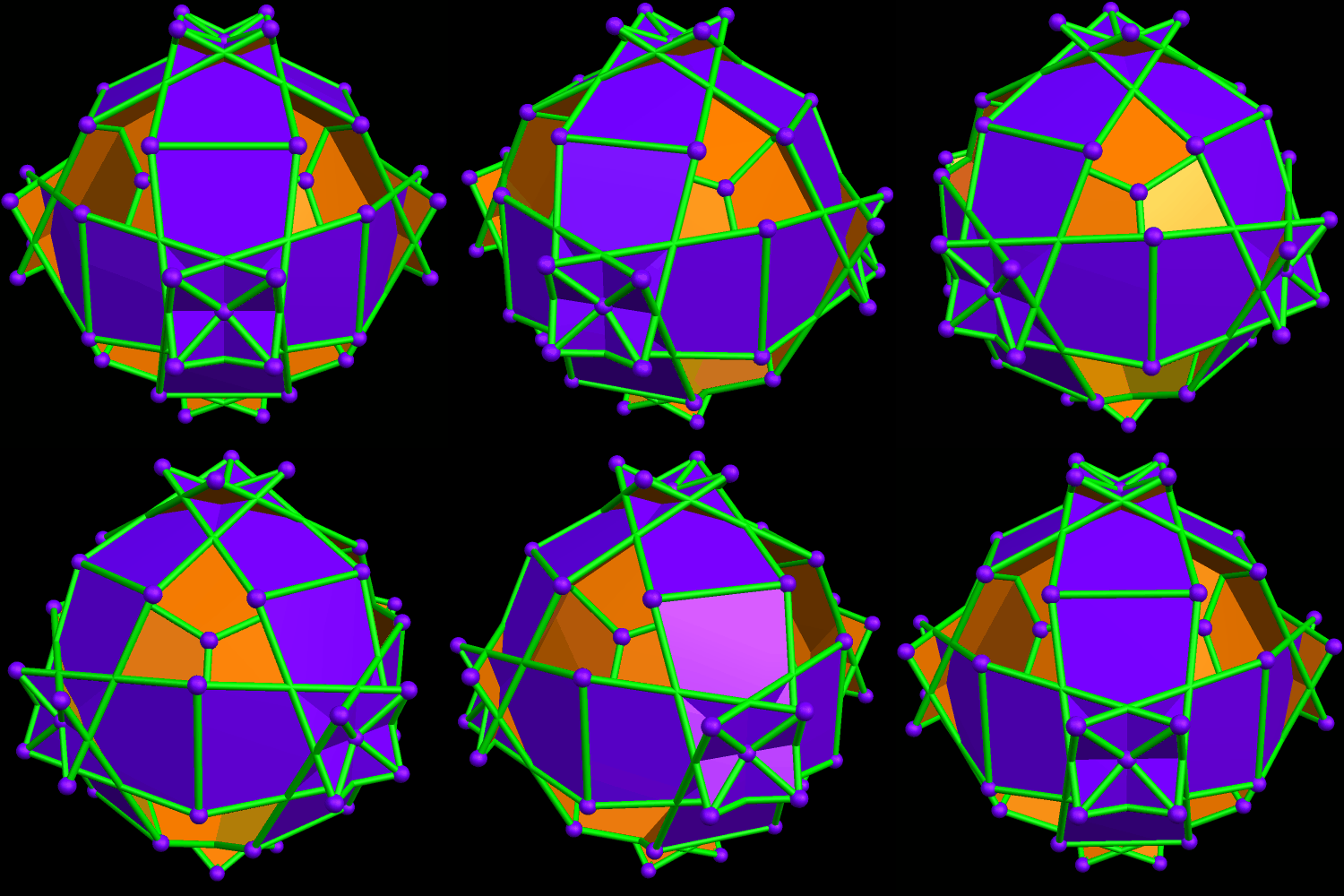
dual of latest polyhedron

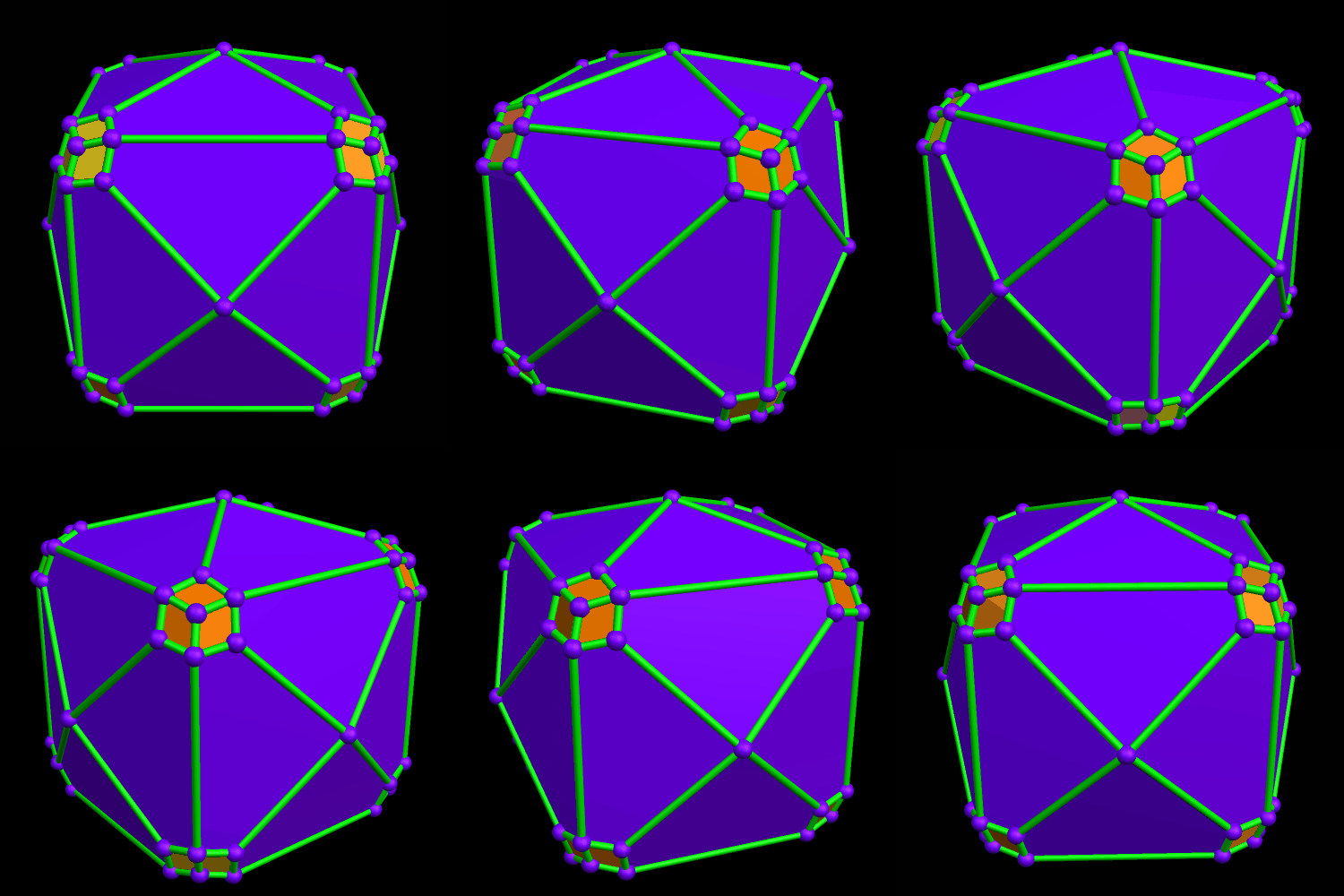
The next step was to take the convex hull of this latest polyhedron. In the result, below, all of the faces are kites — two sets of twenty-four each.

convex hull of last polyhedron with two sets of two dozen kites each

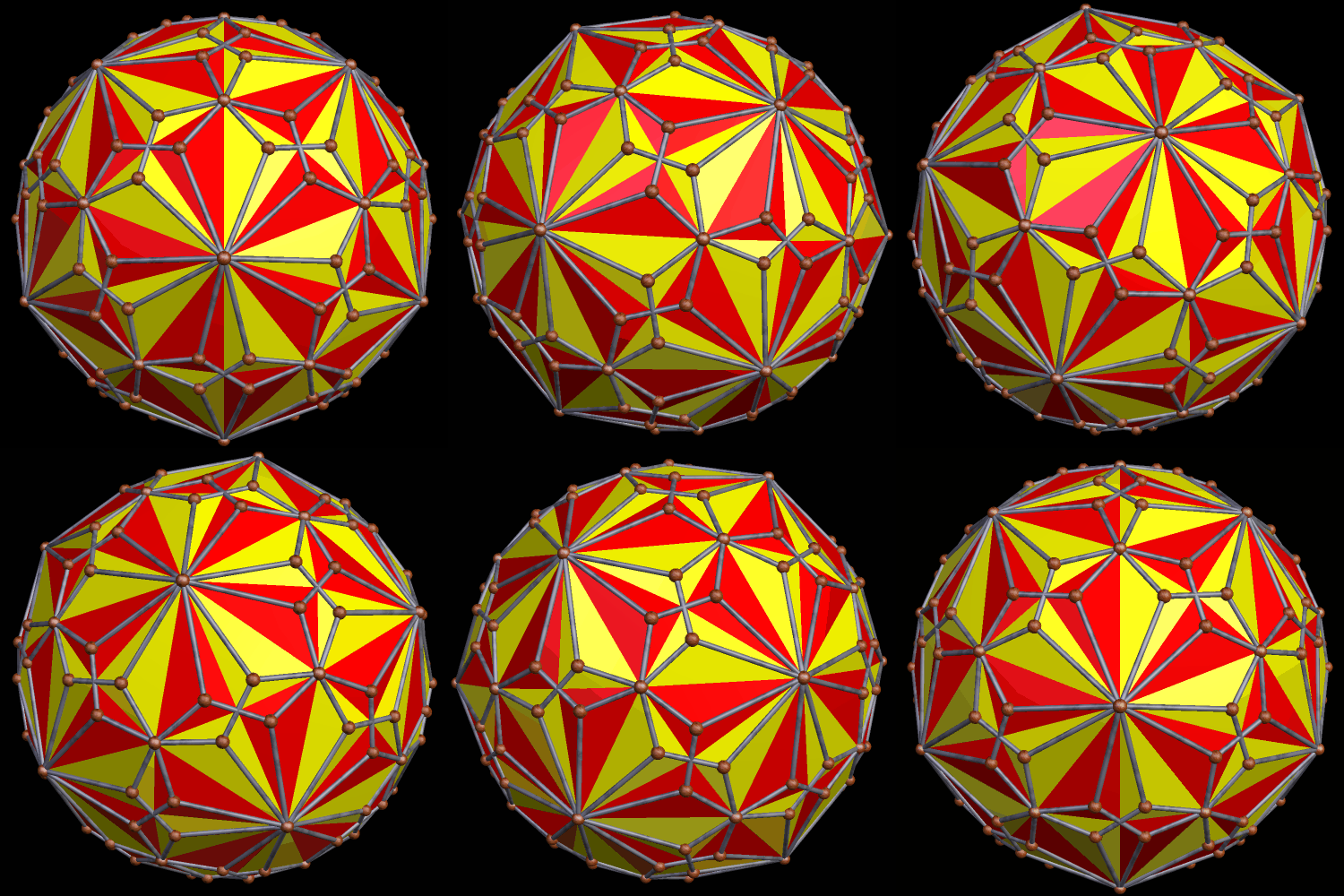
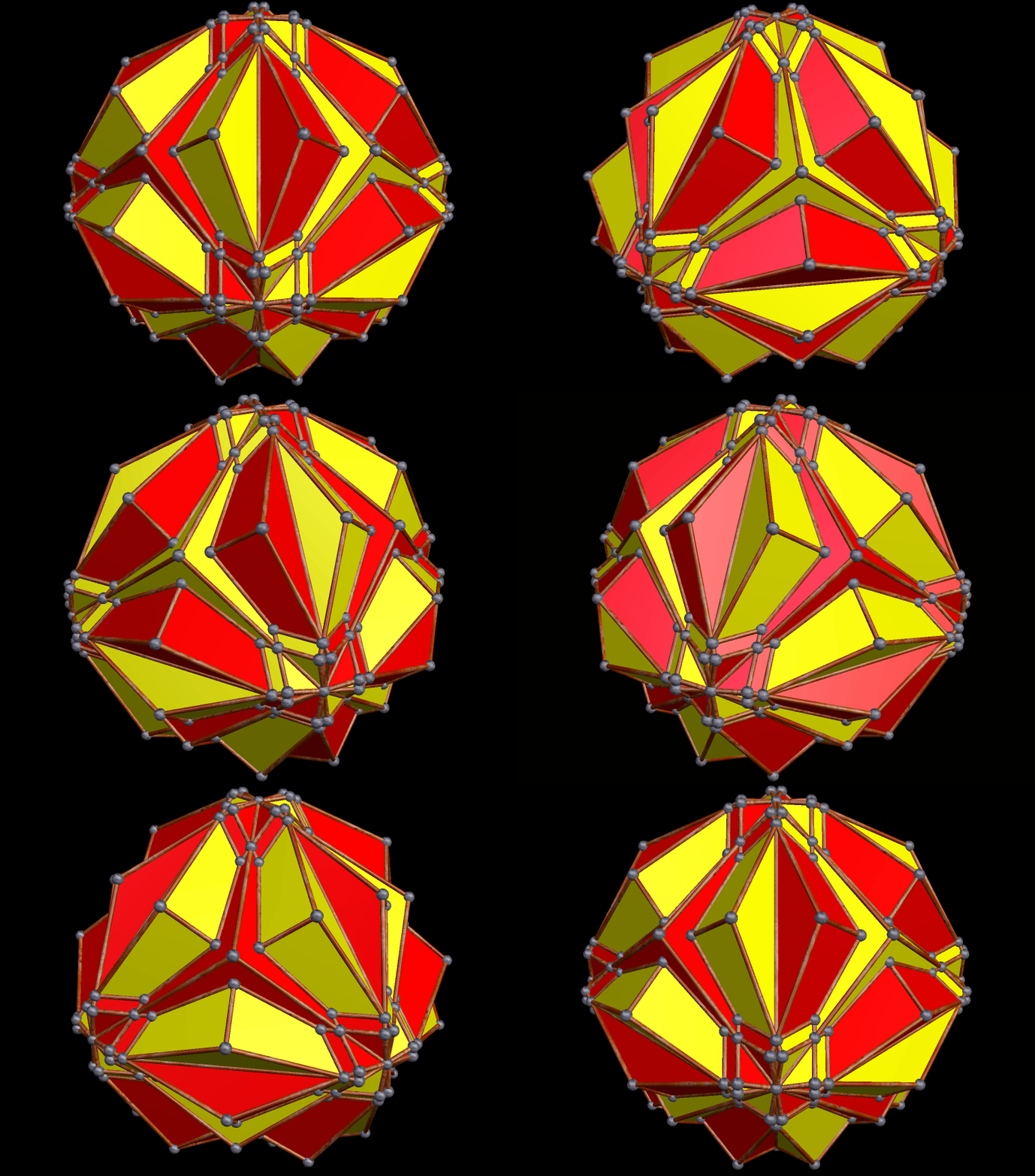
I next stellated this kite-faced polyhedron 33 times, looking for an interesting result, and found this:
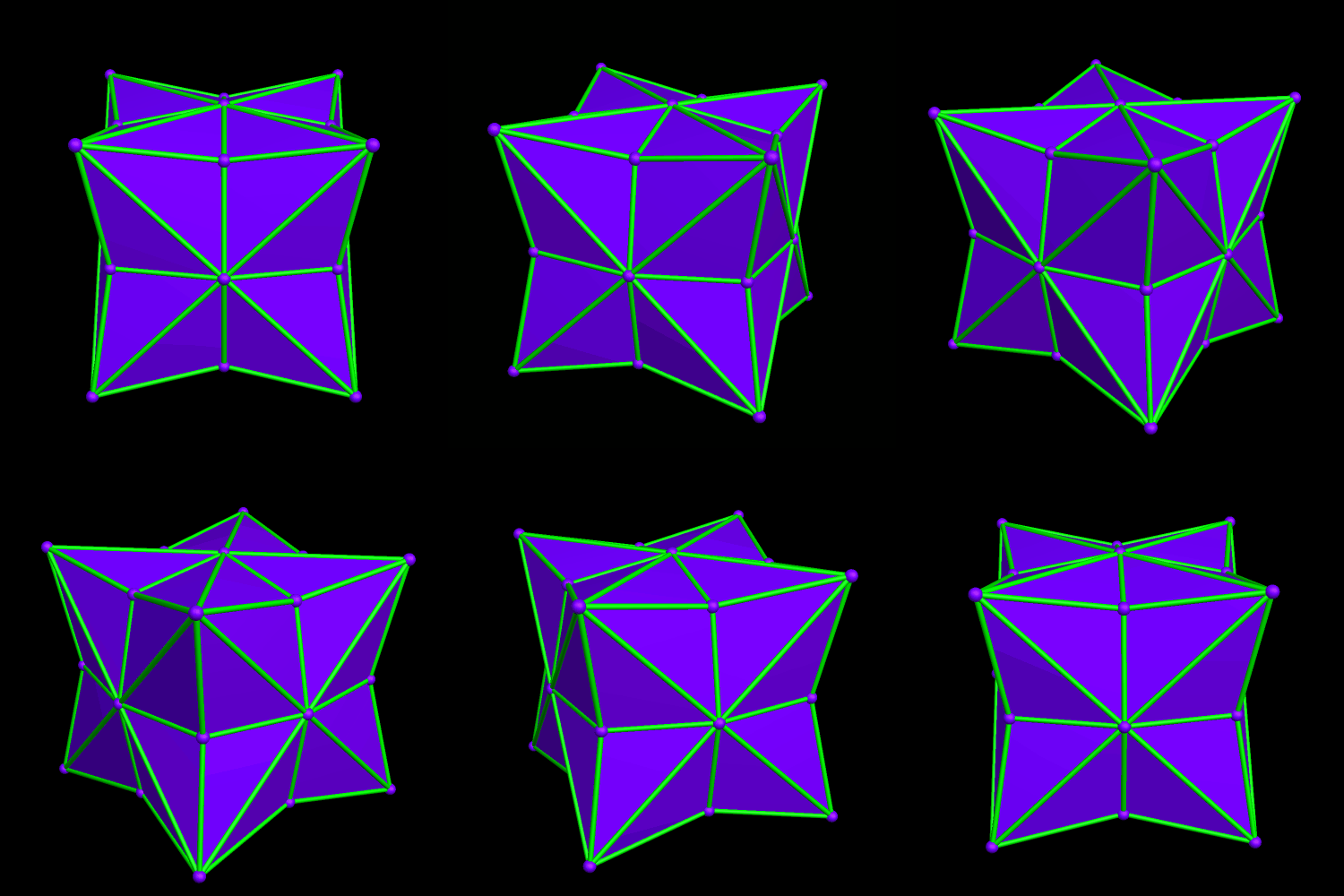
33rd stellation of latest polyhedron

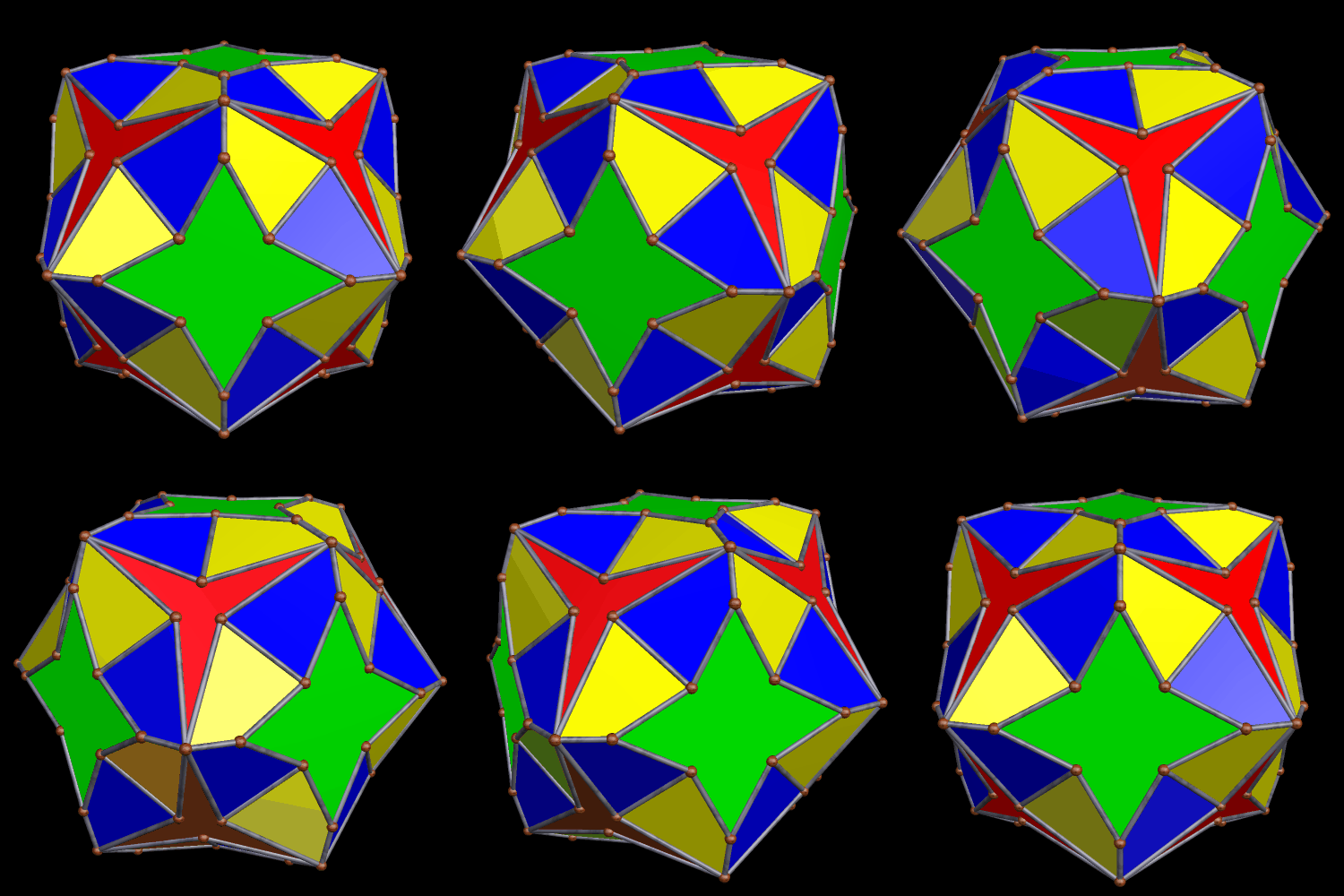
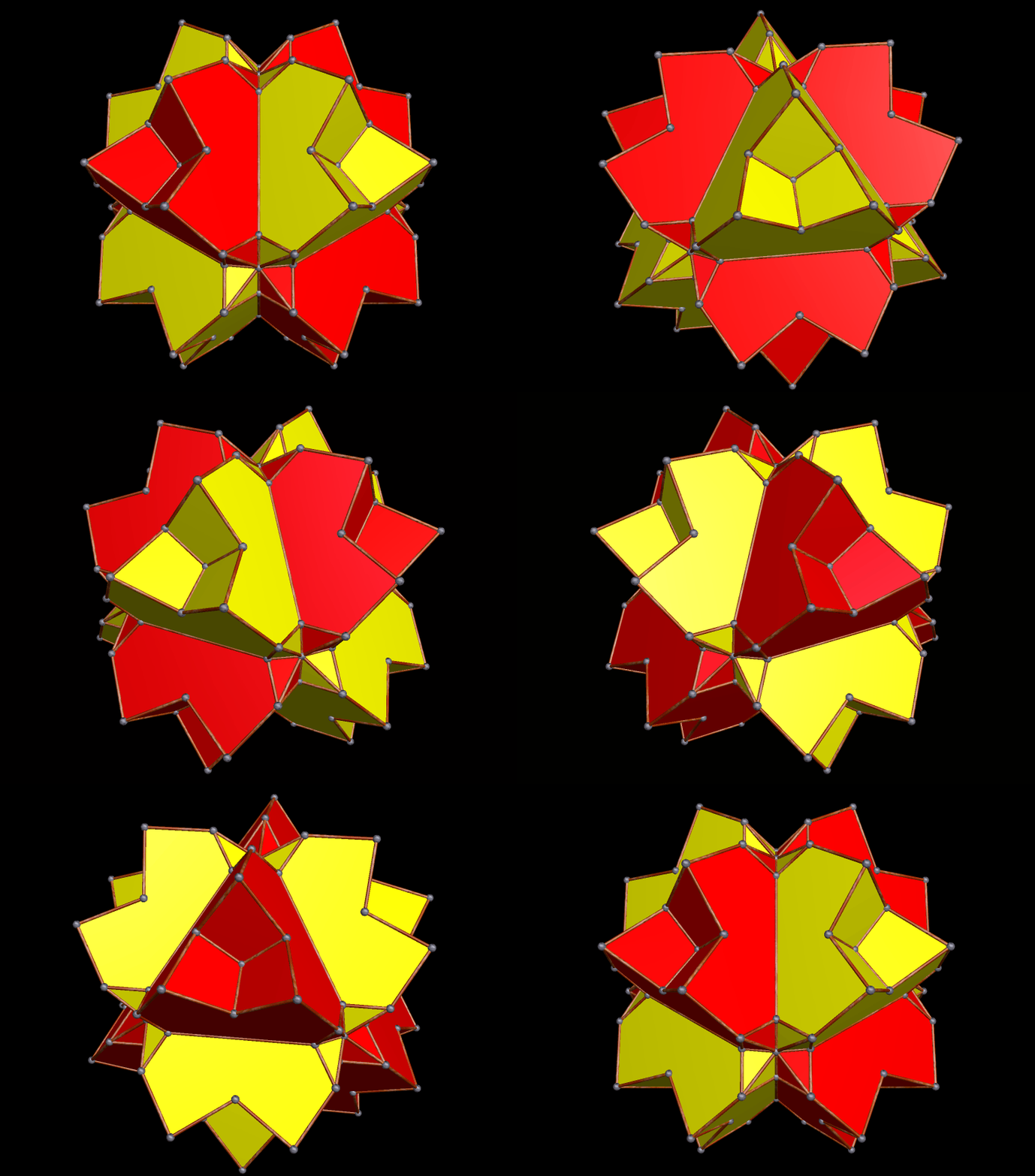
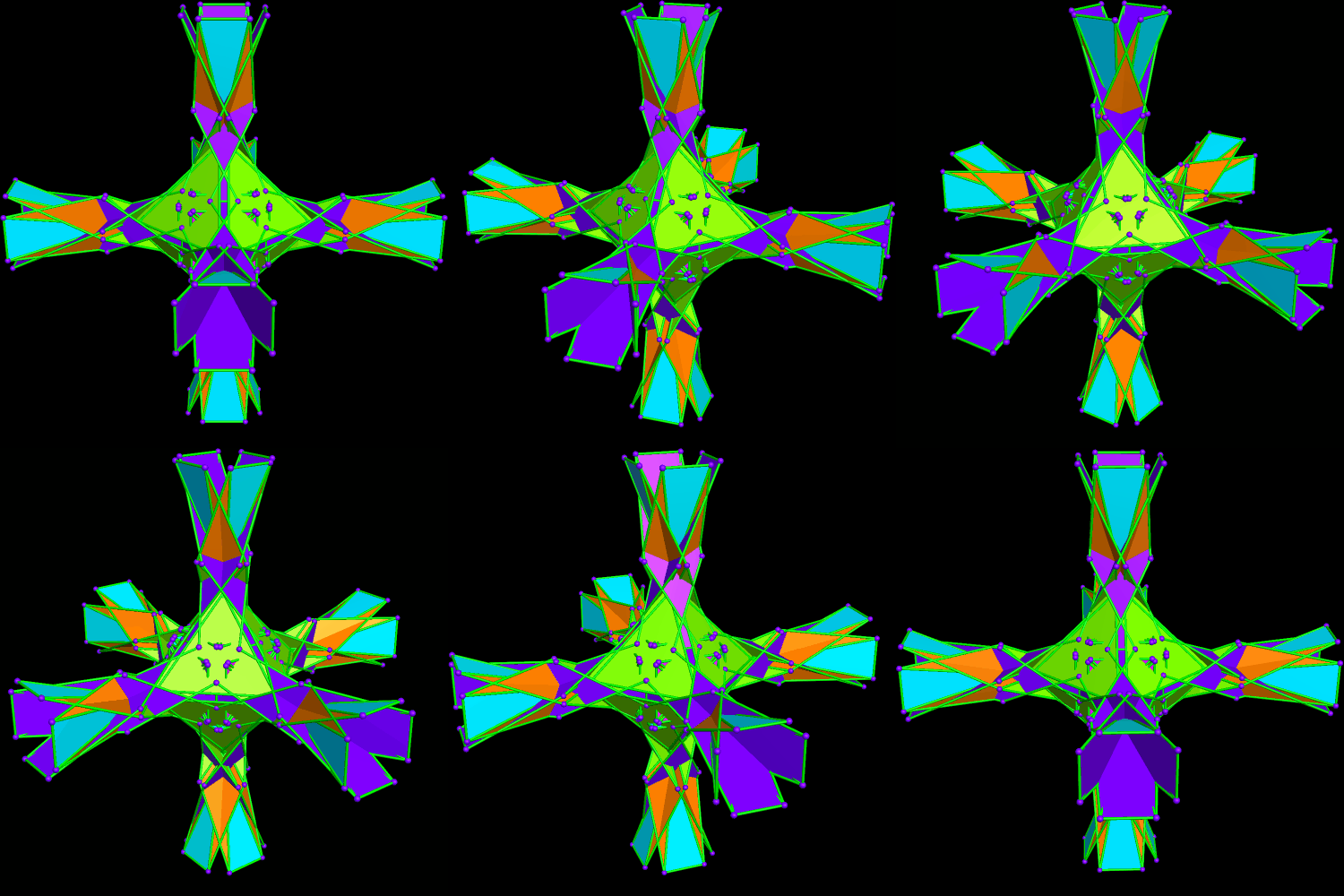
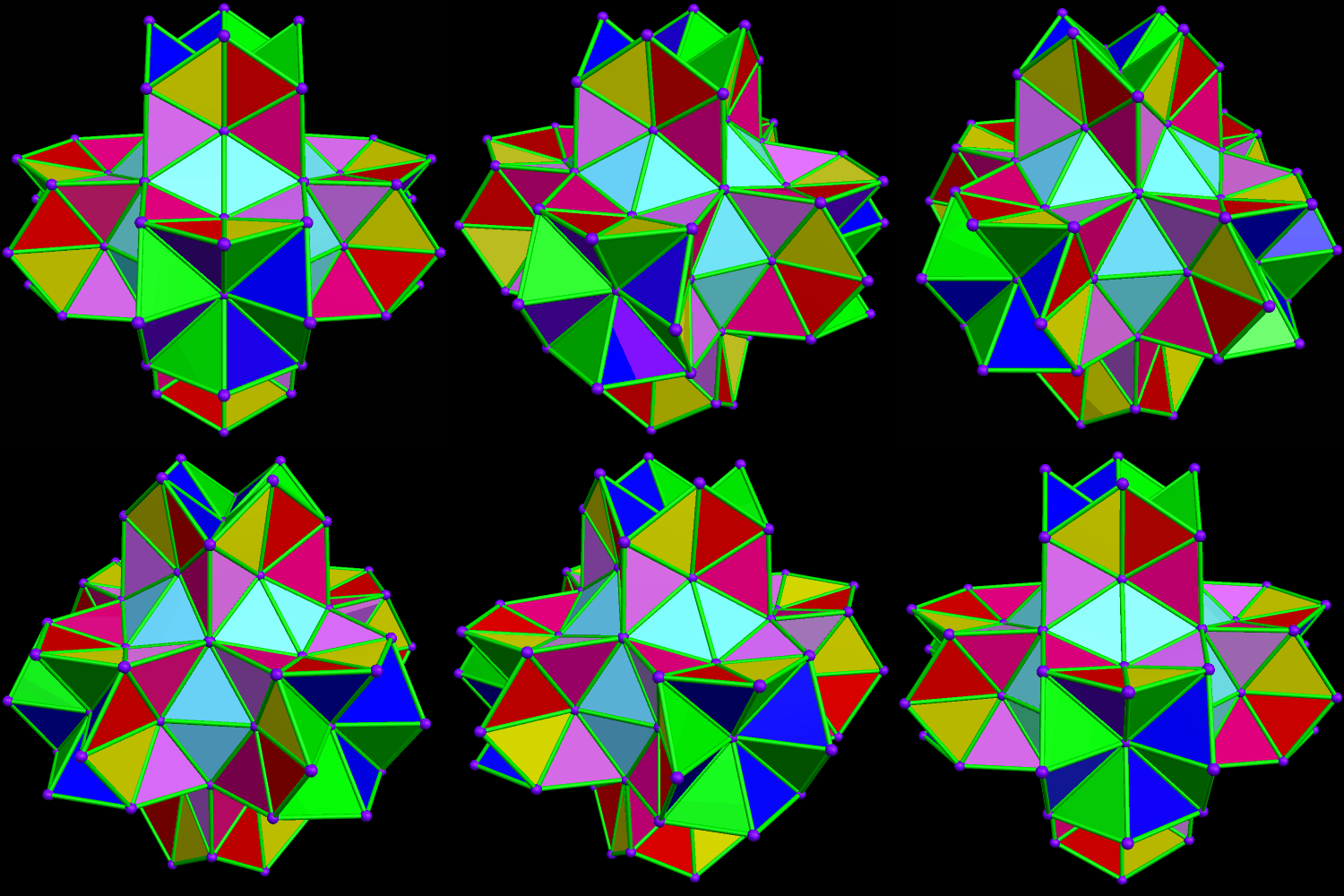
This looked like a compound to me, so I told Stella 4d to color it as a compound, if possible, and, sure enough, it worked.
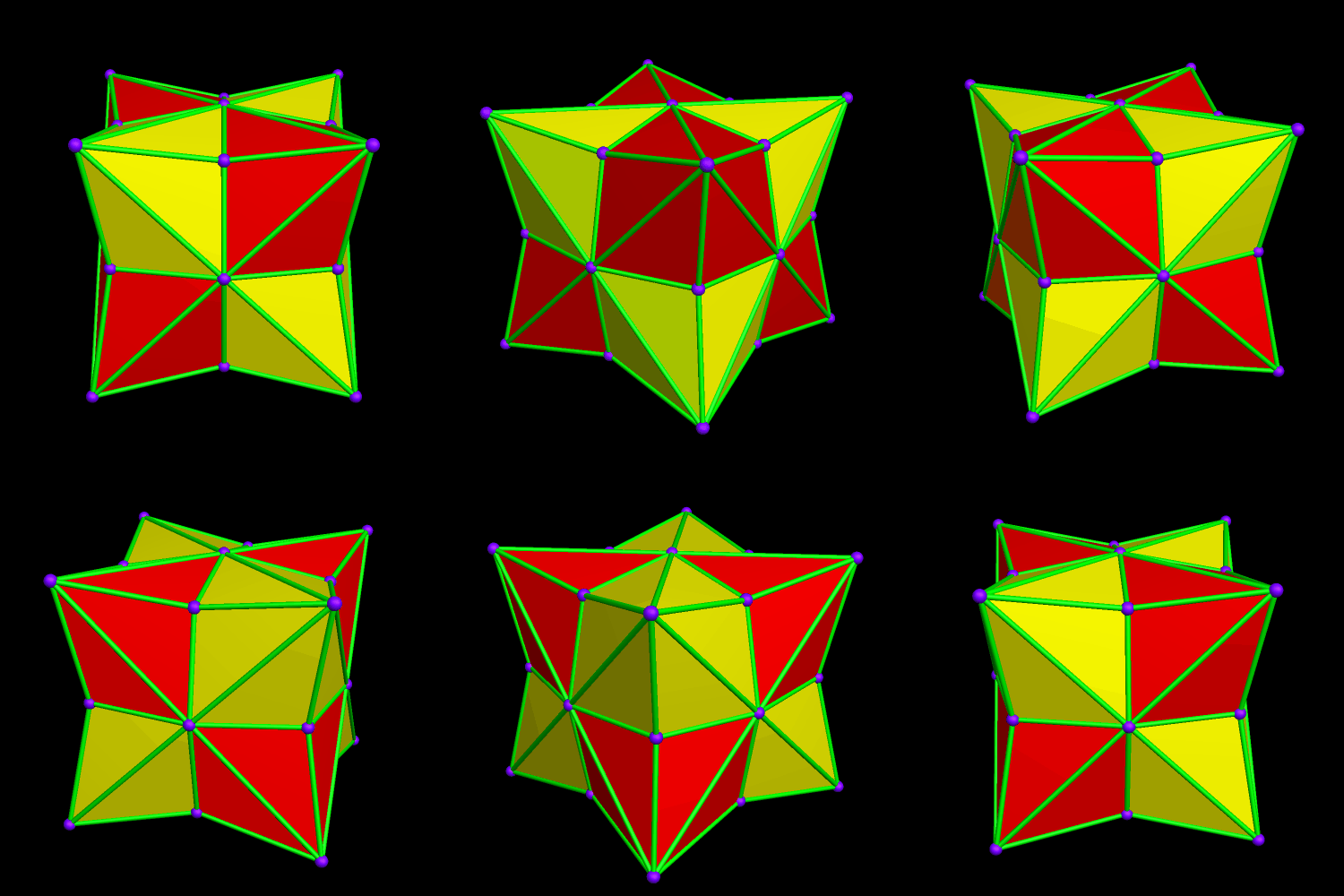
33rd stellation of latest polyhedron colored as a compound

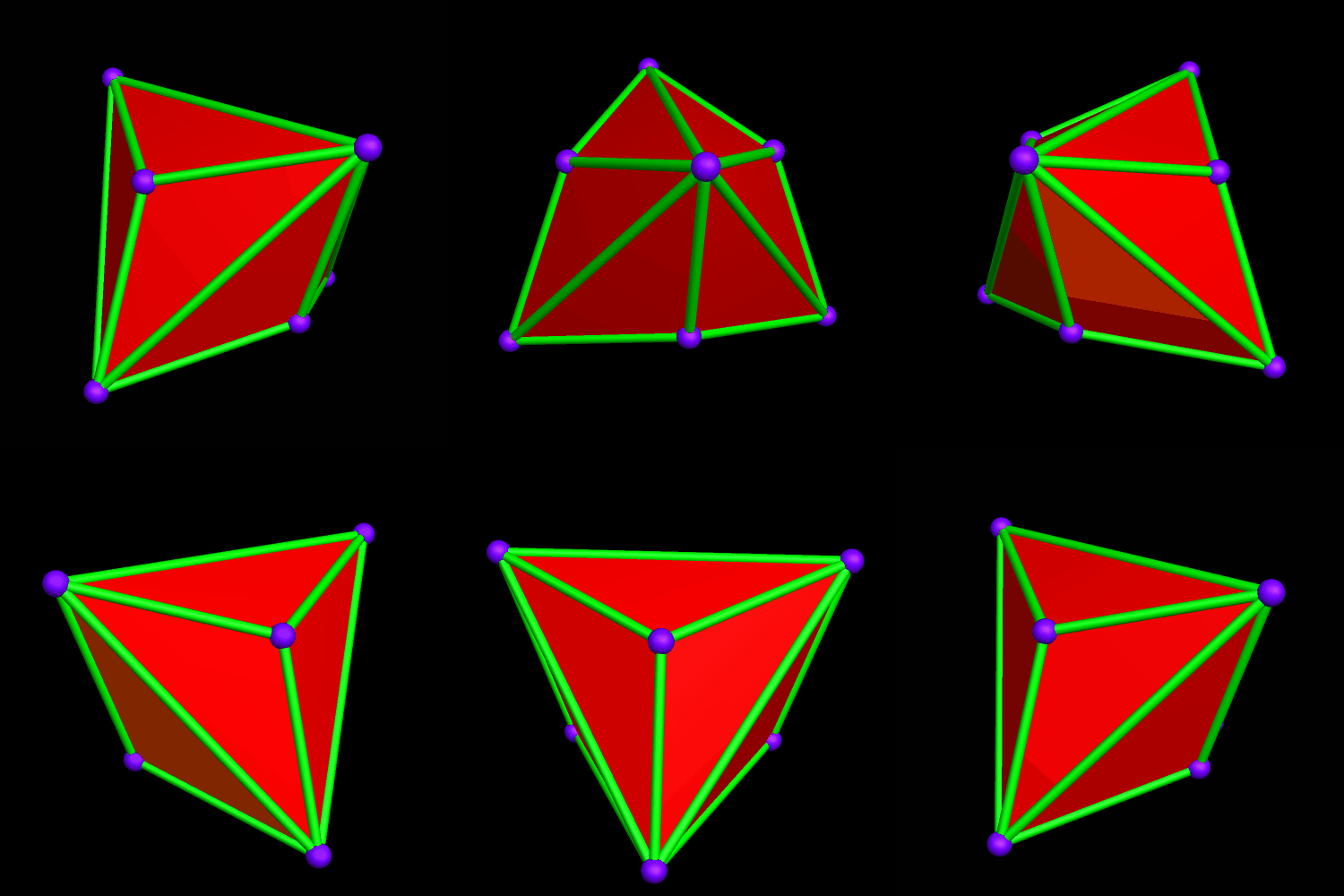
The components of this compound looked like triakis tetrahedra to me. The triakis tetrahedron, shown below, is the dual of the truncated tetrahedron. However, I checked the angle measurement of a face, and the components of the above compound-dual are only close, but not quite, to being the same as the true triakis tetrahedron, which is shown below.

Triakistetra -- ANGLES AREN'T QUITE A MATCH for last polyhedron

This seemed like a logical place to end my latest journey through the world of polyhedra, so I did.
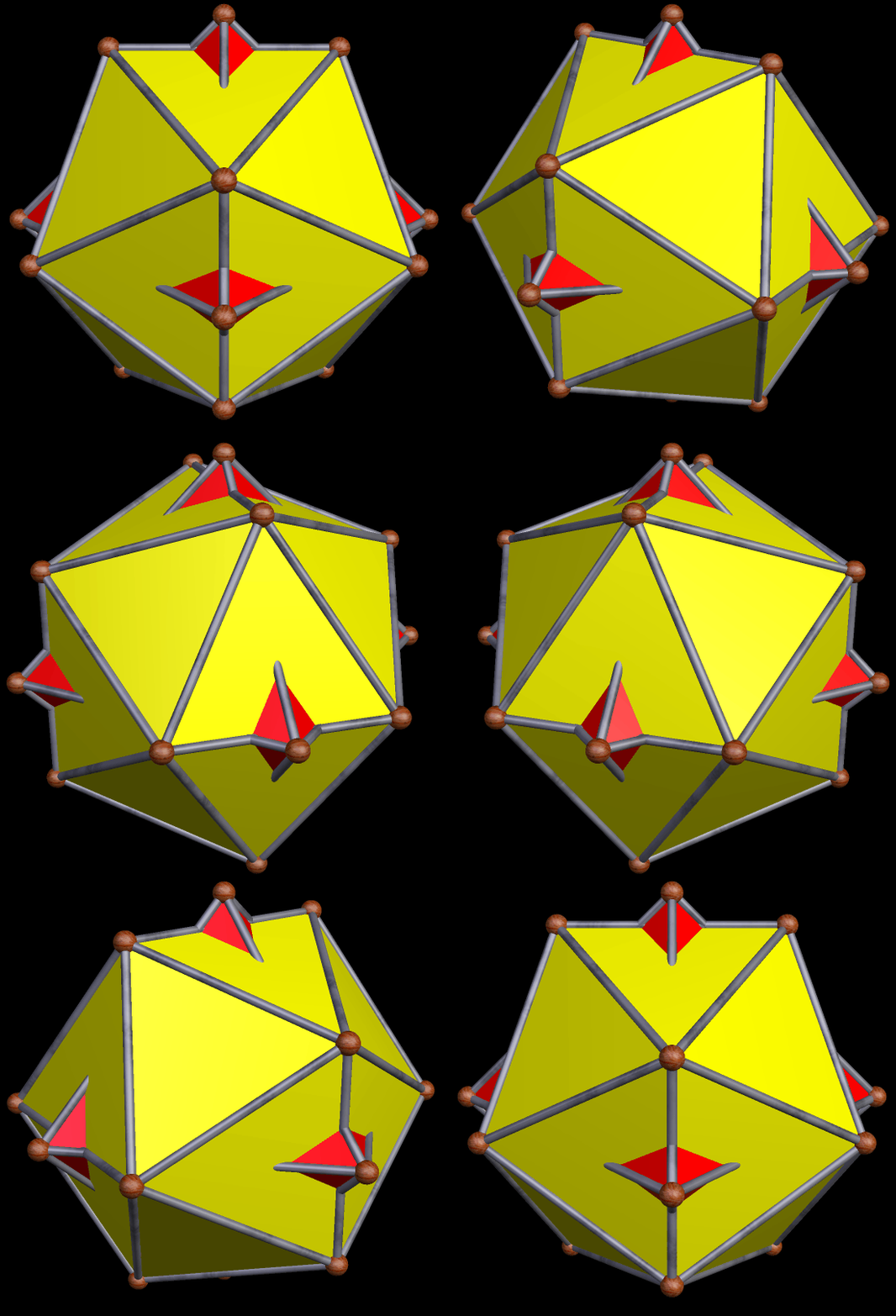

Some Variants of Kepler’s Stella Octangula

The Stella Octangula is also known as the compound of two tetrahedra, which works well because the tetrahedron is self-dual. All of these are also two-part compounds, with varying amounts of similarity to the Stella Octangula. The first one is also the 26th stellation of the triakis octahedron, one of the Catalan solids.

compound and 26th stellation of triakis octahedron

All of these were made using Stella 4d, which may be tried or purchased at http://www.software3d.com/Stella.php.

odd compound

SO var d

SO var sdd

SO variant