Have you noticed what silver’s been doing lately? The price of silver is literally on fire!

silver is literally on fire

Because of the price of silver being literally on fire, they will not be buying and selling troy ounces of metallic silver when the markets open in New York tomorrow morning. Instead, they will be selling “oxide ounces” of silver oxide, in sealed-plastic capsules of this black powder, with an oxide ounce of silver oxide being defined as that amount of silver oxide which contains one troy ounce of silver.

silver oxide capsule

A troy ounce of silver is 31.1 grams of that element, which has a molar mass of 107.868 g/mole. Therefore, a troy ounce of silver contains (31.1 g)(1 mol/107.868 g) = 0.288 moles of silver. An oxide ounce of silver oxide would also contain oxygen, of course, and the formula on the front side of a silver oxide capsule (shown above; information on the back of the capsule gives the number of oxide ounces, which can vary from one capsule to another) is all that is needed to know that the number of moles of oxygen atoms (not molecules) is half the number of moles of silver, or (0.288 mol)/2 = 0.144 moles of oxygen atoms. Oxygen’s non-molecular molar mass is 15.9994 g, so this is (0.144 mol)(15.9994 g/mol) = 2.30 g of oxygen. Add that to the 31.1 g of silver in an oxide ounce of silver oxide, and you have 31.1 g + 2.30 g = 33.4 grams of silver oxide in an oxide ounce of that compound.

In practice, however, silver oxide (a black powder) is much less human-friendly than metallic silver bars, coins, or rounds. As you can easily verify for yourself using Google, silver oxide powder can, and has, caused health problems in humans, especially when inhaled. This is the reason for encapsulation in plastic, and the plastic, for health reasons, must be far more substantial than a mere plastic bag. For encapsulated silver oxide, the new industry standard will be to use exactly 6.6 g of hard plastic per oxide ounce of silver oxide, and this standard will be maintained when they begin manufacturing bars, rounds, and coins of silver oxide powder enclosed in hard plastic. This has created a new unit of measure — the “encapsulated ounce” — which is the total mass of one oxide ounce of silver oxide, plus the hard plastic surrounding it on all sides, for a total of 33.4 g + 6.6 g = 40.0 grams, which will certainly be a convenient number to use, compared to its predecessor-units.  

# # #

[This is not from The Onion. We promise. It is, rather, a production of the Committee to Give Up on Getting People to Ever Understand the Meaning of the Word “Literally,” or CGUGPEUMWL, which is fun to try to pronounce.]


An Illusion of Spin

an_illusion_of_spin.gif

I used three things to make this: Geometer’s Sketchpad (to make one black and white version; the whole thing is made of semicircles), MS-Paint (to color the six different versions which appear here), and the website http://www.makeagif.com (to assemble the six separate still images into one .gif file, with the illusion of motion). The surprising thing to me was how fast the process was, once I had the idea of my goal for a finished product.

A Radial Tessellation, on the Topic of the Difficulty in Tessellating with Regular Pentagons

Image

pentagon tessellation

A Tetrahedral Exploration of the Icosahedron

Mathematicians have discovered more than one set of rules for polyhedral stellation. The software I use for rapidly manipulating polyhedra (Stella 4d, available here, including as a free trial download) lets the user choose between different sets of stellation criteria, but I generally favor what are called the “fully supported” stellation rules.

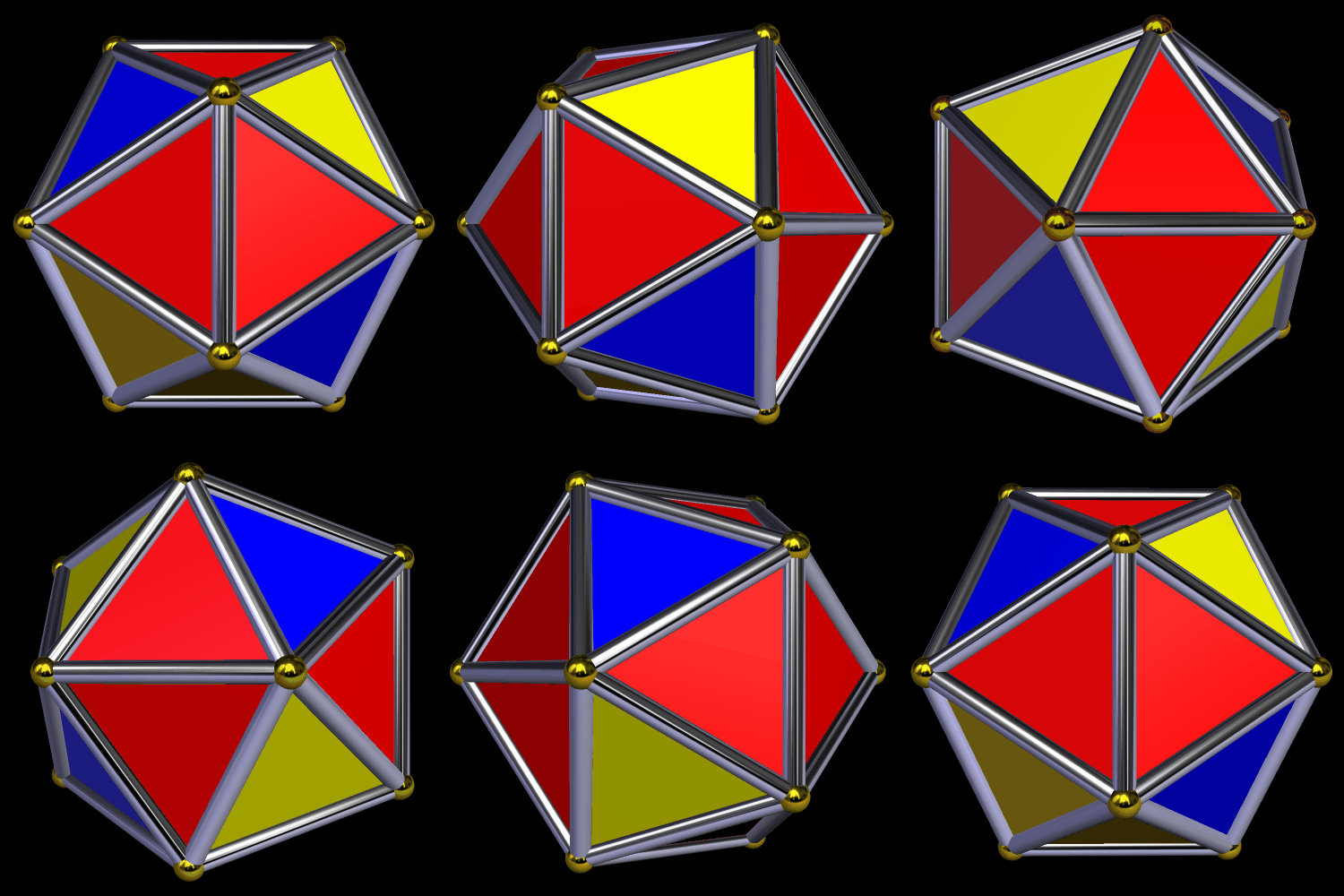
For this exercise, I still used the fully supported stellation rules, but set Stella to view these polyhedra as having only tetrahedral symmetry, rather than icosidodecahedral (or “icosahedral”) symmetry. For the icosahedron, this tetrahedral symmetry can be seen in this coloring-pattern.

Icosa showing tet symm

The next image shows what the icosahedron looks like after a single stellation, when performed through the “lens” of tetrahedral symmetry. This stellation extends the red triangles as kites, and hides the yellow triangles from view in the process.

Icosa showing tet symm stellation 1

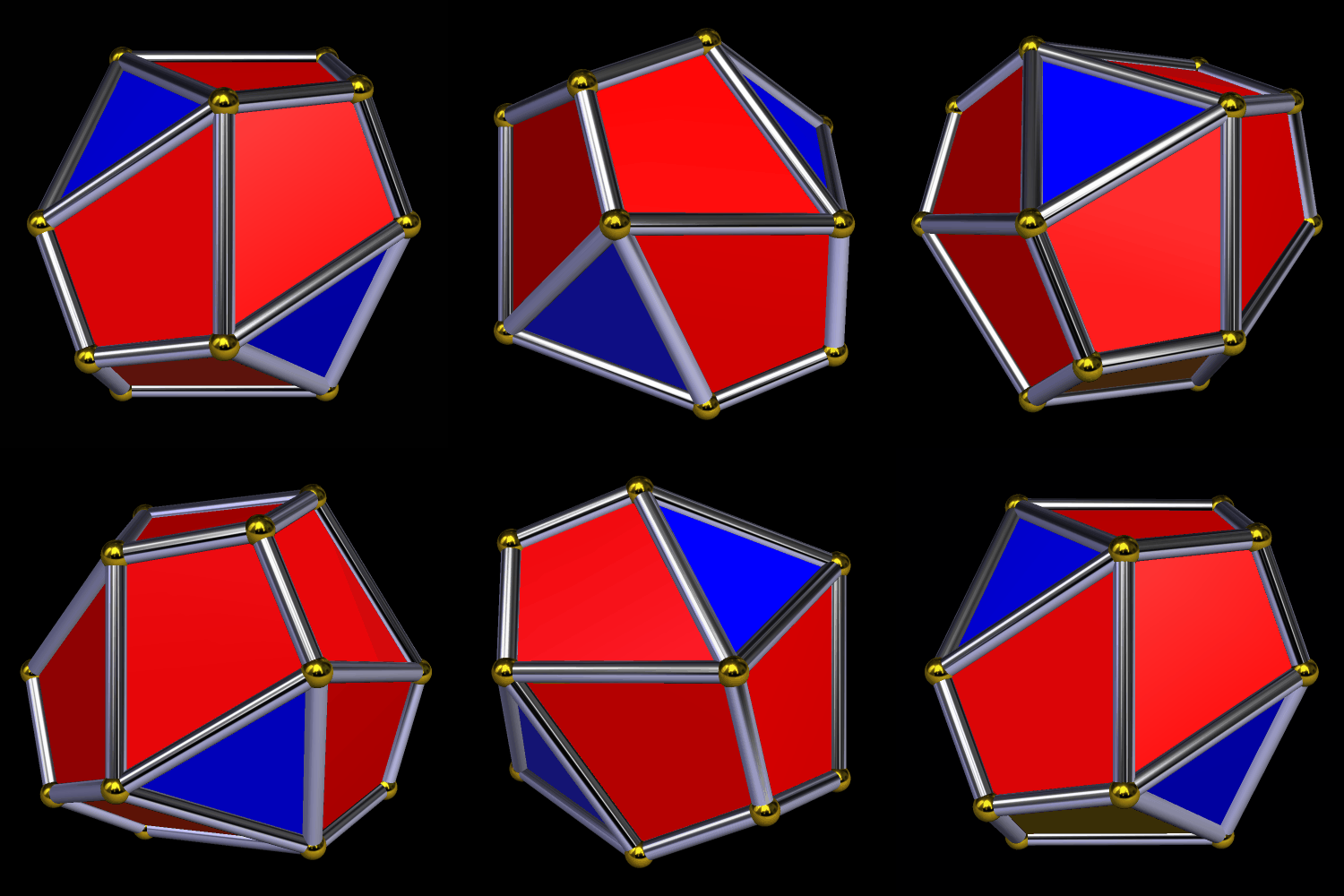
The second such stellation produces this polyhedron — a pyritohedral dodecahedron — by further-extending the red faces, and obscuring the blue triangles in the process.

Icosa showing tet symm stellation 2 pyritohedral dodecahedron

The third tetrahedral stellation of the icosahedron produces another pyritohedral figure, which further demonstrates that pyritohedral symmetry is related to both icosidodecahedral and tetrahedral symmetry.

Icosa showing tet symm stellation 3

The fourth such stellation produces a Platonic octahedron, but one where the coloring-scheme makes it plain that Stella is still viewing this figure as having tetrahedral symmetry. Given that the octahedron itself has cuboctahedral (or “octahedral”) symmetry, this is an increase in the number of polyhedral symmetry-types which have appeared, so far, in this brief survey.

Icosa showing tet symm stellation 4 an octahedron with 2 face types

Next, I looked at the fifth tetrahedral stellation of the icosahedron, and was surprised at what I found.

Icosa showing tet symm stellation 5

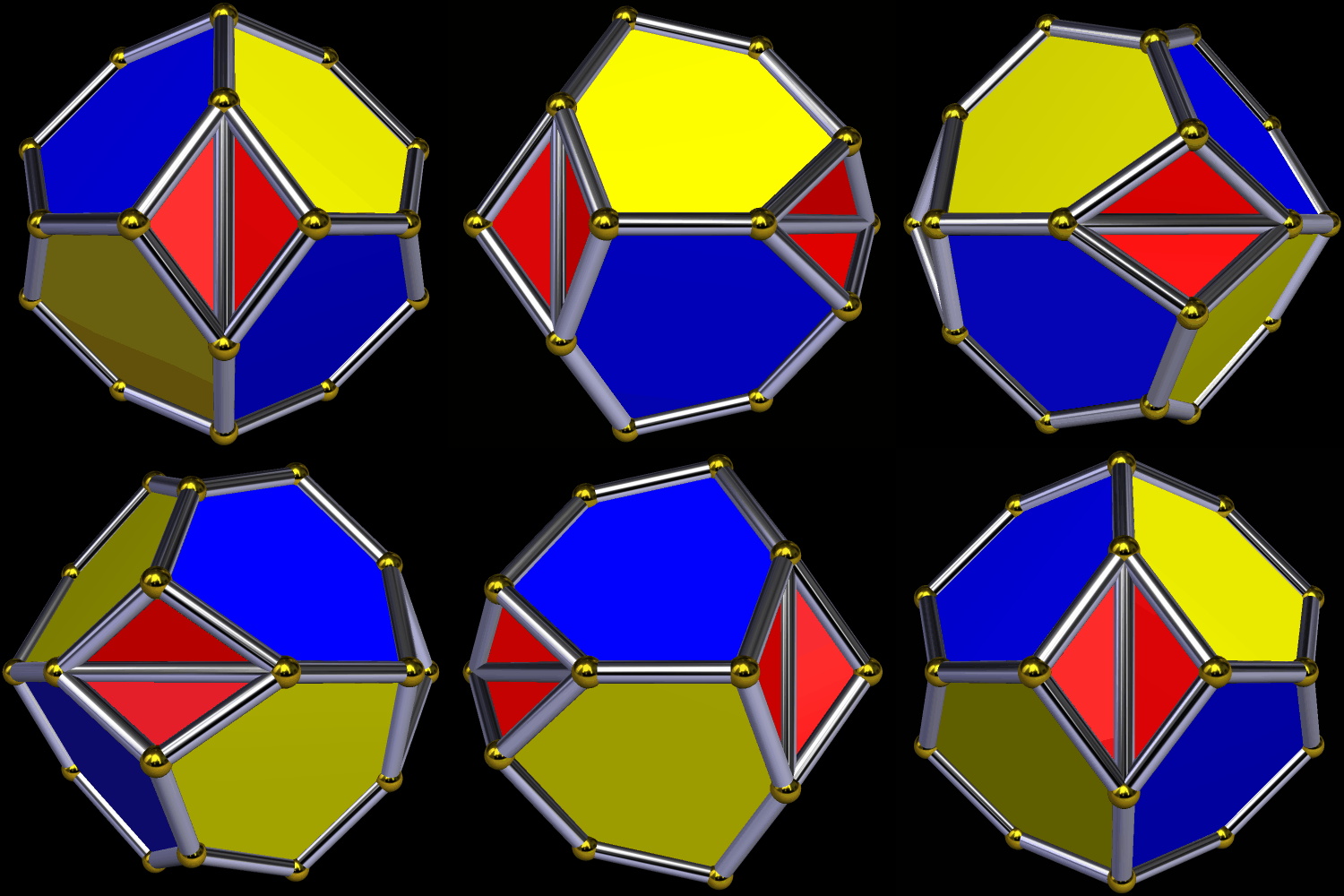
While I was curious about what would happen if I continued stellating this polyhedron, I also wanted to see this fifth stellation’s convex hull, since I could already tell it would have only hexagons and triangles as faces. Here is that convex hull:

Icosa tet sym stellation 5's Convex hull

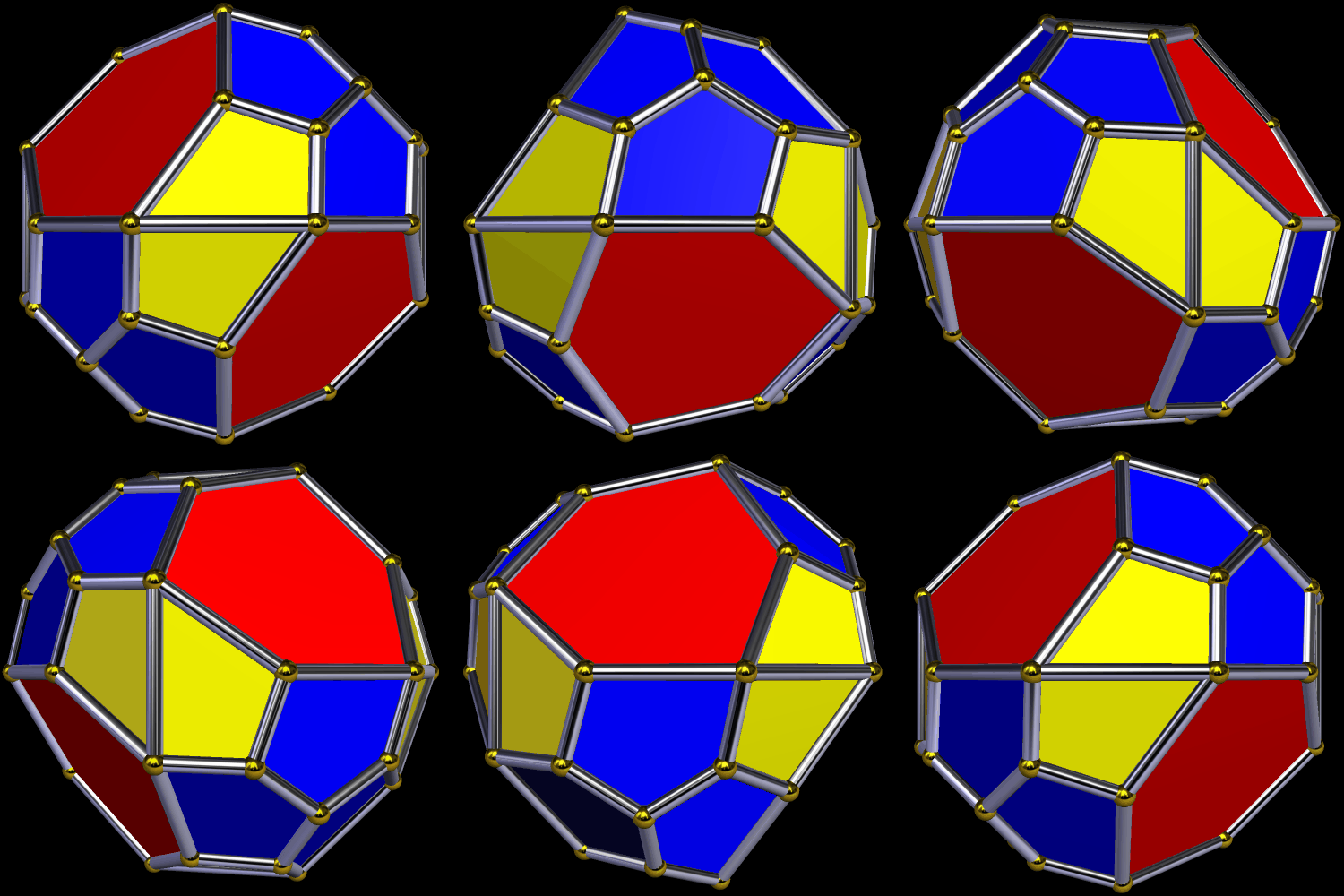
For the last step in this survey, I performed one more tetrahedral stellation, this time on the convex hull I had just produced.

Icosa tet sym stellation 5's Convex hull ist stellation

Variations of the Snub Dodecahedron

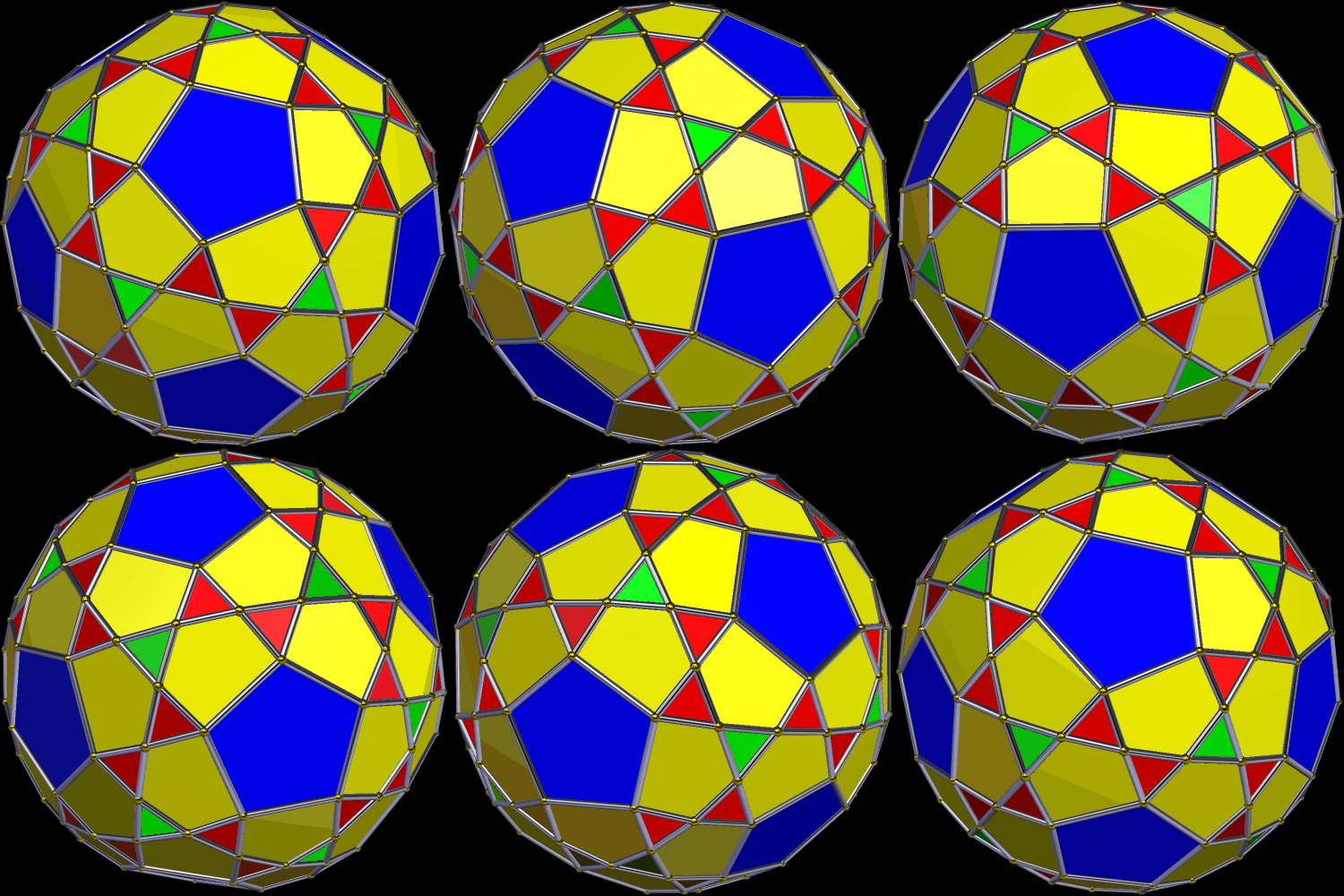
Convex hull of a triangle-expansion of the snub dodecahedron

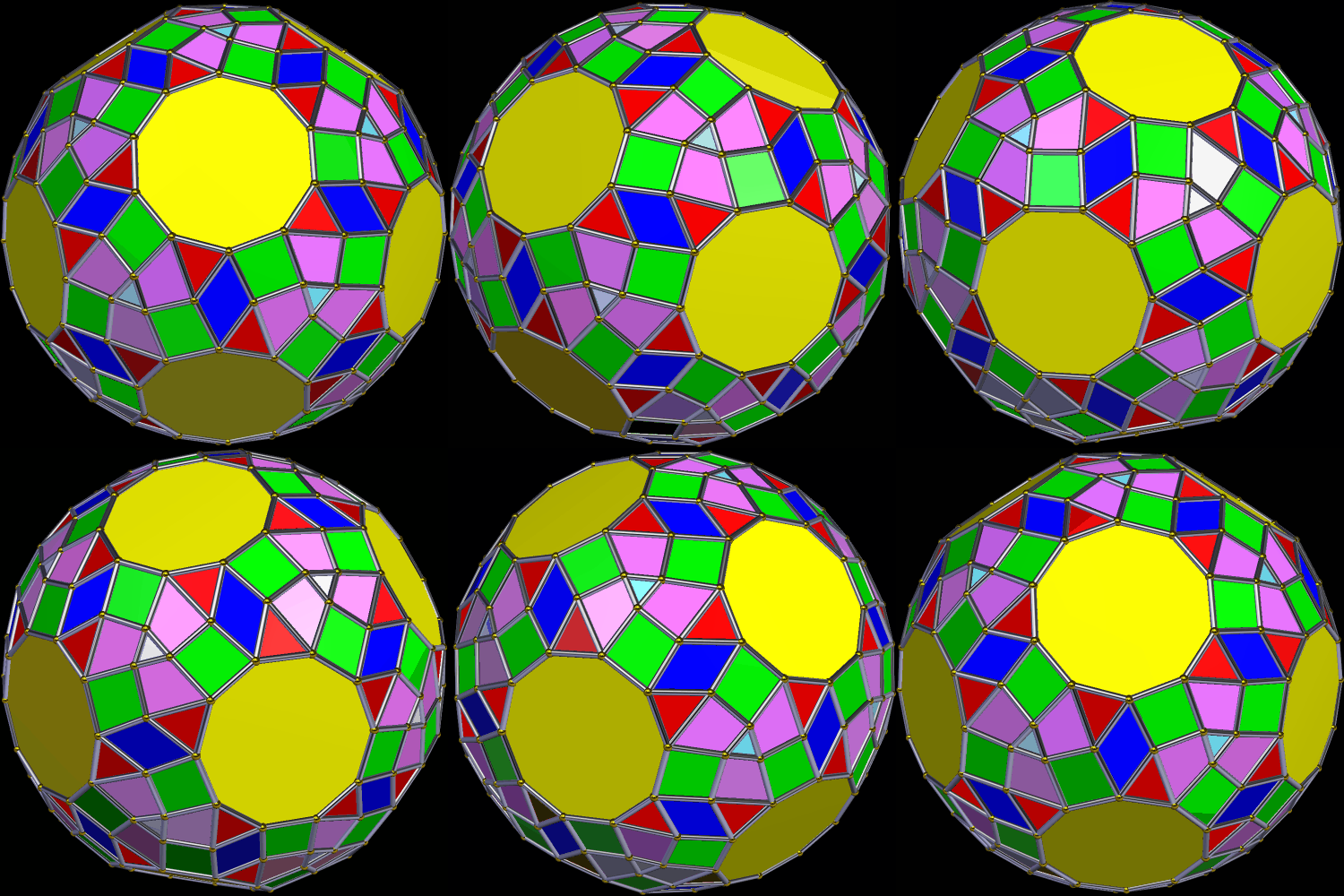
To make the first of these variations, above, I augmented each triangular face of a snub dodecahedron with an antiprism 2.618 times as tall as the triangles’ edge length, and then took the convex hull of the result. The other polyhedra shown, below, were obtained by various other manipulations of the snub dodecahedron, all performed using a program called Stella 4d: Polyhedron Navigator, which you can try right here.

expanded snub truncated dodecahedron

The variant above looked like it needed a name, so I called it an expanded snub truncated dodecahedron. As for the one below, it is one of many facetings of the snub dodecahedron.

Faceted snub dodecahedron

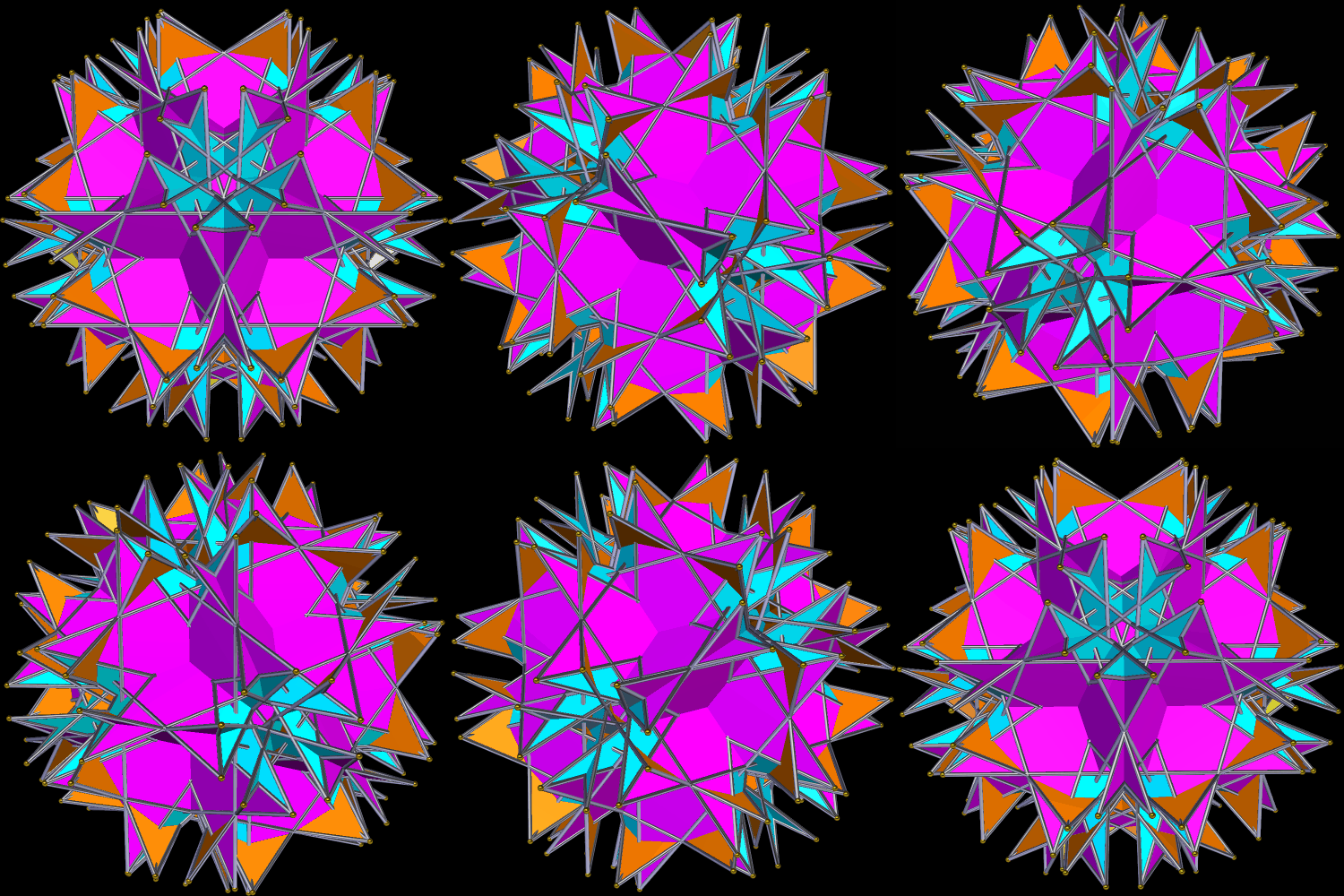
Finally, the last figure shown (stumbled upon during a “random walk” with Stella) is one of many possible figures which are non-convex relatives of the snub dodecahedron.

nco thing

Fractiles’ Mandala, Based on Angles of Pi/7 Radians

fractiles7withblackbackground

Although this was based on something I constructed using the Fractiles-7 magnetic tiling toy, I did not have enough magnetic pieces to finish this. The idea was, therefore, converted into a (non-Euclidean) construction using Geometer’s Sketchpad, and then refined using MS-Paint. The reason I describe this as a non-Euclidean construction is that an angle of pi/7 radians, such as the acute angles in the red rhombi, cannot be constructed using compass and unmarked straight edge: antiquity’s Euclidean tools. The other angles used are whole-number multiples of pi/7 radians, up to and including 6pi/7 radians for the obtuse angles of the red rhombi.

The yellow rhombi have angles measuring 2pi/7 and 5pi/7 radians, while the blue rhombi’s angles measures 3pi/7 and 4pi/7 radians. None of these angles have degree measures which are whole numbers. It is no coincidence that 7 is not found among the numerous factors of 360. It is, in fact, the smallest whole number for which this is true.

I have a conjecture that this aperiodic radial tiling-pattern could be continued, using these same three rhombi, indefinitely, but this has not yet been tested beyond the point shown.

My New Math Project: Calculus

calculus

Now that I’ve let the whole world know this, I have to follow through on my plan. It is difficult to embarrass me, unless I deliberately set up a situation that uses embarrassment on a global scale, as a self-motivational tool, and that’s what I am doing right now. I fully intend to learn calculus in June, and this will help.

I already have books, and a plan of attack. I am not working for pay in June, nor taking any classes, so that gives me the time, and you can’t beat a tuition-price of zero.

The key was moving calculus from my mental “incomprehensible” Venn diagram bubble to my “I can do this” Venn diagram bubble. I never should have created that “incomprehensible” bubble in the first place, but it took a lot of time (30 years or so) to figure that out.

~~~

Update, 14June2016: I have decided to turn this from a project for the current month into an ongoing project . . . for the rest of my life. 

Proof: An Infinite Number of Irrational Numbers Can Be Found Between Any Two Rational Numbers On the Number Line.

number line

[This theorem was proven long ago, in other ways, but this is my way to prove it.]

Let x and y be two rational numbers on the number line. Since both x and y are rational, both x and y can be written as fractions. All fractions, when written in decimal form, either terminate (such as ¼ = 0.25) or form a repeating pattern (such as 1/3 = 0.333…, repeating). To find an infinite number of irrational numbers between x and y on the number line, simply write both x and y in the form of decimals, and then follow the decimal expansion until the two digits no longer match, as is the case for 0.1111172 and 0.1111173, which match each other, up to the digit 7 in the millionths place, but no further. To generate an infinite number of irrational numbers between x and y, simply examine the part of the decimal expansion of the smaller of the two numbers, x or y, which does not match the other number, and randomly jumble up all of the digits (including trailing zeroes) of the smaller of the two numbers, x or y, after the match-point, changing these digits as well (in random ways), which will result in the creation of an irrational number between x and y. Since there is no limit to the number of decimal places a number may have, this may be done in an infinite number of ways.

[I have now fulfilled my ambition to use the phrase “randomly jumble up” in a formal proof.]

A Zome Torus, Before and After Adding Dodecahedra, As a Model for a Pulsar’s Accretion Disk and Radiation Jets

zome torus

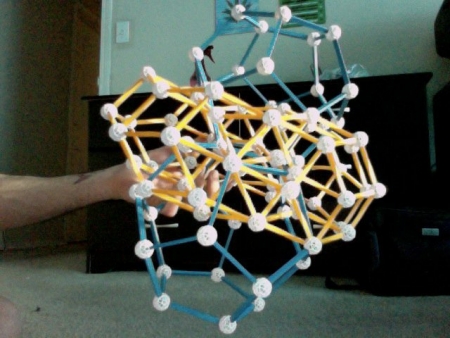
I’ve been using Zometools, available at http://www.zometool.com, to build interesting geometrical shapes since long before I started this blog. I recently found this: a 2011 photograph of myself, holding a twisting Zome torus. While I don’t remember who was holding the camera, I do remember that the torus is made of adjacent parallelopipeds.

After building this torus, I imagined it as an accretion disk surrounding a neutron star — and now I am imagining it as a neutron star on the verge of gaining enough mass, from the accretion disk, to become a black hole. Such an object would emit intense jets of high-energy radiation in opposite directions, along the rotational axis of this neutron star. These jets of radiation are perpendicular to the plane in which the rotation takes place, and these two opposite directions are made visible in this manner, below, as two dodecahedra pointing out, on opposite sides of the torus — at least if my model is held at just the right angle, relative to the direction the camera is pointing, as shown below, to create an illusion of perpendicularity. The two photographs were taken on the same day. 

zome torus with dodecahedra 2011

In reality, of course, these jets of radiation would be much narrower than this photograph suggests, and the accretion disk would be flatter and wider. When one of the radiation jets from such neutron stars just happens to periodically point at us, often at thousands of times per second, we call such rapidly-rotating objects pulsars. Fortunately for us, there are no pulsars near Earth.

It would take an extremely long time for a black hole to form, from a neutron star, in this manner. This is because most of the incoming mass and energy (mostly mass, from the accretion disk) leaves this thermodynamic system as outgoing mass and energy (mostly energy, in the radiation jets), mass and energy being equivalent via the most famous formula in all of science: E = mc².

On Destroying the Universe (With Mathematics)

division by zero

No cause for alarm here; it’s not going to happen. I promise. Now, please, stop worrying about this, if you can. I’m not trying to scare anyone.

If not worrying about this proves to be difficult, simply consult a mathematician.