The Arkansas Education Association, or AEA: How (and Why) to Join

aea

The Arkansas Education Association is the oldest, largest, most effective, and most well-established professional organization (and union) for educators in Arkansas. I’ve been a member for years, and will explain why, below. First, though, here are three ways to join:

  1. A local affiliate of the AEA exists in every school district in Arkansas. My local is called PACT, the Pulaski Association of Classroom Teachers. In the nearby Little Rock School District, the local AEA affiliate is the LREA: the Little Rock Education Association. If you know members at your local, ask them to put you in touch with the teacher at your school who serves as the Representative, or “Rep,” for your school. You can then simply ask your Rep for a membership form, fill it out, and return it to them. The Rep will take it from there.
  2. A second way to join is through the AEA’s website, at http://www.aeaonline.org/how-join. This involves filling out and printing a paper form, and then mailing it to the AEA’s office in Little Rock, using the address at that website.
  3. There’s also a third way, and it doesn’t require paper forms, nor postage stamps. You can join our national organization, the NEA, through their website, at https://ims.nea.org/JoinNea/, and this will automatically make you a member of your state and local affiliate at the same time. Also, this works for educators and support staff in other American states, the District of Columbia, and Puerto Rico, as well — unlike items #1 and 2 above.

So . . . why join these affiliated local, state, and national organizations? Well, first, let me give you some idea what it costs to be a member. I pay dues of $23.08, by paycheck deduction, twice a month, and that’s the total of my NEA, AEA, and PACT dues. (This amount will vary in other school districts, since each local sets their own dues.) In return, I have a network of people dedicated to (1) protecting my rights as a teacher, everywhere from my own classroom to Capitol Hill, (2) helping me develop professionally as a teacher (through collaboration with an extensive network of colleagues, as well as formal, for-credit Professional Development opportunities), and (3) being ready to come to my legal defense, should I need such assistance.

It is important to remember that a teacher can do absolutely nothing wrong, and still end up in a situation where such assistance is needed — to defend yourself against a false accusation, for example. I’ve been falsely accused of unethical conduct, via an anonymous complaint, in the past; it isn’t a fun situation. Because I was already a PACT/AEA/NEA member, help was provided at no extra cost, and my name was fully cleared. Had I not been a member, I might have had to hire an attorney in that situation — if affording one was possible, but it wasn’t. Few teachers have tens of thousands of dollars on hand to privately hire an attorney, should such a need arise in connection with their jobs, and I was no exception — but union membership takes care of that, if (and only if) you are already a member when trouble strikes. If I consider the dues I pay, vs. what attorneys charge when hired by individuals, I realize the truth: union dues are one of the best bargains available — anywhere.

It is a sad reality that some (not all, but some) administrators have a nasty habit of bullying teachers. In fact, such bullying was exactly what drove me to join PACT/AEA/NEA in the first place. The bullying continued after I joined, so I then reported it to my local’s contacts, and the organization intervened to protect me — successfully. Later, I witnessed similar bullying, of my fellow teachers, by a different administrator, and that’s what prompted my move from being a dues-paying union member to being a much more active union member, and a building Representative as well. In that role, I had the privilege of intervening personally, to do my best to stop such adult-on-adult bullying, and enlisted the help of others, whenever such help was needed. Again, such efforts were successful, although our own confidentiality rules do not allow me to describe the specifics, for we carefully protect the privacy of our members. (Important side note: all of this bullying described above happened in schools other than the school where I currently teach. This is not a coincidence; I am at my current school on purpose, so that I can work with good administrators every day. When teachers are well-treated, as is the norm at my current school, we can do a much better job focusing on, and meeting, the educational needs of our students.)

This is what union members do: we help each other. We protect each other. We support each other. Until the miraculous day when every single person in management and administration suddenly begins behaving ethically, 100% of the time, unions will be needed, and our work will continue to be important. We protect the working environment in schools — and that same working environment is the learning environment for America’s children.

There are other, more dollars-and-cents-oriented reasons to join, as well. For example, through the NEA, I have a quarter-million-dollar life insurance policy which costs me only $32.73 per month — an excellent price. Shopping discounts exist in abundance. There even exist benefits which I haven’t even used yet, simply because there are so many.

Of all the benefits of membership, there is one, above all others, which makes the argument for membership most compelling to me, and that is related to the legal right of representation. For AEA members, the statement below is both vital, and true:

right-to-representation

“An employee shall be entitled to and shall be offered the opportunity to have a witness or representative of the employee’s choice present during any disciplinary or grievance matter with any administrator.” This is an Arkansas state law (A.C.A. 6-17-210). Any time an administrator in my district breaks this law, by denying any PACT or PASS member’s request for representation, it is imperative that union leaders be informed of this illegal act, without delay. (One way to reach them is by calling the PACT/PASS office, at 501-374-4955, during business hours.) PACT is our teachers’ union, and PASS is our union for support staff. We work together, which is as it should be. (Those AEA members in other locals, in similar situations, should contact the corresponding leaders of their own locals.)

Union members have representation provided to them upon request, whenever the need for it exists, at no extra cost — for our dues, and the dues of our colleagues, have already paid for it. Those who are not members, by contrast, are at the mercy of the market to find representation, on their own — with no well-organized, powerful organization backing them up, as we have as AEA members. In my opinion, this seals the deal — if you work in an Arkansas school, you can’t afford not to join the AEA, for the benefit of representation, alone. As for the numerous other benefits, they simply make membership an even sweeter deal.

One last thing: should anyone who tries to join the AEA encounter any difficulties doing so, feel free to ask for my personal help, in a comment to this post — and I promise to make certain you get the help you need.

A Simple Cheating-Prevention Idea, for Teachers with Students Sitting at Tables

With just two pieces of cardboard and a pair of scissors, you can partition a table which seats four into four sections — one per student. This makes cheating much more difficult, and that’s a good thing for everybody. No tape is needed; each piece of cardboard holds up the other one.

cardboard privacy screens for tables of 4 students

Other materials can be used as well. For one-time use, posterboard is adequate. For something more permanent, wooden boards are recommended.

The Human Reaction, When Mathematics No Longer Seems to Make Sense: What Is This Sorcery?

Cubes 5

Unless you understand all of mathematics — and absolutely no one does — there is a point, for each of us, where mathematics no longer makes sense, at least at that moment. Subjectively, this can make the mathematics beyond this point, which always awaits exploration, appear to be some form of sorcery.

Mathematics isn’t supernatural, of course, but this is a reaction humans often have to that which they do not understand. Human reactions do not require logical purpose, and they don’t always make sense — but there is always a reason for them, even if that reason is sometimes simply that one is utterly bewildered.

In my case, this is the history of my own reactions, as I remember them, to various mathematical concepts. The order used is as close as I can remember to the sequence in which I encountered each idea. The list is, of necessity, incomplete.

  • Counting numbers: no problem, but what do I call the next one after [last one I knew at that time]? And the next one? And the next? Next? Next? [Repeat, until everyone within earshot flees.]
  • Zero exists: well, duh. That’s how much of whatever I’m snacking on is left, after I’ve eaten it all.
  • Arithmetic: oh, I’m glad to have words for this stuff I’ve been doing, but couldn’t talk about before.
  • Negative numbers: um, of course those must exist. No, I don’t want to hear them explained; I’ve got this already. What, you want me to demonstrate that I understand it? Ok, can I borrow a dollar? Oh, sure, I’ll return it at some point, but not until after I’ve spent it.
  • Multiple digits, the decimal point, decimal places, place value: got it; let’s move on, please. (I’ve never been patient with efforts to get me to review things, once I understand them, on the grounds that review, under such conditions, is a useless activity.)
  • Pi: love at first sight.
  • Fractions: that bar means you divide, so it all follows from that. Got it. Say, with these wonderful things, why, exactly, do we need decimals, again? Oh, yeah, pi — ok, we keep using decimals in order to help us better-understand the number pi. That makes sense.
  • “Improper” fractions: these are cool! I need never use “mixed numbers” again (or so I thought). Also, “improper” sounds much more fun than its logical opposite, and I never liked the term “mixed numbers,” nor the way those ugly things look.
  • Algebra: ok, you turned that little box we used before into an “x” — got it. Why didn’t we just use an “x” to begin with? Oh, and you can do the same stuff to both sides of equations, and that’s our primary tool to solve these cool puzzles. Ok. Got it.
  • Algebra I class: why am I here when I already know all this stuff?
  • Inequality symbols: I’m glad they made the little end point at the smaller number, and the larger side face the larger number, since that will be pretty much impossible to forget.
  • Scientific notation: well, I’m glad I get to skip writing all those zeroes now. If only I knew about this before learning number-names, up to, and beyond, a centillion. Oh well, knowing those names won’t hurt me.
  • Exponents: um, I did this already, with scientific notation. Do not torture me with review of stuff I already know!
  • Don’t divide by zero: why not? [Tries, with a calculator]: say, is this thing broken? [Tries dividing by smaller and smaller decimals, only slightly larger than zero]: ok, the value of the fraction “blows up” as the denominator approaches zero, so it can’t actually get all the way there. Got it.
  • Nonzero numbers raised to the power of zero equal one: say what? [Sits, bewildered, until thinking of it in terms of writing the number one, using scientific notation: 1 x 10º.] Ok, got it now, but that was weird, not instantly understanding it.
  • Sine and cosine functions: got it, and I’m glad to know what those buttons on the calculator do, now, but how does the calculator know the answers? It can’t possibly have answers memorized for every millionth of a degree.
  • Tangent: what is this madness that happens at ninety degrees? Oh, right, triangles can’t have two right angles. Function “blows up.” Got it.
  • Infinity: this is obviously linked to what happens when dividing by ever-smaller numbers, and taking the tangent of angles approaching a right angle. I don’t have to call it “blowing up” any more. Ok, cool.
  • Factoring polynomials: I have no patience for this activity, and you can’t stop me from simply throwing the quadratic formula at every second-order equation I see.
  • Geometry (of the type studied in high school): speed this up, and stop stating the obvious all the time!
  • Radicals: oh, I was wondering what an anti-exponent would look like.
  • Imaginary numbers: well, it’s only fair that the negative numbers should also get square roots. Got it. However, Ms. _____________, I’d like to know what the square root of i is, and I’d like to know this as quickly as possible. (It took this teacher and myself two or three days to find the answer to this question, but find it we did, in the days before calculators would help with problems like this.)
  • The phrase “mental math” . . . um, isn’t all math mental? Even if I’m using a calculator, my mind is telling my fingers which buttons to press on that gadget, so that’s still a mental activity. (I have not yielded from this position, and therefore do not use the now-despised “mental math” phrase, and, each time I have heard it, to date, my irritation with the term has increased.)
  • 0.99999… (if repeated forever) is exactly equal to one: I finally understood this, but it took attacks from several different directions to get there, with headaches resulting. The key to my eventual understanding it was to use fractions: ninths, specifically.
  • The number e, raised to the power of i‏π, equals -1: this is sorcery, as far as I can see. [Listens to, and attempts to read, explanations of this identity.] This still seems like sorcery!
  • What it means to take the derivative of an expression: am I just supposed to memorize this procedure? Is no one going to explain to me why this works?
  • Taking the derivative of a polynomial: ok, I can do this, but I don’t have the foggiest idea why I’m doing it, nor why these particular manipulations of one function give you a new function which is, at all points along the x-axis, the slope of the previous function. Memorizing a definition does not create comprehension.
  • Integral calculus: this gives me headaches.
  • Being handed a sheet of integration formulas, and told to memorize them: hey, this isn’t even slightly fun anymore. =(
  • Studying polyhedra: I finally found the “sweet spot” where I can handle some, but not all, of the puzzles, and I even get to try to find solutions in ways different from those used by others, without being chastised. Yay! Math is fun again! =)
  • Realizing, while starting to write this blog-post, that you can take the volume of a sphere, in terms of the radius, (4/3)πr³, take its derivative, and you get the surface area of the same sphere, 4πr²: what is this sorcery known as calculus, and how does it work, so it can stop looking like sorcery to me?

Until and unless I experience the demystification of calculus, this blog will continue to be utterly useless as a resource in that subfield of mathematics. (You’ve been warned.) The primary reason this is so unlikely is that I haven’t finished studying (read: playing with) polyhedra yet, using non-calculus tools I already have at my disposal. If I knew I would live to be 200 years old, or older, I’d make learning calculus right now a priority, for I’m sure my current tools’ usefulness will become inadequate in a century or so, and learning calculus now, at age 47, would likely be easier than learning it later. As things are, though, it’s on the other side of the wall between that which I understand, and that which I do not: the stuff that, at least for now, looks like magic — to me.

Please don’t misunderstand, though: I don’t “believe in” magic, but use it simply as a label of convenience. It’s a name for the “box ,” in my mind, where ideas are stored, but only if I don’t understand those ideas on first exposure. They remain there until I understand them, whether by figuring the ideas out myself, or hearing them explained, and successfully understanding the explanation, at which point the ideas are no longer thought of, on any level, as “magic.”

To empty this box, the first thing I would need would be an infinite amount of time. Once I accepted the inevitability of the heat death of the universe, I was then able to accept the fact that my “box of magic” would never be completely emptied, for I will not get an infinite amount of time.

[Image credit: I made a rainbow-colored version of the compound of five cubes for the “magic box” picture at the top of this post, using Stella 4d, a program you may try here.]

A Special Type of Compound, Built with Zome, of the Great and Small Stellated Dodecahedra

For years, I have used Zometools (sold here:  http://www.zometool.com) to teach geometry. The constructions for the icosahedron and dodecahedron are easy to teach and learn, due to the use of short reds (R1s) and medium yellows (Y2s) for radii for the two of them, as shown below, with short blue (B1) struts as edges for both polyhedra.

10865862_10204218181029594_3308928268978197013_o

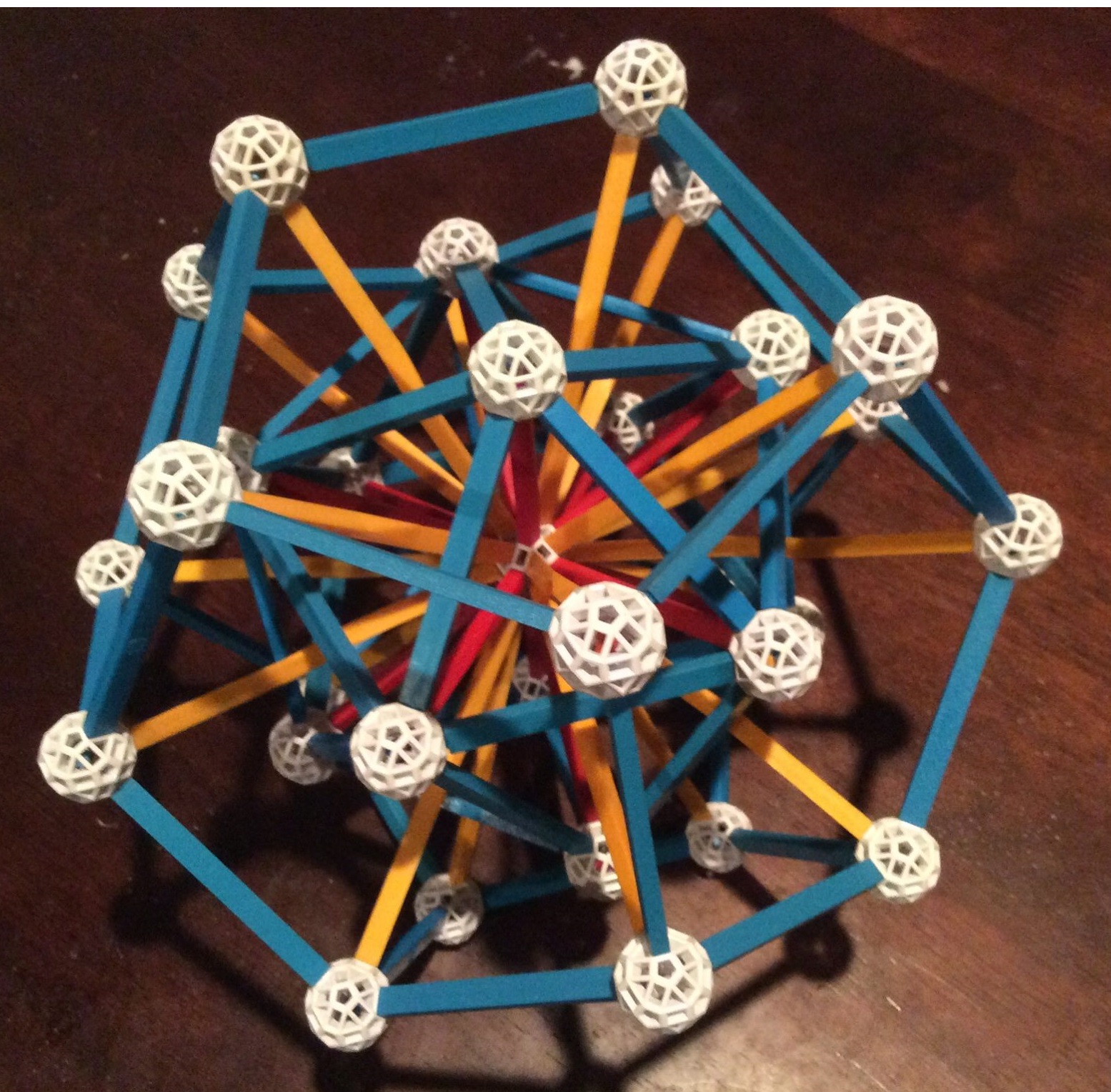
Unexpectedly, a student (name withheld for ethical and legal reasons) combined the two models, making this:

1401165_10204218146948742_4605456240300721240_oI saw it, and wondered if the two combined Platonic solids could be expanded along the edges, to stellate both polyhedra, with medium blues (B2s), to form the great and small stellated dodecahedron. By trying it, I found out that this would require intersecting blue struts — so a Zomeball needed to be there, at the intersection. Trying, however, only told me that no available combination would fit. After several more attempts, I doubled each edge length, and added some stabilizing tiny reds (R0s), and found a combination that would work, to form a compound of the great and small stellated dodecahedron in which both edge lengths would be equal. In the standard (non-stellated) compound of the icosahedron and dodecahedron, in which the edges are perpendicular, they are unequal in length, and in the golden ratio, which is how that compound differs from the figure shown directly above.

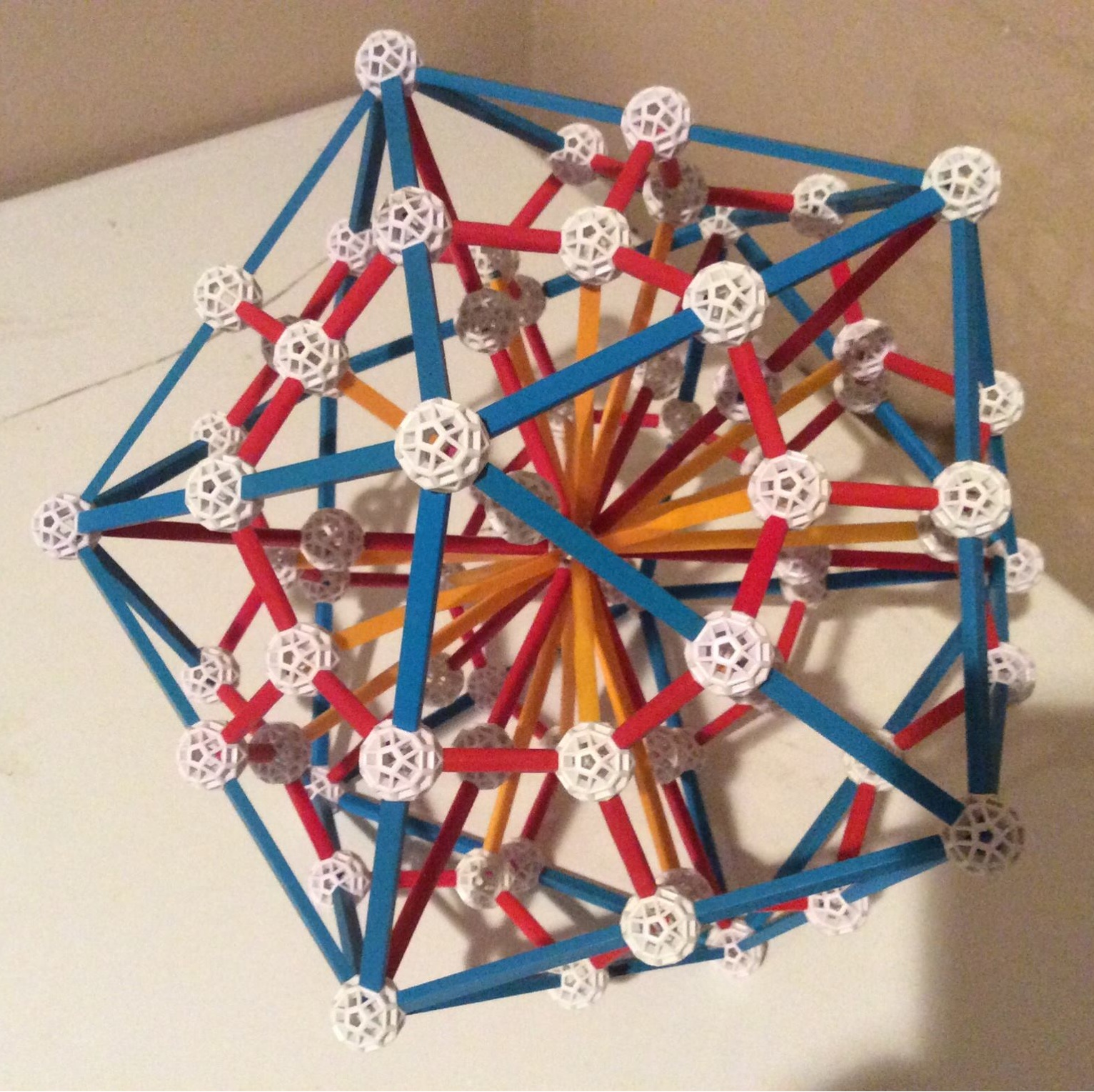
Here’s the stabilized icosahedral core, after the doubling of the edge length:

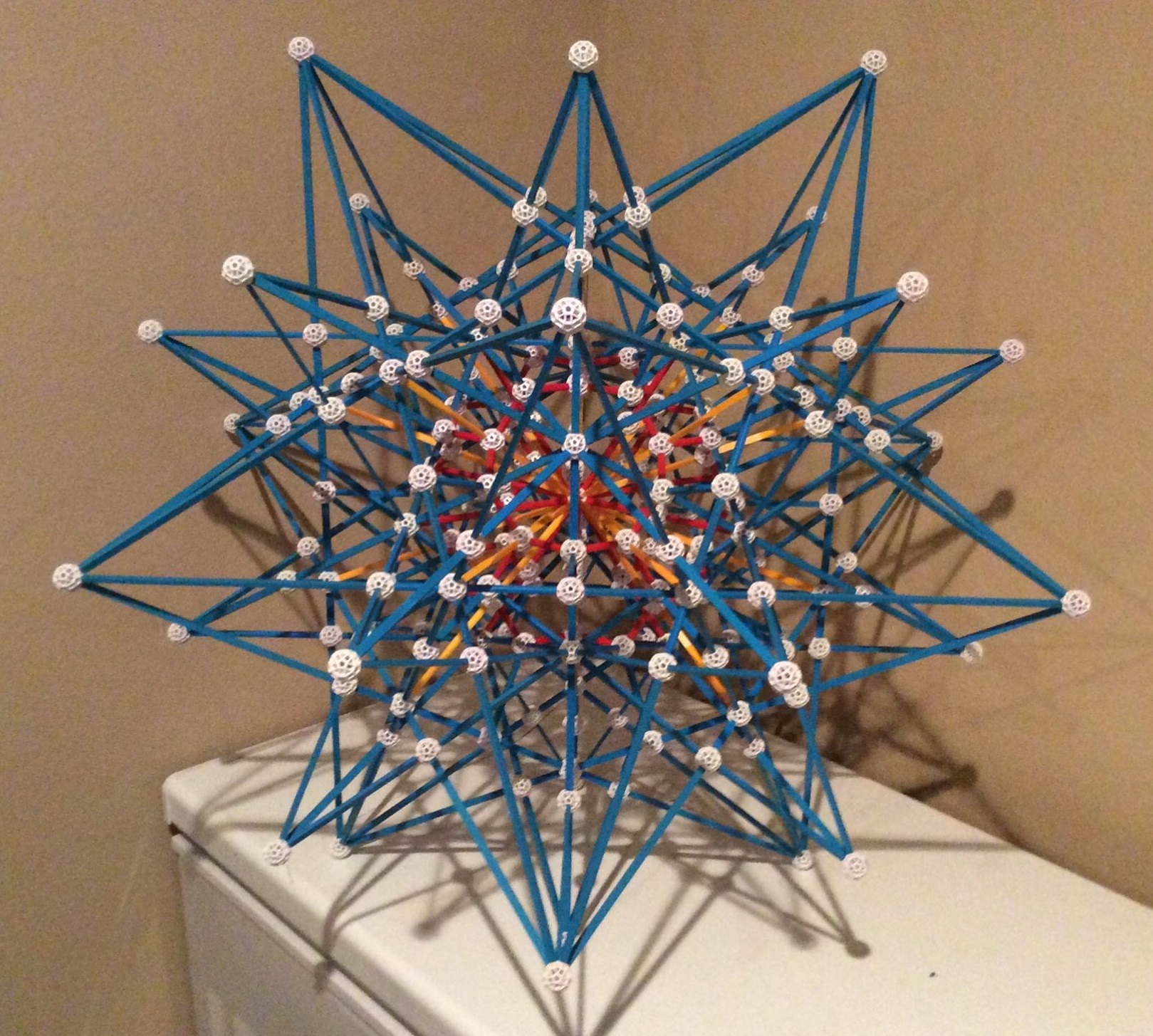
10865862_10204218180989593_3871605705756535601_oThis enabled stellation of each shape by edge-extension. Each edge had a length twice as long as a B2 added to each side — and it turns out, I discovered, that 2B2 in Zome equals B3 + B0, giving the golden ratio as one of three solutions solution to x² + 1/x = 2x (the others are one, and the golden ratio’s reciprocal). After edge-stellation to each component of the icosahedron/dodecahedron quasi-compound, this is what the end product looked like. This required assembling the model below at home, where all these pictures were taken, for one simple reason: this thing is too wide to fit through the door of my classroom, or into my car.

10847334_10204218153268900_1020271669763339706_o

Here’s a close-up of the central region, as well.

closeup

On Triangle Congruence, and Why SSA Does Not Work

Those who have taught geometry, when teaching triangle congruence, go through a familiar pattern. SSS (side-side-side) triangle congruence is usually taught first, as a postulate, or axiom — a statement so obvious that it requires no proof (although demonstrations certainly do help students understand such statements, even if rigorous proof is not possible). Next, SAS (side-angle-side) and ASA (angle-side-angle) congruence are taught, and most textbooks also present them as postulates. AAS (angle-angle-side) congruence is different, however, for it need not be presented without proof, for it follows logically from ASA congruence, paired with the Triangle Sum Theorem. With such a proof, of course, AAS can be called a theorem — and one of the goals of geometricians is to keep the number of postulates as low as possible, for we dislike asking people to simply accept something, without proof.

At about this point in a geometry course, because the subject usually is taught to teenagers, some student, to an audience of giggling and/or snickering, will usually ask something like, “When are we going to learn about angle-side-side?”

The simple answer, of course, is that there’s no such thing, but there’s a much better reason for this than simple avoidance of an acronym which many teenagers, being teenagers, find amusing. When I’ve been asked this question (and, yes, it has come up, every time I have taught geometry), I accept it as a valid question — since, after all, it is — and then proceed to answer it. The first step is to announce that, for the sake of decorum, we’ll call it SSA (side-side-angle), rather than using a synonym for a donkey (in all caps, no less), by spelling the acronym in the other direction. Having set aside the silliness, we can then tackle the actual, valid question: why does SSA not work?

This actually is a question worth spending class time on, for it goes to the heart of what conjectures, theorems, proof, and disproof by counterexample actually mean. When I deal with SSA in class, I refer to it, first, as a conjecture:  that two triangles can be shown to be congruent if they each contain two pairs of corresponding, congruent sides, and a pair of corresponding and congruent angles which are not included between the congruent sides, of either triangle. To turn a conjecture into a theorem requires rigorous proof, but, if a conjecture is false, only one counterexample is needed to disprove its validity. Having explained that, I provide this counterexample, to show why SSA does not work:

no SSA

In this figure, A is at the center of the green circle. Since segments AB and AC are radii of the same circle, those two segments must be congruent to each other. Also, since congruence of segments is reflexive, segment AD must be congruent to itself — and, finally, because angle congruence is also reflexive, angle D must also be congruent to itself.

That’s two pairs of corresponding and congruent segments, plus a non-included pair of congruent and corresponding angles, in triangle ABD, as well as triangle ACD. If SSA congruence worked, therefore, we could use it to prove that triangle ABD and triangle ACD are congruent, when, clearly, they are not. Triangle ACD contains all the points inside triangle ABD, plus others found in isosceles triangle ABC, so triangles ABD and ACD are thereby shown to have different sizes — and, by this point, it has already been explained that two triangles are congruent if, and only if, they have the same size and shape. This single counterexample proves that SSA does not work.

Now, can this figure be modified, to produce an argument for a different type of triangle congruence? Yes, it can. All that is needed is to add the altitude to the base of isosceles triangle ABC, and name the foot of that altitude point E, thereby creating right triangle AED.

HL

It turns out that, for right triangles only, SSA actually does work! The relevant parts of the right triangle, shown in red, are segment DA (congruent to itself, in any figure set up this way), segment AE (also congruent to itself), and the right angle AED (since all right angles are congruent to each other). However, as I’ve explained to students many times, we don’t call this SSA congruence, since SSA only works for right triangles. To call this form of triangle congruence SSA (forwards or backwards), when it only works for some triangles, would be confusing. We use, instead, terms that are specific to right triangles — and that’s how I introduce HL (hypotenuse-leg) congruence, which is what SSA congruence for right triangles is called, in order to avoid confusion. Only right triangles, of course, contain a hypotenuse.

This is simply one example of how to use a potentially-disruptive student question — also known as a teenager being silly — and turn it around, using it as an opportunity to teach something. Many other examples exist, of course, in multiple fields of learning.

Kaizen

kaizen

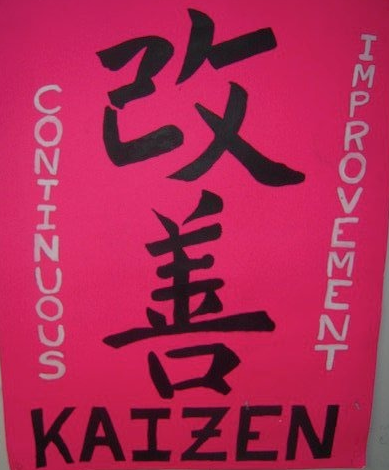
I painted this many years ago, as a classroom poster, and then moved it from classroom to classroom, for years, until the posterboard on which it was painted was finally too damaged for further use. At some point, I will have to make a replacement.

Kaizen is a Japanese word which translates only loosely into English, as “continuous improvement.” To me, it means more than that:  it means never being content with simply staying the person I am today, and going to sleep, each night, with the sincere intention to be a better person tomorrow.

Does this always actually work, as each day becomes the next one? No, I must admit that it doesn’t — but that does nothing to change the fact that keeping the kaizen principle in mind is an excellent way to live one’s life. On a year-to-year basis, it works much better, in practice, than it does from day to day. I am confident that I am a better person now than I was 365 days ago, even though there have, of course, been ups and downs, as the last year has passed.

Setbacks, which happen to everyone, are no reason to give up, and personal improvement, in all important parts of life, will always be a goal worth pursuing.

“How Tall Are You?”

metric system

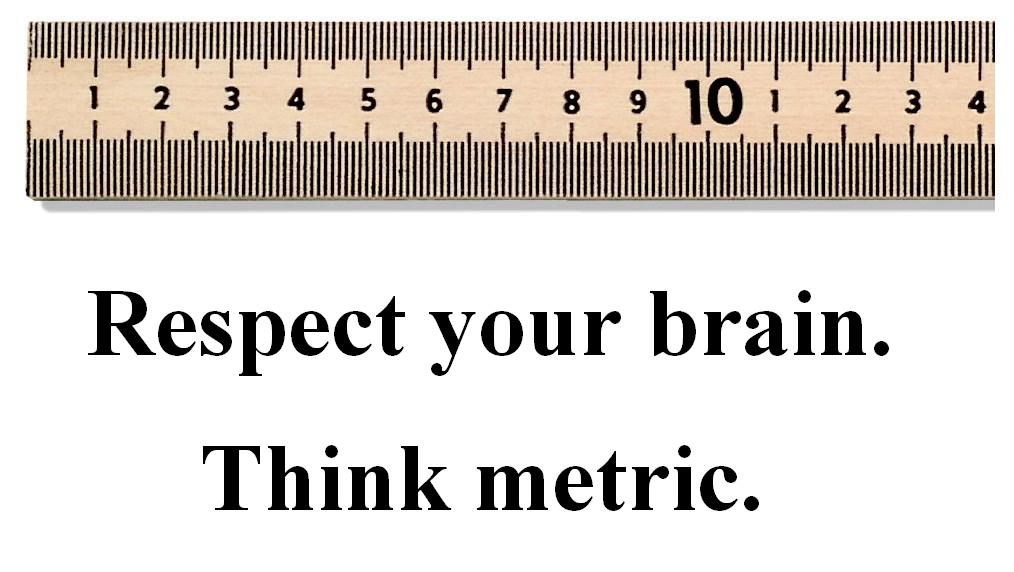
When I am asked for my height, anywhere — especially at school — I answer the question honestly. I am 1.80 meters tall.

I also live in the USA, one of only three remaining countries (the other two holdouts are Liberia and Myanmar) which have stubbornly refused to adopt the metric system. However, I am every bit as stubborn as other Americans, but, on this issue, I choose to be stubborn in the opposite direction.

It should surprise no one who knows me well that my classroom, whether I am teaching science or mathematics, is, by design, an all-metric zone. After all, like >99% of people, I have ten fingers (assuming thumbs are counted as fingers), ten toes, and almost always use the familiar base-ten number system when counting, measuring, doing arithmetic, or doing actual mathematics. (Doing arithmetic is not the same thing as doing real mathematics, any more than spelling is equivalent to writing.) Using the metric system is consistent with these facts, and using other units is not.

Admittedly, I do sometimes carry this to an extreme, but I do so to make a point. Metric units are simply better than non-metric units. Why should anyone need to memorize the fact that there are 5,280 feet in one mile? It actually embarrasses me that I have that particular conversion-factor memorized. By “extreme,” I mean that I have been known to paint the non-metric side of meter sticks black, simply to make it impossible for students in my classes to confuse inches and centimeters, and prevent them from measuring anything with the incorrect units.

To those who object that American students need to understand non-metric units, I simply point out that there are plenty of other teachers who take care of that. This is, after all, the truth.

Often, after giving my height as 1.80 meters, I am asked to give it in other units. Unless the person asking is a police officer (in, say, a traffic-stop situation), however, I simply refuse to answer with non-metric units. What do I say, instead? “I’m also 180 centimeters tall. Would you like to know my height in kilometers?”

If pressed on this subject in class — and it comes up, because we do lab exercises where the height of people must be measured — I will go exactly this far:  I am willing to tell a curious student that there are 2.54 centimeters in an inch, 12 inches in a foot, and 3.28 feet in a meter. Also, I’m willing to loan calculators to students. Beyond that, if a student of mine really wants to know my height in non-metric units, he or she simply has to solve the problem for themselves — something which has not yet happened. I do not wish to tell anyone my height in feet and inches, for I do not enjoy headaches, and uttering my height, in those units I despise, would certainly give me one. Also, obviously, you won’t find my height, expressed in non-metric units, on my blog, unless someone else leaves it here, in a comment — and I am definitely not asking anyone to do that.

I might, just for fun, at some point, determine my height in cubits. For all I know, a person’s height, measured with their own cubits, might be a near-constant. That would be an interesting thing to investigate, and my students, now that I’ve thought about the question, might find themselves investigating this very issue, next week. The variability of cubits, from one person to another, makes them at least somewhat interesting. It also makes cubits almost completely useless, which explains why they haven’t been used since biblical times, but that’s not the point. One can still learn things while investigating something which is useless, if one is sufficiently clever about it.

Feet and inches, however, are not interesting — at all. They are obsolete, just as cubits are, and they are also . . . offensive. It is not a good thing to insult one’s own brain.

My Aqua Regia Story

This is my twentieth year teaching, but only the first year when I have not taught at least one class in chemistry, and I miss it. One of my fondest memories of chemistry lab involves the one time I experimented with aqua regia — a mixture of acids which, unlike any single acid, can dissolve both gold and platinum, the “noble metals.” I had read a story of a scientist’s gold Nobel Prize being protected from the Nazis by dissolving it in aqua regia, and then recovering the gold from solution after World War II had ended. Having read about this, I wanted to try it myself, and also thought it would make an excellent lab for classroom use — if I could figure out how to recover the gold, and also learn what precautions would be needed to allow high school students to perform this experiment safely. For sensible and obvious reasons, I conducted a “trial run” without students present, but with another chemistry teacher nearby, since aqua regia, and the gases it produces when dissolving gold, are quite dangerous. Someone else has put a video on YouTube, showing aqua regia dissolving gold, so you can see something much like what I saw, simply by watching this video.

First, I obtained one-tenth of a troy ounce of gold, which cost about $80 at the time. I had read about the extreme malleability of gold, one of the softest metals, and wanted to see evidence for it for myself — so, before I prepared the the aqua regia, I used a hammer to try flattening the gold sample into a thin sheet. That didn’t work, but it didn’t take long for me to figure out why — I had accidentally bought gold coin-alloy, which is 10% copper, not pure gold. Since this alloy is far less malleable than pure gold, my attempt to flatten it had failed, but I also knew this would not pose a problem for my primary experiment — the one involving aqua regia. Also, I didn’t have another spare $80 handy, to purchase another 1/10 troy ounce of pure gold, so I proceeded to make, for the first time in my life, a small amount of aqua regia — Latin for “royal water.”

Unlike what is shown in the video above, I prepared the acid-mixture first, before adding the gold, using a slightly-different recipe:  the traditional 1:4 ratio, by volume, of concentrated nitric acid to concentrated hydrochloric acid. Both these acids look (superficially) like water, but the mixture instantly turned yellow, and started fuming, even before anything was added to it. Wearing full protective gear, I watched it for a few minutes — and then, using tongs held by gloved hands, lowered my hammer-bashed sample of gold into the fuming, yellow mixture of concentrated acids.

It worked. It was a fascinating reaction, and a lot of fun to watch. At approximately the same time that the last of my gold sample dissolved, something occurred to me:  I had failed to research how to recover the dissolved gold from the resulting solution! No problem, I thought — I can figure this out. (I am seldom accused of lacking self-confidence, even when I’m wrong.)

My first idea was to use a single-replacement reaction. Many times, I have had students extract pure silver from a solution of silver nitrate by adding a more-active metal, such as copper. The copper dissolves, replacing the silver in the silver nitrate solution, and silver powder forms, as a precipitate, on the surface of the copper. Thinking that a similar process could be used to precipitate out the gold from my gold / aqua regia mixure, I simply added come copper to the reaction beaker. The corrosive properties of my aqua regia sample had not yet been exhausted, though, and so the remaining aqua regia simply “ate” the copper. The result was a mess — I had only succeeded in turning an already-complicated problem into an even-more-complicated problem, by adding more chemicals to the mixture. More attempts to turn the gold ions back into solid gold dust, using other chemicals, followed, but all of them failed. Finally, I used a strong base, sodium hydroxide, to neutralize the still-acidic mixture, and then, disgusted by my failure to recover the gold, found a way to safely dispose of the mixture, and did so.

In retrospect, I think I know where I messed up — I should have neutralized the remaining acids in the mixture with sodium hydroxide first, before adding copper to cause the gold to precipitate out, in a no-longer-acidic solution of ions with much less hydronium present. That, I think, will work, and I do intend to try it sometime — after doing more research first, to increase my level of certainty, and also after waiting for the current price of gold to drop to less-expensive levels. Right now, after all, a tenth of a troy ounce of gold costs roughly $120, not a mere $80.

As for the lost $80, I’m not upset about that anymore. I definitely learned things while doing this, and now view the $80 spent as simply the cost of tuition for an educational experience.

Zome: Strut-Length Chart and Product Review

This chart shows strut-lengths for all the Zomestruts available here (http://www.zometool.com/bulk-parts/), as well as the now-discontinued (and therefore shaded differently) B3, Y3, and R3 struts, which are still found in older Zome collections, such as my own, which has been at least 14 years in the making.

Zome

In my opinion, the best buy on the Zome website that’s under $200 is the “Hyperdo” kit, at http://www.zometool.com/the-hyperdo/, and the main page for the Zome company’s website is http://www.zometool.com/. I know of no other physical modeling system, both in mathematics and several sciences, which exceeds Zome — in either quality or usefulness. I’ve used it in the classroom, with great success, for many years.

My Australia Story

australia

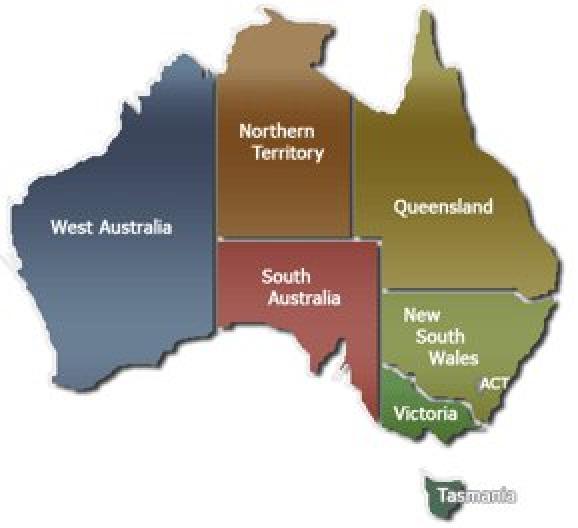
I once got into a huge argument, as a 7th grade student, in a “talented and gifted” section of Social Studies. The issue:  how many countries are there in the continent of Australia?

The assignment was to choose a continent, and draw a map of it on a full-size posterboard. I had worked for hours on this map, only to get it back, ruined, for the teacher had taken a red ball-point pen, slashed through my line “state and territorial boundaries” in my map’s key, and had written, as a correction, “not states — COUNTRIES.” She also docked points from my grade, but that was a minor issue, to me, compared to her ruining my map. She could have, at least, written her incorrect comment on the back of my map!

When I confronted her about her mistake, she maintained that the political divisions you see above are independent countries. In my opinion, “Northern Territory,” especially, doesn’t sound particularly sovereign, and I said so, but she may not have understood the definition of “sovereign,” for that did not work. Confronted with this absurd situation, I proceeded to grab the “Q” volume of a nearby encyclopedia, and began reading the article about Queensland, loudly enough for the entire class to hear: “Queensland: one of the states of Australia….” I freely admit that, at the time, my goal was to embarrass and humiliate her right out of the teaching profession — for the benefit of her present and future students. I’ve changed my approach, a lot, since then.

A huge brouhaha ensued, and we ended up taking each other to the assistant principal’s office:  her, to report a disruptive and defiant student; and me, to report an incompetent teacher, who, in my view, at that age, should have been fired on the spot. Dealing with this situation was probably one of the stranger, and more difficult, situations of that assistant principal’s career, for he knew that Australia is both a single country, and a continent — but he could not, for political reasons I did not yet understand, agree with me in front of this teacher. As for me, I was simply incredulous that someone could be a certified social studies teacher, and not know this basic fact about world geography. The whole scenario, to me, was surreal.

The assistant principal handled it well. To the teacher, he said, “You can go back to class — I’ll handle Robert.” He then “handled” me, after she left, in the only way that could have possibly worked: with an apology, and a polite request to do my best to endure her ignorance until the upcoming end of the year. I respect honesty, was being given a request, not an order, and he had conceded that I was correct. I therefore chose to cooperate — with his polite request.

If he had not taken this approach, I likely would have added him to the list I had, at the time, of people (a mixture of administrators and teachers) whom I was trying to drive out of the education profession, for the benefit of all — but he did the right thing, thus earning my respect.

As for the teacher, I survived the rest of her class, brain intact, and assume she is now retired, this being well over thirty years ago. I’m now in my twentieth year as a teacher, myself, and am pleased to report that average teacher quality has dramatically improved since this fiasco happened. (I wish I could say the same about average administrator quality, but there are, at least, a few competent people working in that field, as well.) During my years of teaching, I haven’t encountered a single teacher who lacked this basic bit of knowledge about world geography. In fact, I count, among my colleagues, many of the smartest people I know.

I am glad, however, that I don’t have to call the teacher in this story a colleague. I simply cannot respect willful, stubborn ignorance, especially in the face of evidence that one is wrong. When one of my students catches me making a mistake, I do the right thing: I thank them, make certain everyone understands the correction, and then we move on with the lesson. That’s what this 7th grade teacher of mine should have done, as well.