Silver Conversion Chart: Troy, Metric, and U.S. Coin Information

silver

I’m most likely to need the information in the top third of this chart, myself, but I continued it all the way through 100 kg, for the benefit of those with much more money to invest in silver than I have.

How much does silver cost, per troy ounce? Right now, it’s in the $15 neighborhood, but that changes all the time. This is the website I use to keep an eye on the “spot” price of silver, but there are many other such sources, as well.

The First High-Resolution Images from Pluto Have Arrived, and They Bring a Major Mystery: Where Are the Impact Craters?

pluto-observations-through-the-years

As new pics from the Pluto/Charon system become available, you can’t beat the image gallery at the New Horizons portion of NASA’s website to keep up with them, which is where I found this .gif file showing images of Pluto itself throughout the years. It culminates in the latest, and most detailed, image of any part of Pluto — a small portion of its surface. To see more of the latest pics, as they are released, I refer you to that web-page. NASA plans to keep it updated with the latest from the Pluto/Charon system, for months to come, as new images are transmitted, received, and processed.

The big surprise today is not the “heart of Pluto” that’s gotten so much press this week, but something newly discovered (and completely unexpected) with the latest small batch of new pics: on both Pluto and Charon, they can’t find a single impact crater. Not one. And that is just flat-out weird. Here, see for yourself (same image source): unexpected ice mountains, check; unexpectedly-smooth plains, check; craters — hey, the craters are missing!

nh-plutosurface

According to everything we know, impact craters should be there. The ice mountains and numerous plains are mysteries, also, but it is the lack of craters which really has scientists puzzled this morning. Everyone expected to see lots of impact craters, myself included. Small worlds, so far from the sun, should have frozen internally long ago, based on present models, making them geologically dead, and therefore unable to “erase” impact craters (seen on dozens of other planets, dwarf planets, satellites, and asteroids) with surface-altering geological activity. This mass-erasure-of-craters happens on a only a few other solid bodies in the solar system, such as Earth, and Jupiter’s moon Io — both larger, and much warmer, than anything in the Pluto/Charon system. Some scientists are already going public with conjectures for the energy source needed to keep Pluto and Charon crater-free. However, I have yet to read any such conjecture which I find convincing, which is why I am not including them in this post. (Such guesswork is easy to find, though, here, among other places.)

On the other hand, the scientific community has had very little time, yet, to explain this new puzzle; there might be a convincing explanation out there by this time next week — or this could persist, as one of many mysteries in astronomy, for decades. At this point, it is too early to even venture a guess regarding when, if ever, this mystery will be solved.

An Image, from Outside All of the Numerous Event Horizons Inside the Universe, During the Early Black Hole Era

late universe

This image shows exactly what most of the universe will look like — on a 1:1 scale, or many other scales — as soon as the long Black Hole Era has begun, so this is the view, sometime after 1040 years have passed since the Big Bang. This is such a long time that it means essentially the same thing as “1040 years from now,” the mere ~1010 years between the beginning of time, and now, fading into insignificance by comparison, not even close to a visible slice of a city-wide pie chart.

This isn’t just after the last star has stopped burning, but also after the last stellar remnant (such as white dwarfs and neutron stars), other than black holes, is gone, which takes many orders of magnitude more time. What is left, in the dark, by this point? A few photons (mostly radio waves), as well as some electrons and positrons — and lots — lots — of neutrinos and antineutrinos. There are also absurd numbers of black holes; their mass dominates the mass of the universe during this time, but slowly diminishes via Hawking radiation, with this decay happening glacially for large black holes, and rapidly for small ones, culminating in a micro-black-hole’s final explosion. Will there be any baryonic matter at all? The unanswered question of the long-term stability of the proton creates uncertainty here, but there will, at minimum, be at least be some protons and neutrons generated, each time a micro-black-hole explodes itself away.

Things stay like this until the last black hole in the cosmos finally evaporates away, perhaps a googol years from now. That isn’t the end of time, but it does make things less interesting, subtracting black holes, and their Hawking radiation, from the mix. It’s still dark, but now even the last of the flashes from a tiny, evaporating black hole has stopped interrupting the darkness, so then, after that . . . nothing does. The universe continues to expand, forever, but the bigger it becomes, the less likely anything complex, and therefore interesting, could possibly have survived the eons intact.

For more on the late stages of the universe, please visit this Wikipedea article, upon which some of the above draws, and the sources cited there.

Stephen Hawking, on the Reasons We Explore

hot

The source for this screenshot-image, and quote, is the congratulatory message from Stephen Hawking to the entire New Horizons team at NASA, regarding the historic achievement of the fly-by through the Pluto/Charon system, earlier today. All I did was take the screenshot, and then add the quote to it.

Here is the entire message, as NASA posted it to YouTube.

Simplified Arkansas Weather Forecast for June, July, and August, of Almost Any Year

Warning: to avoid serious risk of major depression, read no further during May of any year, if trapped in Arkansas with little or no hope of quick escape.

hot

  • Today: hot!
  • Tonight: so hot you won’t be able to sleep, because you’ll stick to your bedsheets!
  • Tomorrow: hot!
  • The day after tomorrow: hot!
  • Three to six days from now: hot! Each day!
  • A week from now: hot!
  • Next week: hot! All week long!
  • The remainder of the month: hot! 
  • Next month (if it’s June or July now): hotter than this month!
  • The month after that (if it’s June now): hotter than it is right now!
  • Next month (if it’s August now): hot for weeks, turning to only-slightly miserable later in September. Maybe.

On Pertrigonometric Functions

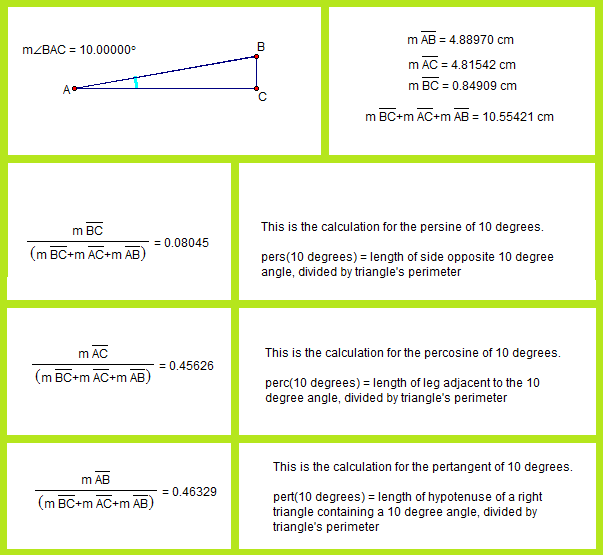
Pertrigonometric functions are modifications of the three primary trigonometric functions. Unlike the familiar sine, cosine, and tangent functions, the “pertrig” functions include triangle perimeter in their right-triangle-based definitions, which are given in the bulleted list below. The longer form of “pertrigonometric functions” is “perimeter-based trigonometric functions,” and the shorter, informal version is “pertrig functions.”

  • The persine of an acute angle (abbreviated “pers”) equals the length of the side opposite that angle, in a right triangle, divided by the triangle’s perimeter.
  • The percosine of an acute angle (abbreviated “perc”) equals the length of the leg adjacent to that angle, in a right triangle, divided by the triangle’s perimeter.
  • The pertangent of an acute angle (abbreviated “pert”) equals the length of the hypotenuse of a right triangle containing this acute angle, divided by the triangle’s perimeter.

After defining these terms, I used Geometer’s Sketchpad to construct a right triangle containing a 10º angle, and then used the “measure” and “calculate” functions to find the values of pers(10º), perc(10º), and pert(10º). Since these are ratios, they would have the same values shown for larger or smaller right triangles which contain 10º angles.

pertrig functions

An observation: the pertangents of complementary angles are equal. Why? Because complementary angles appear in all right triangles, as pairs of acute angles in the same triangle. For each such complementary angle pair, therefore, the same triangle is used to define pertangent. The hypotenuse/perimeter ratio (which is pertangent) would, it follows, remain unchanged — because both its numerator and denominator remain unchanged.  This relationship does not hold for the tangent function; instead, the tangents of complementary acute angles are reciprocals of each other.

Of course, I wanted to know more than just the pers, perc, and pert values for 10º, but I had no desire to repeat the same calculations, many more times, to form a table. Instead, I simply graphed the functions, again using Geometer’s Sketchpad. The units on the x-axis are degrees, not radians.

pertrig functions B

In the graph above, the dark blue curve is the persine function, with the sine function in light blue, for comparison. Similarly, percosine is shown in red, with cosine shown in pink. Finally, pertangent is shown with a heavy, dark green curve, while tangent is shown as a thinner, light green curve.

Entering the equations for these curves was a little tricky, due to the fact that I wanted this graph to venture beyond 0 and 90 degrees, in both directions, on the x-axis. When that is done, the unit circle must be used (in place of right-triangle based definitions), simply because no right triangles contain angles outside this range. The radius of the unit circle is 1, by definition, and that is the hypotenuse of the right triangle which exists in the zero-to-ninety degree part of the domain of the graph above. As a consequence of setting the length of the hypotenuse of each right triangle at 1, the side opposite the angle in question (used for persine) becomes, simply, the sine of that angle, while the adjacent leg’s length is the angle’s cosine. It then follows that the perimeter (the denominator of the pers, perc, and pert ratios) is equal to sin(x) + cos(x) + 1.

Calculations are shown on the graph above, and you can click on the graph to enlarge it, to make them more readable. In these calculations, one more adjustment had to be made, and that was to the perimeter portion of each pertrigonometric ratio. Using sin(x) + cos(x) + 1 works fine for perimeter, for the zero-to-ninety degree portion of the domain, but, outside that, negative numbers intrude, for values of sin(x) and/or cos(x). It is my contention that triangle perimeter only makes sense as a sum of absolute values of a triangle’s three side lengths. To obtain absolute values for both sin(x) and cos(x) in the perimeter-part of each calculation, then, I simply squared each of these two functions, and then took the square roots of those squares. The result of this can be seen on the graph, in the curve for the pertangent function, which resembles a child’s drawing of waves in the ocean. On the y-axis, it never reaches as low as 0.4, and its maximum value is clearly exactly 0.5 — at the sharp “wave peaks.” At the (smooth) troughs, the actual minimum is equal to the square root of two, minus one, or ~0.414, although I have not yet figured out exactly why that is the case — I simply noticed it on the graph — but, to investigate it further, I know where to look: the 45-45-90 triangle, since these minima are hit when x = (45 ± 90n) degrees, where n is any integer. The pertangent function has the shortest period of all the functions shown above, at a mere 90º. For tangent, by contrast, the period is 180º. All four of the other functions shown have periods of a full 360º.

It is striking that the pertangent and tangent curves bear little resemblance to each other, while marked resemblances do exist between the persine and sine curves, as well as between the percosine and cosine curves. In informal terms, the persine curve is a shorter and spikier (but still recognizable) version of the sine curve (vertically, with the amplitude exactly one-half as great for the shorter persine curve, relative to the sine curve), but, horizontally, the two curves are synchronized. The same relationship holds for the percosine and cosine curves. Also, it is well-known that the cosine curve is simply the sine curve, phase-shifted one-quarter cycle (or 90º, or π/2 radians) to the left. This phase-shift relationship between the cosine and sine curves holds, precisely, for the percosine and persine curves.

There is a simple reason why persine, percosine, and pertangent all peak at exactly y = ½. All three functions generalize, for acute angles, to this ratio — (some side of a right triangle)/(perimeter of that same triangle) — and no side of any triangle can ever exceed, nor even reach, half that same triangle’s perimeter. In all three cases, the maximum y-value is only reached, even in the zero-to-ninety degree portion of the domain, for “degenerate cases” — angles of 0º or 90º, which are, of course, not acute angles at all. Interpreted as triangles, these are cases where either a triangle becomes so short that it collapses to a single segment, or the opposite degenerate situation: two parallel lines, connected by a single segment. If you try to make either (or both) of the acute angles in a right triangle into an additional right angle, after all, that’s what you get.

To my knowledge, no one has described these pertrigonometric functions before, by this or any other name, although I could be wrong. (If I am wrong on this point, please let me know in a comment.) Regardless of whether this is their first appearance, or not, I did not invent them. The reason for this is simple: nothing in mathematics is ever “invented” — only discovered — for mathematics existed long before human beings existed, let alone started writing things down. How do I know this? Simple: there was a universe here before there were people, and all evidence indicates that it operated under the same laws of physics we observe today — and all evidence to date also indicates that those laws are mathematical in nature. Therefore, with the “pertrig” functions, I either discovered them, or, if they have been found before, then I independently rediscovered them.

Finally, I’ll address that question so often asked, about numerous things, in mathematics classes: what are these pertrigonometric functions used for? As far as I know, the answer in this case, so far, is absolutely nothing, other than delighting me by their very existence. It is possible that this may change, for someone might find a way to make a profitable application of these functions — and I won’t get any money if they do, either, for I am not copyrighting any of this. Nothing in mathematics is subject to ownership.

Honestly, though, I hope no one ever finds any practical, “real-world” use, at all, for pers, perc, or pert. Right now, they are pure mathematical ideas, unsullied by tawdry, real-world applications, and, well, I like that. I am far from the only person who ever had such an attitude about a mathematical idea, either — such views are actually fairly common in the mathematical community. Most of those who try to discover previously-unseen things in mathematics do so solely, or primarily, for one reason: the joy of discovery, in its purest form.

My Antibirthday Occurs at Midnight Tonight

Birthday-Cake

Clearly, this requires some explanation.

January 12 is my birthday, and today is July 13, 2015.

  • Remaining days in January, after today: 19
  • Days in February through June, this year, which isn’t a leap year: 28 + 31 + 30 + 31 + 30 = 150
  • Days in July up to, and including, today: 13
  • Total days after my last birthday, up to and including today: 19 + 150 + 13 = 182

How long until my next birthday, starting at midnight, tonight?

  • The rest of July: 18 days
  • August through December: 31 + 30 + 31 + 30 + 31 = 153
  • Pre-birthday January days: 11
  • Total days between today and my next birthday: 18 + 153 + 11 = 182, also.

Since the number of days between the end of my last birthday, and midnight tonight, is exactly the same as my number of pre-birthday days which follow midnight, it follows that midnight tonight is the one point in time, this year, which is as far away from my birthday as one can get, on the calendar. The fact that antibirthdays are usually points in time, rather than full days, is a consequence of the fact that most years have an odd number of days. Subtract one for my birthday (or anyone’s, except for those rare people born on February 29 — we’ll get to them later), and 364 days remain in most years. Divide this by two, and there are 182 days to fall on either side of an antibirthday midnight, for most people, during most years.

Next year, 2016, is a leap year. What will happen to my antibirthday next year, then, with its 366 days? As it turns out, next year’s antibirthday, for me, will be a full day. Why? Adding “leap day” makes it necessary to subtract two days, rather than just one, to get 364. (An even number of post-subtraction days is needed for divisibility, by two, with no remainder.) My antibirthday in 2016 will be on July 13, all day long, because there are 182 days between that day and both of my nearest birthdays — one in that antibirthday’s near past, and one in its near future.

If we don’t have the same birthday, and you want to figure out when your own antibirthday is, you can follow the pattern above, with only minor adjustments, if your birthday, like mine, falls on or before February 28. Some additional adjustments will be needed for those with birthdays in March through December, though. Why it that? Simple: my birthday occurs before February, and this isn’t true for most people. My full-day antibirthdays occur during leap years only because of this fact. If your birthday occurs after February is over, you’ll still get full-day antibirthdays every four years, but those years won’t be leap years — they’ll be one year removed from leap years, instead. Whether this means such years will immediately precede, or follow, leap years is left as an exercise for the reader.

There’s a small group of people for whom this gets even more complicated: those whose birthdays only happen every four years, on “leap day,” February 29th. Of the people I know well, only one of them, my friend Todd, was born on a leap day, and, just to be a pest, I’m going to assign him the problem of figuring out his own antibirthdays. After all, he has plenty of time for this, since the fact that he only has a birthday every four years causes him to age at 25% of the normal rate. He looks only a bit older than me, having had only a few more birthdays that I’ve had, even though he was born in 1812, and can remember the American Civil War clearly. Fortunately for him, he was still a child in the 1860s, and this saved him from actually having to fight in that war, or any other. It must be nice to have a 280-year life expectancy, Todd!

[Image credit: before turning the birthday-cake picture above upside-down, I downloaded it from this website.]

Free the Frozen People!

150127_0000

After seeing this sign in a local grocery store, I carefully searched the entire frozen food section, but I could find neither the frozen Mexican, nor the frozen Asian. Since they were gone, but the sign indicates they were there at one point, I concluded that the experiment was over, and hoped they had thawed out both experimental test subjects, found them still healthy after a few days in cryogenic suspended animation, and sent them home, each with a fat check to compensate them for the huge risk they just took.

However, even with compensation and signed consent forms, I still have certain ethical reservations about scientists performing this sort of experiment on actual human beings. Why not freeze, thaw, refreeze, and rethaw mice, instead? Is PETA really that scary?

Are they still doing these experiments, in my town or elsewhere? If so . . . free the frozen people!

There is one last thing about this whole thing which I just can’t figure out, though, and that’s this: why were they storing their frozen, experimental, human test subjects in the middle of a central Arkansas grocery store in the first place?

I Can’t Stop Listening to the Unsilent Quiet

An incomplete list of things I can hear right now:

1. The spinning of my laptop’s hard drive
2. The spinning of the blades of the exhaust fans that keep my laptop from overheating
3. This apartment’s air conditioning
4. The ringing in my own ears, which I blame on living in a noisy world
5. The “sixty-cycle hum” — a 60 Hz humming sound produced by pretty much anything running off alternating current (refrigerators are the worst)
6. The sound of my own fingers typing on the keyboard of my laptop
7. The whirling blades of ceiling fans in several places in this apartment, and adjacent apartments
8. Traffic on nearby roads
9. My never-ending internal monologue

Except during power failures, which shorten the list a lot, this is about as quiet as it ever gets here. Another person might call this “silence.” It isn’t.

There is no silence.

Ever.

Testing a Climate Change Claim: Does Burning a Gallon of Gasoline Really Put Twenty Pounds of Carbon Dioxide Into the Atmosphere?

OLYMPUS DIGITAL CAMERA

OLYMPUS DIGITAL CAMERA

When I read, recently, that “every gallon of gas you save not only helps your budget, it also keeps 20 pounds of carbon dioxide out of the atmosphere,” (source) I reacted with skepticism. Twenty pounds? That seemed a bit high to me.

Just because it seems high, to me, though, doesn’t mean it’s wrong, any more than “about.com” putting it on the Internet makes the statement correct. No problem, I thought: I’ll just do the math, and check this for myself.

So, in this problem, we start with a gallon of gasoline. In units I can more easily work with, that’s 3.785 liters (yes, they rounded it incorrectly on the gas can shown above). Google tells me that the density of gasoline varies from 0.71 to 0.77 kg/L (reasonable, since it floats on water, but is still heavy to lug around), so I’ll use the average of that range, 0.74 kg/L, to find the mass of a gallon of gasoline: (3.785 L)(0.74 kg/L) = 2.8 kg.

Next, I need to find out how much of that 2.8 kg of gasoline is made of carbon. That would be an easy chemistry problem if gasoline were a pure chemical, but it isn’t, so I’ll estimate. First, I’ll ignore the elements which only make up a minor part of gasoline’s mass, leaving only hydrogen and carbon to worry about. Next, I consider these things:

  1. Alkanes larger than methane (major gasoline components), whether branched-chain or not, have slightly more than two hydrogen atoms for every carbon atom. This ratio doesn’t exceed three, though, and is equal to three only for ethane, which has too high a boiling point to remain in liquid form at typical temperatures and pressures, anyway.
  2. Cycloalkanes, another major component of gasoline, have exactly two hydrogen atoms for every carbon atom.
  3. Aromatic hydrocarbons can have fewer than two hydrogen atoms for every carbon atom, and these chemicals are also a major component of gasoline. For the simplest aromatic hydrocarbon, benzene, the H:C ratio drops to its lowest value: 1:1.

For the reasons above, I’m choosing two to one as a reasonable estimate for the number of atoms of hydrogen for every atom of carbon in gasoline. Carbon atoms, however, have twelve times the mass of hydrogen atoms. Gasoline is therefore ~12/14ths carbon, which reduces to ~6/7. I can now estimate the mass of carbon in a gallon of gasoline: (6/7)(2.8 kg) = 2.4 kg.

So how much carbon dioxide does that make? Well, first, does a car actually burn gasoline completely, so that every carbon atom in gasoline goes out the tailpipe as part of a carbon dioxide molecule? The answer to this question is simple: no.

However, this “no” doesn’t really matter, and here’s why. In addition to carbon dioxide, automobile exhaust also contains carbon present as carbon monoxide, unburned carbon, and unburned or partially-burned hydrocarbons. To have an environmental impact, though, it isn’t necessary for a given carbon dioxide molecule to come flying straight out of the tailpipe of one’s car. In our oxygen-rich atmosphere, those carbon atoms in car exhaust which are not yet fully combusted (to each be part of a carbon dioxide molecule) are quite likely to end up reacting with oxygen later on — certainly within the next year, in most cases — and the endpoint of carbon reacting with oxygen, once combustion is complete, is always carbon dioxide. What’s carbon monoxide, then? Well, one way to look at it is this: molecules of carbon monoxide are simply half-burned carbon atoms. When the other half of the burning (combustion) happens, later, carbon dioxide is the product. So, for purposes of this estimate, I am assuming that all 2.4 kg of carbon in a gallon of gasoline ends up as carbon dioxide — either directly produced by the car, or produced in other combustion reactions, later, outside the car.

The molar mass of elemental carbon is 12 grams. For oxygen, the corresponding figure is 16 g, but that becomes 32 g of oxygen in carbon dioxide, with its two oxygen atoms per molecule. Add 12 g and 32 g, and you have carbon dioxide’s molar mass, 44 g. Therefore, 12 g of carbon is all it takes to make 44 g of carbon dioxide; the rest of the mass comes from oxygen in the air. By use of ratios, then, I can now find the mass of carbon dioxide formed from burning a gallon of gasoline, with its 2.4 kg of carbon.

Here is the ratio needed: 2.4 kg of carbon / unknown mass of carbon dioxide produced = 12 g of carbon / 44 g of carbon dioxide. By cross-multiplication, and using “x” for the unknown, this equation becomes (12 g)(x) = (44 g)(2.4 kg), which simplifies to 12x = 105.6 kg, so, by division, x = 8.8 kg of carbon dioxide produced from one gallon of gasoline.

Each kilogram (of anything), near sea level on this planet, weighs about 2.2 pounds. This 8.8 kg of carbon dioxide, then, translated into “American,” becomes (8.8 kg)(2.2 pounds/kg) = 19.36 pounds. Given the amount of estimation I had to do to obtain this answer, this is close enough to twenty pounds for me to conclude that the statement I was examining has survived my testing. In other words, yes: burning a gallon of gasoline goes, indeed, put about twenty pounds of carbon dioxide into the atmosphere.

However, I’m not quite finished. Carbon dioxide is an invisible gas, making it quite difficult to picture what twenty pounds of it “looks” like. To really understand how much carbon dioxide this is, it would be helpful to know its volume. So I have a new problem: 8.8 kg of pure carbon dioxide is trapped, in a balloon, at standard temperature and pressure. What is the balloon’s volume?

To solve this problem, one needs the density of carbon dioxide under these conditions, which chemists refer to as “STP” (standard temperature and pressure). According to Google, the density of carbon dioxide at STP is about 1.98 kg per cubic meter. Since 8.8 kg / (1.98 kg/m³) = 4.44 m³, this means that a gallon of gasoline can produce enough carbon dioxide, held at STP, to inflate this balloon to a volume of 4.44 cubic meters. For the benefit of those who aren’t used to thinking in metric units, that volume equals the volume of a perfect cube with an edge length of ~5.4 feet. You could fit a bunch of people into a cube that large, especially if they were all on friendly terms.

Now, please consider this: all of that was from one gallon of gasoline. How many gallons of gas do you typically buy, when you fill up your car’s gas tank? Well, multiply by that number. How many times do you fill up your car, on average, in a year? Multiply again. Next, estimate the total number of years you will drive during your lifetime — and multiply again. You now have your own personal, lifetime carbon dioxide impact-estimate from just one activity: driving.

This may sound like a change of topic, but it isn’t: what’s the hottest planet in the solar system? Even though Mercury is much closer to the Sun, the answer is Venus, and there is exactly one reason for that: Venus has a thick atmosphere which is chock-full of carbon dioxide. In other words, yes, the planet nearest the Earth, and the brightest object in the sky (behind the Sun and the Moon), Venus, is one of the best warnings about global warming known to exist, and we’ve known this for many decades. One wonders if any theologian has ever speculated that the creator of the universe designed Venus this way, and then put it right there “next door,” on purpose, specifically as a warning, to us, about the consequences of burning too much carbon.

The science, and the math which underlies it, are both rock-solid: climate change is real. Lots of politicians deny this, but that’s only because of the combined impact of two things: their own stupidity, plus lots of campaign contributions from oil companies and their political allies. Greed and stupidity are a dangerous combination, especially when further combined with a third ingredient: political power. Voting against such politicians helps, but it isn’t enough. One additional thing I will do, immediately, is start looking for ways to do the obvious, in my own life: reduce my own consumption of gasoline. Since I’m putting this on the Internet, perhaps there will be others persuaded to do the same.

The truth may hurt, but it’s still the truth: the United States is a nation of petroleum junkies, and we aren’t just harming ourselves with this addiction, either. It’s time, as a people, for us to invent, and enter, fossil-fuel rehab.

[Image credit: “GasCan” by MJCdetroit – Own work. Licensed under CC BY 3.0 via Wikimedia Commons – https://commons.wikimedia.org/wiki/File:GasCan.jpg#/media/File:GasCan.jpg]