Is the Moon a Magnet for Ignorance?

is the moon

Google’s search-suggestions for “is the moon,” shown above, clearly indicate support for the “magnet for ignorance” conjecture.

My favorite one from this list: “is the moon real”? I’ve looked into this, and there are apparently quite a few people utterly convinced that the Moon is a hologram, created by NASA, for reasons I have not been able to discern.

A Proven Method for Getting Teenagers to Read

read

Although I am a teacher, I am not an English teacher — but I also believe that, as a teacher of anything, I have an ethical and professional responsibility to promote literacy.

Many such methods for doing so exist. This is the one I use. The authors I have gotten teens reading most often, with this method, are Richard Feynman, Robert Heinlein, Neil deGrasse Tyson, Jung Chang, Flannery O’Connor, and Stephen Hawking. If a teenager in a science class, a subject I do teach, completes his work from me, with a high level of accuracy, and in an unusually short time, I keep books by these authors on hand as my set of “emergency back-up teachers.” Turning bored students into engaged and interested students is, I am learning, the key to avoiding teacher-burnout — at least for me.

Next on my list to add to the books I use for this ongoing project: multiple copies of The Autobiography of Malcolm X. I haven’t read it since I was in high school myself, and its impact still lingers.

Why I Do Not Write Books

not writing

It’s very simple: errors in writing, of any kind, horrify me. If I wrote a book, and it were published, some would likely slip through, such as the one in the image above. If a book with my name on the cover had been published, and I then discovered an error, I would end up trying to get corrected copies to every buyer of the first edition, eating all profits, and then some. I also just don’t need that type of stress.

Please do not misunderstand: I love books.

Therefore, I do two other things, in lieu of actually writing a book (which has been suggested, to me, more than once). First, I read other peoples’ books. I seek higher-quality books to avoid those irritating typos, for they actually cause me pain when I see them. Even so, some slip through — ouch! — but at least the mistakes aren’t mine. I am almost immune to conventional causes of embarrassment, but this isn’t a conventional cause, and I certainly have no immunity to it.

The other thing I do is to blog, which is, of course, another form of writing. It’s a perfect forum for someone with this writing-quirk — because, when I discover a mistake in my writing, even months or years later, I can edit it away in seconds. This is why, for me, blogging > writing books. However, I am grateful that there are good writers for whom the inequality symbol points in the other direction.

On the Problem of Evangelical Atheism

evangelical atheism

The term “evangelical atheism” may seem like a contradiction, but, hopefully, the image above clarifies what it means. It’s the zealous pushing of others to abandon religious beliefs, and it isn’t helpful to anyone.

John Lennon never, to my knowledge, publicly proclaimed a personal religious belief, but he didn’t apply the word “atheist” to himself, either; others did that. The same thing has happened repeatedly to Neil deGrasse Tyson, as he explains further, below. In both cases, these are people who are fiercely independent in their thinking, and not afraid to offend others — but that doesn’t mean they want to be associated with evangelical atheists, whose hostility to religion, and religious people, makes the world a more dangerous place. The more logical goal is a peaceful world, and that means one where the faithful and the skeptical can coexist peacefully.

For this to happen, work is needed on both sides, by the people on each side. The reasonable and moderate religious millions have religious extremists to (try to) calm down, each in their own groups, and they’ve got their hands full with that. It falls to non-religious people to deal with the extremists on the other side — the type who go beyond Richard Dawkins, Sam Harris, and the late Christopher Hitchens, all three of whom conceded, in books of theirs which I have read, that they would change their minds on the subject of the existence of a deity, shown adequate empirical evidence for the existence of one. This was a consequence of the fact that all three men have written things based on rational thought. (They’ve also let their emotions get in the way sometimes, and become overly angry, but I’m referring to their better works, especially that of Harris.)

Evangelical atheists don’t write books. They can’t calm down long enough for that. Instead, they are more likely to speak out through angry and insulting videos they post on YouTube, harassment of believers (or agnostics, or those who simply don’t want to be labeled by others) on Facebook, and, of course, old-fashioned, face-to-face bullying.

I prefer the term “skeptic” for myself, as I have explained here before, for I like that balance struck by that term: insistence on evidence, balanced by openness to new evidence, even if it contradicts previous views (about anything). I also don’t want to associate myself with the evangelical atheists, which is the primary reason I abandoned use of the word “atheist” for myself, some time ago.

This made a few evangelical atheists angry, some to the point of losing all ability to reason (predictably), to the point of open warfare on my Facebook. To stop this, I literally deactivated that account for several days, that being the easiest option to shut that down quickly.

As for Neil deGrasse Tyson and John Lennon, I will let them speak for themselves.

Religious people aren’t going away any time soon. Neither are the non-religious. If we’re going to enjoy “living life in peace,” the hatred and hostility both need to go, from both sides of the “divide of belief” . . . and that isn’t too much to ask.

The True Tale of the “Facebook Agent”

facebook

Today, a guy claiming to be named Ronnie Crider friend-requested me on Facebook. It wasn’t long after I accepted the friend-request before I got a private message from him, at which time I found out that, according to his profile and his messages to me, he’s a “Facebook Agent.”

It seems this supposed F.A. needed certain personal information from me, so that he could get my “$200,000 thousand United State dollars” prize to me, at which point the conversation got bogged down, since I wanted clarification whether he wanted to give me two hundred thousand thousand (which is two hundred million, and is what he typed), or just a “mere two hundred thousand,” as I called it, it only being 0.1% of the originally stated figure. The amount he was pretending to offer sounded paltry, when compared to the much higher figure he actually, but accidentally, pretended to offer!

After getting giving him sufficient “rope,” which he used, as predicted, for the usual purpose in such situations, I reported him to Facebook — for impersonating Facebook. I thought T.R. Facebook (“The Real Facebook”) would have a serious problem with F.S. Facebook (“Fake Scammy Facebook”) doing their fake scammy things. This seems reasonable, does it not?

However, I just got a message, in response to my report, from T.R. Facebook, and they aren’t closing F.S. Facebook’s account. Apparently, T.R. Facebook is just fine, for reasons I do not understand, with people pretending to be “Facebook Agents,” but I still wouldn’t recommend it. To anyone. That’s no way to live one’s life. 

I have this guy blocked now, but I did notice we had a bunch a mutual friends on T.R. Facebook, so those who know me on T.R. Facebook, in particular, are advised to watch out for F.S. Facebook, who uses the name mentioned above, and a profile-picture of a white guy in a suit, approximate age 50. I’m including the actual name he used because he (or she) probably stole it from some guy whose real name is Ronnie Crider, and perhaps that identity-theft victim will find out he is being impersonated because of this blog-post. The odds are small, but it is possible. Perhaps, if the actual Ronnie Crider reports F.S. Facebook for impersonating him, then T.R. Facebook will close his account. Maybe.

Now, of course, “watching out” for Agent F.S. Facebook, as I advised above, doesn’t mean you can’t have a little fun at his expense. If you would find it an entertaining diversion, and want to toy with him over his terrible math and writing when/if he contacts you, as I did, I suppose that’s what he deserves, for trying to scam people.

Later note: T.R. Facebook contacted me again, and now they are reviewing the rules of Facebook with F.S. Facebook, which sounds like oh so much fun to endure, does it not? Perhaps T.R. Facebook follows my blog?

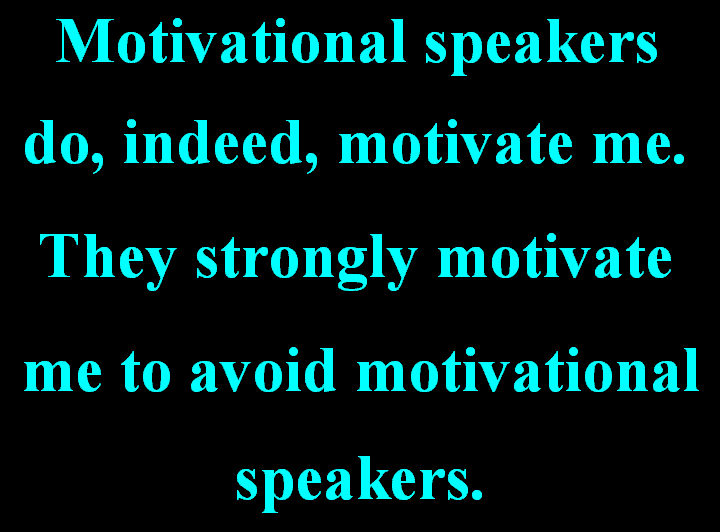
On Motivational Speakers

motivational speakers

The Physics of Cats, Copperheads, Centipedes, Catbounce, and Catbouncemax

catbouncemax

Definition of catbouncemax (shortened form of “maximum catbounce”): for any particular cat, its catbouncemax is equal to the takeoff kinetic energy of that cat if it suddenly and unexpectedly finds itself face-to-face with an adult copperhead snake.

I’ve actually seen this happen. Really. The cat reached a height I estimate as 1.4 meters.

Measured in joules, a cat’s catbouncemax can most easily be approximated by observing and estimating the maximum height of the cat under these conditions. For ethical and safety reasons, of course, one must simply be observant, and wait for this to happen. Deliberately introducing cats and copperheads (or other dangerous animals) to each other is specifically NOT recommended. Staying away from copperheads, on the other hand, IS recommended. Good science requires patience!

After the waiting is over (be prepared to wait for years), and the cat’s maximum height h, in meters, has been estimated, the cat’s catbouncemax can then be determined by energy conservation, since its takeoff kinetic energy (formerly stored as feline potential energy, until the moment the cat spots the copperhead) is equal to the gravitational potential energy (PE = mgh) of the cat at the top of the parabolic arc. In the catbounce I witnessed, the cat who encountered a copperhead (while walking through tall grass, which is why the cat didn’t see the snake coming) was a big cat, at an estimated mass of 6.0 kg. His catbouncemax was therefore, by energy conservation, equal to mgh = (6.0 kg)(1.4 m)(9.81 m/s²) = ~82 joules, which means this particular cat had 82 J of ophidiofeline potential energy stored, specifically for use in the event of an encounter with a large, adult copperhead, or other animal (there aren’t many) with the ability to scare this cat equally as much as such a copperhead. (I’m using a copperhead in this account for one reason: that’s the type of animal which initiated the highest catbounce I have ever witnessed, and I seriously doubt that this particular cat could jump any higher than 1.4 m, under any  circumstances.)

It should be noted that the horizontal distance covered by a catbounce is not needed to calculate a cat’s catbouncemax. However, this horizontal distance will not be zero, as is apparent in the diagram above. Why? Simple: cats don’t jump straight up in reaction to copperheads, for they are smart enough not to want to fall right back down on top of such a snake.

It is more common, of course, for cats to jump away from scary things which are less scary than adult copperheads. For example, there certainly exist centipedes which are large enough to scare a cat, causing it to catbounce, but with that centipede-induced catbounce being less than its catbouncemax. The following fictional dialogue demonstrates how such lesser catbounces can be most easily described. (Side note: this dialogue is set in Arkansas, where we have cats and copperheads, and where I witnessed the copperhead-induced maximum catbounce described above.)

She: Did you see that cat jump?!?

He: Yep! Must be something scary, over there in that there flowerpatch, for Cinnamon to jump that high. At least I know it’s not a copperhead, though.

She: A copperhead? How do you know that?

He: Oh, that was quite a jump, dear, but a real copperhead would give that cat of yours an even higher catbounce than that! The catbounce we just saw was no more than 75% of Cinnamon’s catbouncemax, and that’s being generous.

She: Well, what IS in the flowerpatch? Something sure scared poor Cinnamon! Go check, please, would you?

He: [Walks over from the front porch, where the couple has been standing this whole time, toward the flowerpatch. Once he gets half-way there, he stops abruptly, and shouts.] Holy %$#@! That’s the biggest centipede I’ve ever seen!

She: KILL IT! KILL IT NOW!

Silver Conversion Chart: Troy, Metric, and U.S. Coin Information

silver

I’m most likely to need the information in the top third of this chart, myself, but I continued it all the way through 100 kg, for the benefit of those with much more money to invest in silver than I have.

How much does silver cost, per troy ounce? Right now, it’s in the $15 neighborhood, but that changes all the time. This is the website I use to keep an eye on the “spot” price of silver, but there are many other such sources, as well.

Stephen Hawking, on the Reasons We Explore

hot

The source for this screenshot-image, and quote, is the congratulatory message from Stephen Hawking to the entire New Horizons team at NASA, regarding the historic achievement of the fly-by through the Pluto/Charon system, earlier today. All I did was take the screenshot, and then add the quote to it.

Here is the entire message, as NASA posted it to YouTube.

Simplified Arkansas Weather Forecast for June, July, and August, of Almost Any Year

Warning: to avoid serious risk of major depression, read no further during May of any year, if trapped in Arkansas with little or no hope of quick escape.

hot

  • Today: hot!
  • Tonight: so hot you won’t be able to sleep, because you’ll stick to your bedsheets!
  • Tomorrow: hot!
  • The day after tomorrow: hot!
  • Three to six days from now: hot! Each day!
  • A week from now: hot!
  • Next week: hot! All week long!
  • The remainder of the month: hot! 
  • Next month (if it’s June or July now): hotter than this month!
  • The month after that (if it’s June now): hotter than it is right now!
  • Next month (if it’s August now): hot for weeks, turning to only-slightly miserable later in September. Maybe.