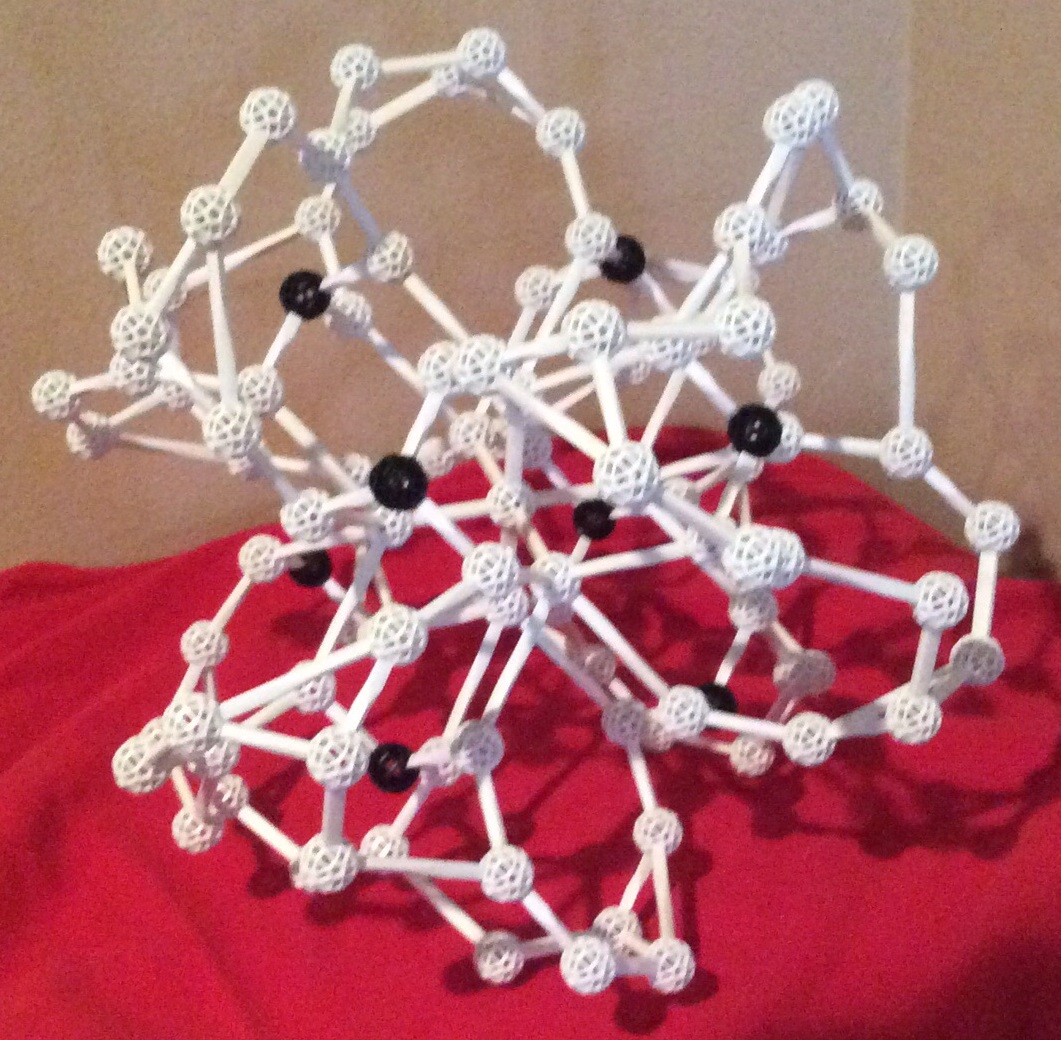
A Chiral Solution to the Zome Cryptocube Puzzle

This is my second solution to the Zome Cryptocube puzzle. In this puzzle, you start with a black cube, build a white, symmetrical, aethetically-pleasing geometrical structure which incorporates it, and then, finally, remove the cube. In addition, I added a rule of my own, this time around: I wanted a solution which is chiral; that is, it exists in left- and right-handed forms.

image (34)

It took a long time, but I finally found such a chiral solution, one with tetrahedral symmetry. Above, it appears with the original black cube; below, you can see what it looks like without the black cube’s edges.

image (35)

So an Ancestor of Mine Fed Insects to George Washington . . . .

“I have two cooks … one of them, Mr. Foutz … fancies himself quite the expert in worldly cuisine. … If we fed this army in the same manner Mr. Foutz has attempted to feed me, there would be mass desertion. He actually set out an elaborate dinner whose main attraction was bugs. Covered in some kind of sauce, mind you, but bugs nonetheless. I made the decision at that moment that Mr. Foutz would better serve this army by shouldering a musket.” ~George Washington, to Benjamin Franklin (Source: Rise to Rebellion, by Jeff Shaara, p. 385.)

I’ve just been told that this guy, whose name we know as Andrew Fouts, is an ancestor of mine. I rather like the idea of being descended from someone who fed insects to George Washington.

Does Everything Move at the Speed of Light?

everything moves at c

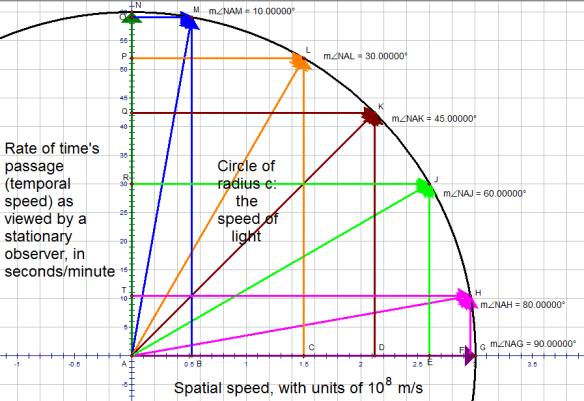
I have a friend who once explained to me his way of understanding spacetime, and what Einstein discovered about it, which was to start with the idea that, as he put it, “everything is traveling at c,” and proceed from there. Light travels at c, of course, but time does not pass for light, forming vector AG, shown in purple. A spatially-stationary rock is still traveling — temporally, into the future, at a rate of sixty seconds per minute, as represented by dark green vector AN. My friend’s idea was to interpret this rate of time-passage — the normal time passage-rate we generally experience — as another form of c. Sublight moving objects are moving at c, according to this idea, as a vector sum of temporal and spatial velocities. In this diagram, all spatial dimensions are collapsed into one direction (parallel to the x-axis), while time runs up (never down) the y-axis, into the future (never the past).

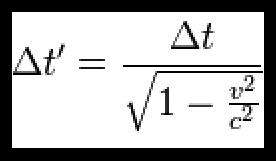
I don’t know why it took me perhaps a decade to see that my friend’s idea is testable. Better than that, the data needed to test it already exist! All I need to do is cross-check the predictions of my friend’s idea against a thoroughly-tested formula regarding relativistic time dilation. The relevant equation for time dilation is this one, which you can find in any decent Physics textbook:

equation for time dilation

In the diagram at the top of this post, the blue horizontal component-vector NM represents a spatial velocity of (c)sin(10º) = 0.173648c. It is a component of the total velocity of the object represented by blue vector AM, which is, if my friend is correct, is c, as a vector-sum total velocity — the sum, that is, of temporal and spatial velocities. By the equation shown above, then, the measured elapsed time for an event — say, the “minute,” in “seconds per minute” — to take place, at an object with that speed, as measured by a stationary observer, should be 1/sqrt[1-(0.173648)²] = 1/sqrt(1 – 0.0301537) = 1/sqrt(0.969846) = 1/0.984808 = 1.01543 times as long as the duration of the same event, for the observer, with the event happening at the observer’s location.

Now, if time is taking longer to pass by, then an object’s temporal speed is shrinking, so this slightly longer elapsed time corresponds to a slightly slower temporal speed. As seen in the equations above, near the end of the calculation, the two have a reciprocal relationship, so such an object’s temporal speed would only be 0.984808(temporal c) = 0.984808(60 seconds/minute) = 59.0885 seconds per minute. Therefore, an object moving spatially at 0.173648c would experience time at 0.984808k, where k represents the temporal-only c of exactly 60 seconds per minute — according to Einstein.

Next, to check this against my friend’s “everything moves at c” idea, I need only compare 0.984808 to the cosine of 10º, since, in the diagram above, based on his idea, vector BM = (vector AM)cos(10º). The cosine of 10º = 0.984808, which supports my friend’s hypothesis. It has therefore just passed its first test.

As for the other sets of vectors in the diagram, they provide opportunities for additional testing at specific relativistic spatial velocities, but I’m going to skip ahead to a generalized solution which works for any spatial velocity from zero to c, corresponding to angles in the diagram from zero to ninety degrees. Substituting θ for 10º, the spatial velocity, (c)sin(10º), becomes simply (c)sinθ, which corresponds to a temporal velocity of (c)cosθ, with it then necessary to show that the “cosθ” portion of this expression is equivalent to the reciprocal of 1/sqrt[1 -(sinθ)²],  after the cancellation of c² in the numerator and denominator of the fraction, under the radical, in the denominator of Einstein’s equation for time dilation. By substitution, using the Pythagorean trigonometric identity 1 = (sinθ)² + (cosθ)², rearranged as 1 – (sinθ)² = (cosθ)², the expression 1/sqrt[1 -(sinθ)²] = 1/sqrt[(cosθ)²] = 1/cosθ, the reciprocal of which, is, indeed, cosθ, which is what needed to be shown for a generalized solution.

My friend’s name is James Andrew Lemley. When I started writing this post (after the long process of preparing the diagram), I did not know what result I would get, comparing what logically follows from Andrew’s idea with the well-tested conclusions of Einstein’s time-dilation formula, at even one specific relativistic speed. Andrew, I salute you, and think this this looks quite promising. Based on the calculations above, and after all these years, I must tell you that I now think you are, indeed, correct: in a sense that allows us to better understand spacetime, we are all moving at c.

The Misadventures of Jynx the Kitten, Chapter Four: Jynx “Helps” with Grading Papers, and Discovers a New Talent

Pic-03292015-001

This is the last day of Spring Break, and grades for the third quarter are due tomorrow, so it should surprise no one that I’m grading papers. Things were going well, too, until Jynx the Kitten decided to “help.”

I told Jynx that I did not need his “help,” since I already know how to grade papers; I even told him that I very much needed not to have his “help.” Jynx did not care. Papers were there, and he was determined to grade them.

The only problem (for Jynx) was that, before Spring Break even began, I had sorted all the papers to be graded, folded each set separately, and fastened each bundle shut with a separate rubber band, simply to organize the papers to be graded. Some of us in education call this sorting-process “pre-grading,” or something like that. Jynx didn’t like it, though, for the rubber bands kept him from getting to the papers he so desperately wanted to grade (or eat, or shred, or something).

He could, of course, get to the rubber bands, for they were on the outside of each of the bundles of papers. He has claws to pluck them, and did so. He also started trying to pull off the rubber bands with his teeth. Each time a rubber band got plucked, by tooth or claw, twang! Different rubber bands on different bundles were stretched with varying tensions, producing rubber-band-twanging sounds of varying frequency. In other words: Jynx played different musical notes.

Soon, Jynx had forgotten all about grading papers, and was simply having fun playing music for the first time. He was delighted to be playing music . . . or frustrated that he couldn’t get the bundles open . . . or possibly both.

I had also forgotten all about grading papers, and simply sat, listening in amazement, for I’ve had cats all my life, and, aside from the familiar “cat on a piano” song many people have heard, I have never before heard a cat, nor a kitten, attempt to play music.

Jynx’s improvisational rubber-band piece started to improve rapidly with practice, and soon Jynx’s music was much better than even the best-rendered version of “cat on a piano” I have ever heard before — and he’s still a kitten!

Unfortunately, I was not able to open software to record Jynx’s music in time, before he moved on to other things, as kittens do fairly often. As a result, only my wife and I know what Jynx’s music actually sounds like. I did manage to snap the picture above, of him looking up at me from his “musical instruments,” before he moved on to the next of his hijinks for the day, of which there are always many.

And, now that Jynx has decided it’s nap time, I’ll get back to grading these papers.

My Impressions, Upon Wearing a CPAP Machine, at Home, for the First Time

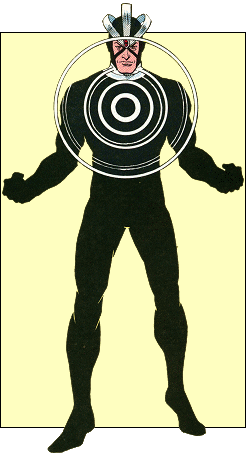
I was recently diagnosed with sleep apnea. As a result, I now have a CPAP machine, on me and running, for the first time at home. The headgear reminds me of the uniform Alex Summers wears, as Havok of the X-Men, except that his nose isn’t covered, as mine is. I also have shown no ability to focus the energy from cosmic rays at targets of my choice, or anything remotely like that . . . at least not yet.

Alexander_Summers_(Earth-616)_0001

Others seem to think I look a tad more ridiculous, however.

As far as how I sound, I literally have to keep my big mouth shut for this thing to work, so my wife (without whose help I couldn’t have gotten into this contraption) always gets the last word now. (Also last snicker, etc., as she just pointed out to me, happy that she can talk, without risk of interruption, for a change.) As she was putting it on, though, I talked as much as I could, until she reminded me that I’m not supposed to talk while, um, “CPAPping.” However, my last bit of chatter for the night sounded like Darth Vader doing an impersonation of Stephen Hawking.

Darth_Vader

Do You Like the Changes Here?

To reflect the fact that my blogging here has broadened from what it used to be (all polyhedra, all the time), I gave this blog a new tagline, title, and changed a few other things about the blog’s appearance. If you remember the way it looked before, I have a simple question for you: do you like the changes?

An Involuntary Conversation with Siri

I use an iPad, but I don’t like Siri. When she’s turned on, it’s by mistake, and without the need for her, um, “help.”

siri

The other day, I accidentally activated Siri. After she said her standard opening bit, I barked at her, “&%$# it, Siri! Go away!”

She replied, in the tone of one with hurt feelings, “I’m just trying to help.” I hadn’t even thought about the fact that she was listening.

Someone actually went to the trouble to give proto-A.I., which is what Siri is, the ability to sulk.

The Most Disturbing Thing I Ever Witnessed in a College Class

  • The Year: 1993
  • The College: The University of Central Arkansas
  • The Course: Educational Psychology

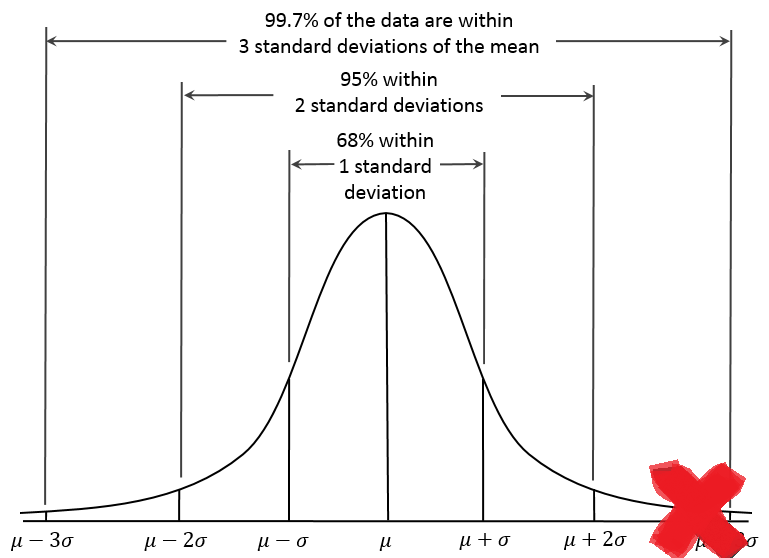
In a class called “Educational Psychology,” the bell curve, a statistical concept often used to describe the distribution of intelligence in humans, should be expected to receive some attention, and, when I took the class, it did — for about five minutes. I found the image below here; in this class, the professor drew a somewhat simpler version of it on a chalkboard.

Empirical_Rule (1)

The professor (who should be glad I do not remember his name, since I would blog it) proceeded to describe, briefly, characteristics associated with different “columns” of the bell curve, as some in academia apply it to intelligence. He then said, “Actually, what I’ve always really wanted to do was to get rid of these people.” He then added an “x” to what he’d drawn on the board. I’ve made it red, simply to make the location where he drew his “x” easier to see.

Empirical_Rule

I sat, in shocked silence, as the majority of the students in the class laughed. Laughed.

Once I could move again, after the initial, paralyzing shock turned into a deepening horror, I looked around the classroom. No one looked appalled, as I was; no one else even seemed to be disturbed, nor even slightly upset. Some were still visibly amused, in fact. I considered objecting, directly to the professor, but I was so affected by the whole episode that I was experiencing severe nausea. I couldn’t speak, for fear of throwing up.

The professor may not have known this — in fact, I would be surprised if he had — but what he was “joking” about has actually happened. It was called the Cambodian genocide, and was carried out by one of the most brutal regimes of the 20th Century, the Khmer Rouge. One of their tools used to stay in power was intimidation, taken to an extreme. In this photograph, from the article linked immediately above, you can see one form of this intimidation: the public display of the skulls of their victims. One need not be able to read to understand the message of such a display; below, the reason why this was important to the Khmer Rouge should become apparent.

800px-Choeungek2

I’ve studied this genocide. From just 1975 to 1979, the Khmer Rouge, driven by a radical Stalinist-Maoist and extremely anti-intellectual ideology, managed to reduce the population of Cambodia by an estimated 25%. They targeted, among many others, teachers. They separated children from their parents, since parents are often known to teach their children. They killed people who were seen wearing glasses — because glasses are often used to help people read books. They did their utmost to wipe out as much of the high-intelligence part of the bell curve as possible. They did their best to eliminate literacy.

Those who survived this horror were still devastated, for a whole nation had been traumatized — just imagine an entire country with PTSD (post-traumatic stress disorder). To make this situation even worse, the very people who could have helped most with the post-Khmer-Rouge recovery (doctors, therapists, teachers, clergy, etc. — all professions which require education) were almost entirely wiped out, and the people who could train new recruits for such professions had also been killed. As a direct result of this targeting of intellectuals for slaughter, the effects of the Cambodian genocide lasted far longer than the regime which perpetrated it.

I was thinking about this as the class period ended. In a daze, I walked away — far away. Even though I did return for future class sessions, since the course was a requirement for teacher certification, I never listened to another word that professor said, for he had permanently lost all credibility with me. At the end of the term, I left his class with an “A,” and a renewed determination to oppose those who, like the Khmer Rouge, try to “dumb down” society — at every opportunity. As for the people of Cambodia . . . they are still recovering, and will be, for many more years.

Wiping out a group of people — any group — simply isn’t funny.

“That which does not kill us makes us stronger.” Oh, really?

I have observed that many people often stop thinking about a phrase, and simply accept it, if they hear it repeated enough times. Since I don’t want to make this error, I’ve developed a habit of questioning such phrases. This quote, from Friedrich Nietzsche, definitely qualifies as a phrase which many believe because it’s repeated a lot, and it is certainly questionable. More than that, in fact: it is utter nonsense — and I can prove it.

The method I will use for this proof is reductio ad absurdam, in which one temporarily assumes the statement is true, then shows that it leads to a conclusion which is pure nonsense, which, in turn, shows that the original assumption of truth was a faulty one.

So the Nietzsche quote, purely for the purposes of this proof, is now (temporarily) assumed to be true. Since being stronger is beneficial, it now follows that we should actually seek out things which damage us, but without killing us. It isn’t hard to think of examples of such behaviors.

SONY DSC

If a person were to drive to a hospital’s emergency room, and, while standing just outside the entrance with a hacksaw, started using one hand to attempt to saw off the other one (warning: do not try this yourself!), damage would certainly result. This hypothetical person probably wouldn’t completely lose his hand, for (a) hacksaws are not fast, and (b) someone else would no doubt notice, and take action to stop the self-damage, in time to get him medical attention. He is, after all, already in the perfect place for it.

Another, much more common example:

img-thing

It’s possible for a person to drink these boxes of inexpensive red wine at a rate of five a week, but it’s an incredibly bad idea. Alcohol will do serious damage, consumed at that rate, given enough time, as can be verified with virtually any physician. Surviving prolonged binge-drinking is possible (but not guaranteed), even if done for a few years; I know this to be true because I have witnessed it. It wasn’t a pretty thing to watch, and the binge drinker could not be persuaded to stop. The binge drinking finally ended, but with an emergency trip in an ambulance needed, for immediate medical care, to prevent imminent death.

In each case, (1) the hypothetical person who tries to saw off his own hand while standing outside an emergency room, and (2) the real person (an adult whom I will not name) who consumed dangerous quantities of alcohol, something happens which damages them, but doesn’t kill them. Does it make them stronger? The first person could easily lose some functionality in his hand, and could also end up in a psychiatric institution. The second person suffered numerous forms of permanent damage to multiple systems of the body, resulting in permanent disability. Both rack up huge medical bills. These aren’t good things, for either person, and they are quite unlikely to “make one stronger.” A far more likely outcome is the exact opposite — each person is weakened, in the sense that are are rendered less able to deal effectively with the rest of their lives.

The proof is now complete. It turns out that those things which do not kill you can, quite possibly, weaken you, and expecting them to make you stronger simply makes no sense. So, world, please stop repeating this insipid Nietzsche-quote. Not only is it logically invalid; it’s also become one of the most annoying clichés in existence.

Fortunately, for those who want advice which actually makes sense, there are many sources available which are not Friedrich Nietzsche.

[Note: I did not create the images in this post, but simply found them with Google image-searches for “hacksaw” and “box of wine.”]

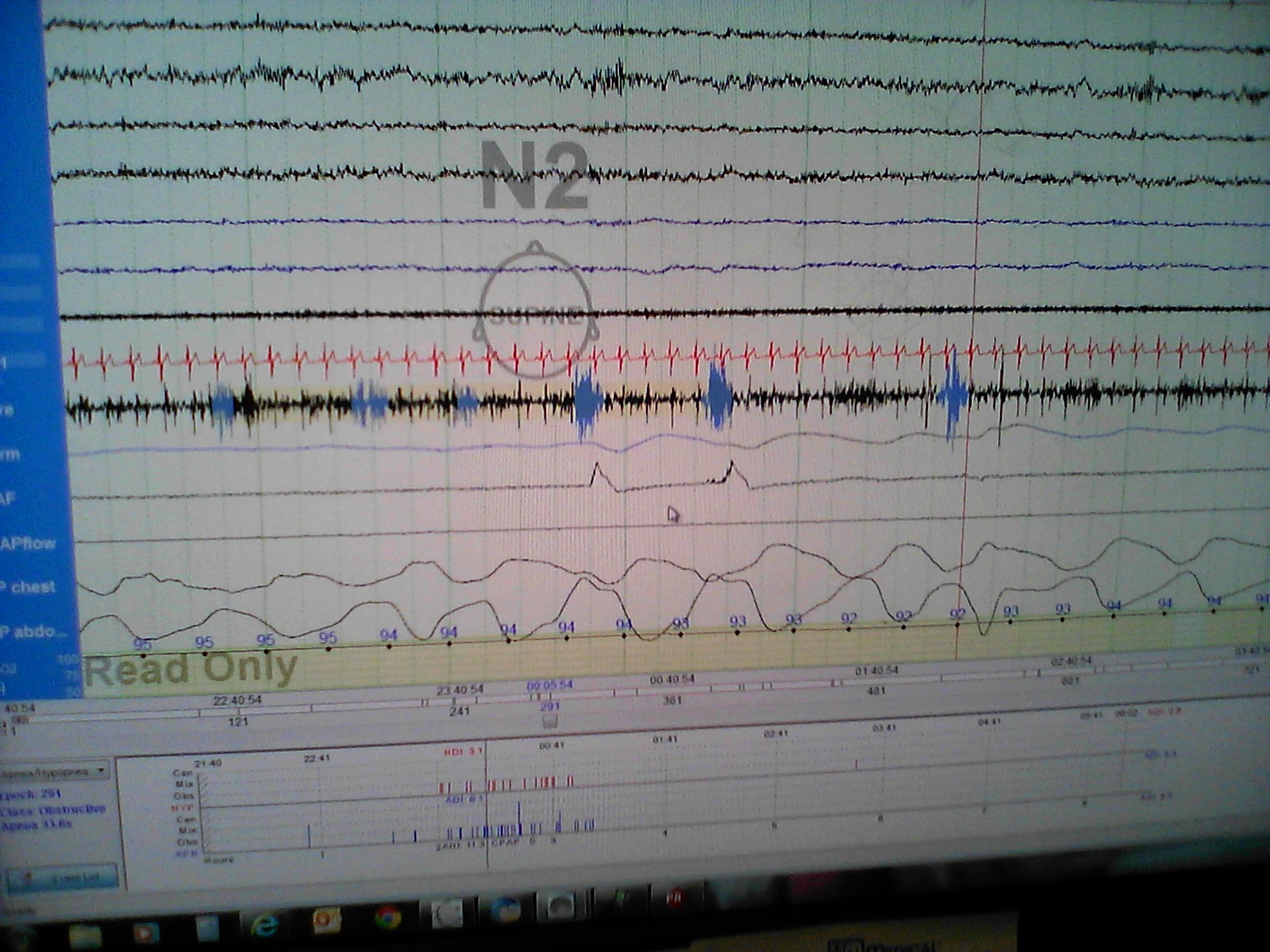
I Now Have Empirical Evidence for the Existence of My Own Brain!

Pic-03202015-001

A doctor needed to look at my brainwaves (and a bunch of other MSLs, also known as “medical squiggly lines”), as recorded during a sleep study, so of course I asked him if I could see them myself. Who wouldn’t want to see their own brainwaves?