
“Dysphoria” is the antonym of “euphoria.” Exposure to facts increases your risk of developing Trump Dysphoria Disorder, or TDD. To avoid the pain and suffering associated with TDD, you may wish to avoid any media outlets which are not Fox News.
“Dysphoria” is the antonym of “euphoria.” Exposure to facts increases your risk of developing Trump Dysphoria Disorder, or TDD. To avoid the pain and suffering associated with TDD, you may wish to avoid any media outlets which are not Fox News.

The design on each face of these great rhombcuboctahedra is made from 19 circles, and was created using both Geometer’s Sketchpad and MS-Paint. I then used a third program, Stella 4d (available here), to project this image on each of a great rhombcuboctahedron’s 26 faces, creating the image above.
If you watch carefully, you should notice an odd “jumping” effect on the red, octagonal faces in the polyhedron above, almost as if this polyhedron is suffering from an anxiety disorder, but trying to conceal it. Since I like that effect, I’m leaving it in the picture above, and then creating a new image, below, with no “jumpiness.” Bragging rights go to the first person who, in a comment to this post, figures out how I eliminated this anxiety-mimicking effect, and what caused it in the first place.
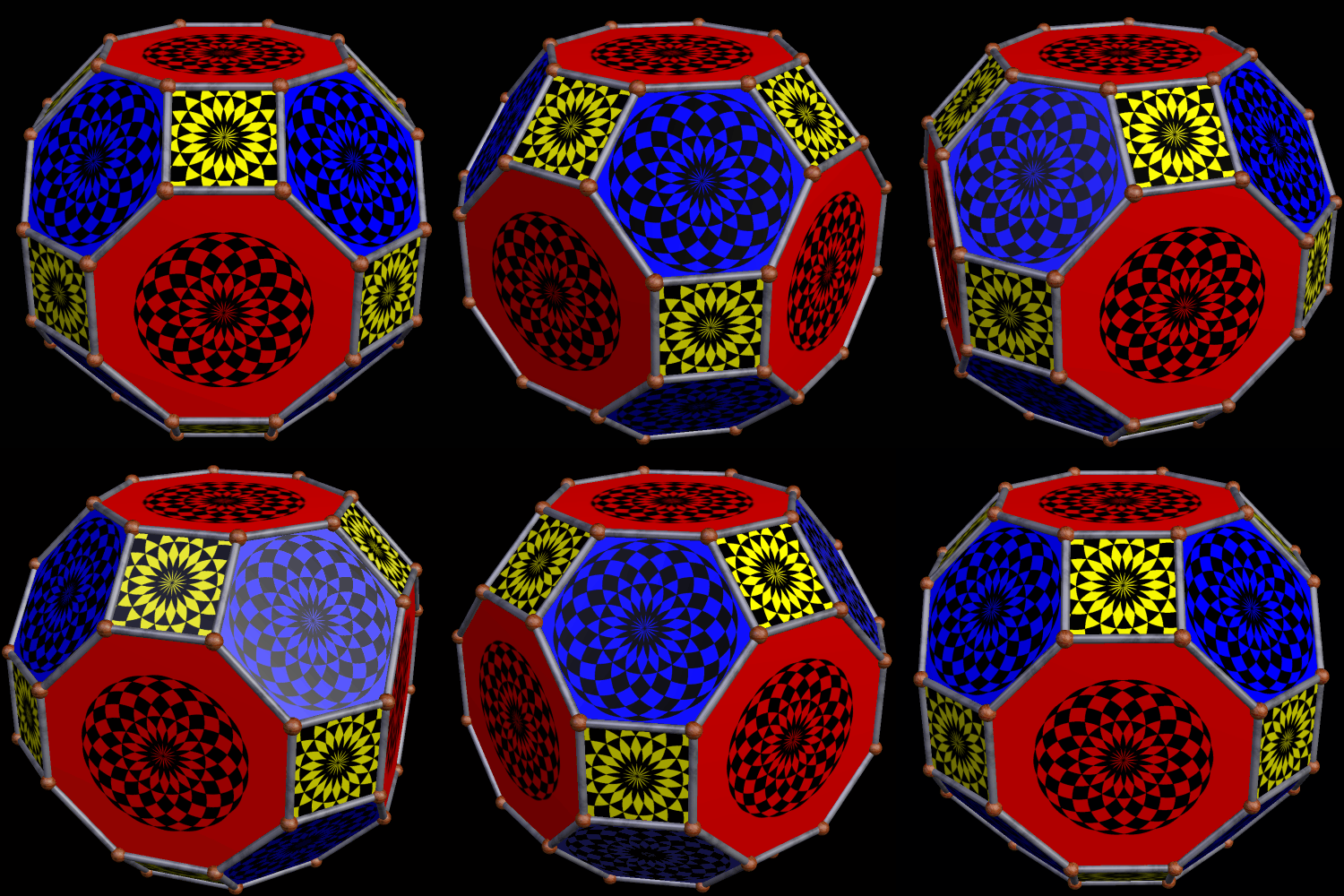
Your first hint is that no anti-anxiety medications were used. After all, these polyhedra do not have prescriptions for anything. How does one “calm down” an “anxious” great rhombcuboctahedron, then?
On a related note, it is amazing, to me, that simply writing about anxiety serves the purpose of reducing my own anxiety-levels. It is an effect I’ve noticed before, so I call it “therapeutic writing.” That helped me, as it has helped me before. (It is, of course, no substitute for getting therapy from a licensed therapist, and following that therapist.) However, therapeutic writing can’t explain how this “anxious polyhedron” was helped, for polyhedra can’t write.
For a second hint, see below.
.
.
[Scroll down….]
.
.
Second hint: the second image uses approximately twice as much memory-storage space as the first image used.

When my mother died, last November 16, I wrote an obituary for her, which I was then asked (unexpectedly) to read at her funeral, as one of two eulogies. This was one of the most difficult things I have ever done, but writing it did help me (somewhat) with the immediate problem I was having dealing with grief.
After the funeral, I felt numb much of the time, for months, until May 16 arrived — exactly six months after she died — at which point my tightly-controlled emotional state shattered, leaving me in worse shape (in some ways) than I was on, say, November 17 of last year. This was unexpected, and caused significant problems, including the development of monthly hexakaidekaphobia, a morbid dread and fear of the 16th day of every month. (The word is a modification of “triskaidekaphobia,” an irrational fear of the number thirteen).
June 16 was worse than May 16 — absolutely full of PTSD attacks. (I’ve had PTSD for most of my life; my mother’s death made it worse.) Fortunately, I don’t try to hide mental health problems, as I once did — I try to find the help I need, from physicians, to deal with such problems, and, when I find things that help me, I write about them. I also have long used recreational mathematics to help me feel better when depressed.
It was in this context that mid-July arrived. I went to sleep on July 15th with the knowledge that it was extremely important for me to find better coping mechanisms before the start of school in August. When I woke up on July 16, which could have been another horrific day of severe depression, anxiety, and other problems, I did not feel those negative emotions. This does not mean I had “gotten over” the facts that my mother did die, and that I miss her terribly. However, it did mean I was experiencing grief differently: I was feeling grief, rather than letting feelings of grief control me — and there is a huge difference between the two.
That morning, July 16, I knew what I needed to do as soon as I woke up: I needed to write. For me, that generally means blogging, and that’s what happened. This “therapeutic writing,” as I call it, was helpful enough on July 16 that I continued it the next day. When I next spoke to my doctors, I told them I was doing this, and why, and they agreed that such writing (like the “mathematical therapy” I have done for years) was an excellent, helpful activity. (This “check with professionals” step is essential, and I do not recommend attempting mental health therapy without the help of at least one licensed, qualified psychiatrist, and/or other type of therapist, such as a clinical psychologist.)
Of course, I could do this therapeutic writing in a spiral notebook, and keep it private; no writing has to go on the Internet. Why, then, do I choose to post such material where anyone can see it? I first explained why I blog about mental health issues in this post, but the short version is this: I hope that my openness on this subject can help reduce the social stigma which, unfortunately, still surrounds topics related mental health. This stigma is harmful because it keeps millions of people from seeking the professional help they need. I have also found it a personally liberating experience to come out of the “closet” on such issues, for, as with other metaphorical “closets,” it is the truth that closets are not good places for people to live their lives.
School starts on August 15 — only four days from now — and I’m going to do everything I can to make that day, the next day (the formerly-dreaded 16th of the month), and the rest of the days in the school year as good as they can possibly be for my students, as well as myself. I could tell I was on the right track when I decided to write about monthly hexakaidekaphobia early this morning, but in the past tense. Before I started writing, I “warmed up” by constructing the geometric art at the top of this post, which, if you examine carefully, you will see is based on — what else? — the number sixteen. In my case, at least, mathematical therapy and therapeutic writing go hand-in-hand, and this is what I am doing to try to leave my monthly hexakaidecaphobia in the past, where it belongs.
I still miss my mother. She was once, as I am, a science teacher, and was also involved in education in many other ways. She would want me to have good school days on August 16th, September 16th, and so on, as well as the days in-between — and, to properly honor her memory, and give my students the education they deserve, I am determined to do my best to do exactly that.

First, here is where to find Part I of this post. In it, I explained the reasons for my view that my phobias are among the uncommon ones, while I actually like many things (such as mathematics, darkness, and spiders) which are feared by those with more common phobias. I find such self-analysis, and reflective writing, helpful. This is unusual, of course, but those with Asperger’s Syndrome tend to be unusual in many ways, and this includes being different from each other.
For Part II, I used Google, and searched for “100 most common phobias.” My goal was to determine the extent to which my current and past phobias are atypical, when compared to the incidence of various phobias within the general population. The top search result was http://www.fearof.net/, where 100 common phobias are listed, in descending order of world-wide incidence. These 100 phobias were then split into the seven categories, ranging from phobias about things I like a lot, to things about which I am phobic myself, as seen below.
Category 1: I have a strong affinity (a philia) for these things which people commonly fear, and I have never feared them myself. There are 17 phobias in this category, including four of the ten most common phobias.
Category 2: I like these things people commonly fear, but not with high enough intensity for the word “philia” to apply. There are 23 phobias in this category, including three more of the top ten.
Category 3: I used to fear these commonly-feared things, although not to the level of a phobia, but now I no longer fear them at all. This category has a mere six phobias.
Category 4: I am indifferent to these commonly-feared things, or have a like/dislike balance. In other words, for these things. . . meh. This is the largest category, which I view as healthy. It contains 25 phobias.
Category 5: I currently have an aversion to these commonly-feared things, but my aversion, in this category, does not reach the level of a phobia, and never has. This category contains only nine phobias, and none are in the top 32.
Category 6: I used to be phobic regarding these things, and still don’t like them. However, I can manage, now, to keep my aversion below the intensity of a phobia. This is also the category that has involved the most work, for it is difficult to shed a phobia. This category has three of the top ten, and 14 total — but these are former phobias, not current ones.
Category 7: I am phobic, now (or very recently), about these things, and still actively try to avoid them, when I can. There are only six left in this category, and, with professional help, I am working on eliminating them, as well. Nothing left in this category is ranked in the top 35, which is consistent with my idea that my remaining phobias are among the less common ones.
Further evidence that my phobias are rare was discussed in Part I. I may actually have some which are unique to me, such as my dread of the 16th of each month, which has plagued me since my mother’s death, last November 16th. Since fear of the number thirteen is called triskaidekaphobia, fear of the number sixteen is hexakaidekaphobia. This is what July looked like, to me, as I approached the 16th.

Yesterday was the 16th of July, and that is when I wrote Part I of this post, which is no coincidence. The 16th is now over. By focusing on improving my mental health, and using therapeutic writing (which I am also doing right now), I made it through yesterday without falling apart, although it was not easy. Sixteen is a rational number, and it is time for me to resume being rational about it.
This makes me hopeful that hexakaidekaphobia will now stay in the past, where it belongs. No one need suggest that I get medical help, including seeing a mental health professional, for the appointments to do exactly those things, before school resumes, are already scheduled.

The image above contains three colors: white, black, and red. The words appear in red because I see it as a color denoting positive or negative intensity, and phobias and philias are both certainly intense. To “see red,” I have learned, does not usually mean what it would mean if I said it myself. Consistent with Asperger’s Syndrome, which I have, I tend to be almost completely literal in the words I use, while the non-Aspie majority often uses words in confusing (to me) non-literal ways. Over the years, I have figured out that this phrase means, when non-Aspies say it, that they are extremely angry. (I, however, would only say “I see red” if I was actually seeing light with the wavelength-range, ~620 to ~740 nm, which our species has labeled, in English, as “red.”) On the other hand, red roses and Valentine’s Day hearts are popularly used to symbolize romantic love, which is an intensely positive emotion, while extreme anger is extremely negative. White and black, the other colors above, in much of the world, are commonly associated with, respectively, positive and negative things. I, on the other hand, view these colors the opposite way: I have avoided sunlight for much of my life, and continue to do so (to the point where I need to take supplements of vitamin D), while also reveling in darkness, in much the same way that I revel in my “Aspieness.” Right now, it is daytime here, and I am writing this inside, in a dark room, with the only artificial light reaching me coming from computer screens.
It is a common misconception that Aspies (an informal term many people with Asperger’s use for ourselves) are non-emotional. After all, two well-known fictional characters from different incarnations of Star Trek, Spock and Data, are based, in my opinion, on Aspie stereotypes. Stereotypes, I have observed, are usually based on some real phenomenon, and in this case, that phenomenon is that many Aspies experience emotions in radically different ways from the non-Aspie majority — so differently that we are sometimes perceived by non-Aspies to be emotionless, although that is not the case. This causes a considerable amount of tension, and no small amount of outright hostility, between the community of Aspies and the non-Aspie majority. When I write on the subject of Asperger’s Syndrome, I try to do so with the goal of explaining and understanding our differences, in order to reduce Aspie/non-Aspie misunderstanding, which is both common and unhelpful — in both directions. This is the reason I use the factual, non-hostile term “non-Aspie,” in place of the unhelpful and perjorative term “neurotypical” (a word in common use within the Aspie community), one of three unfortunate words discussed in this post.
Explaining my choices of colors in the image above was a prelude to a personal, mathematical analysis of the inverted popularity of my own phobias and philias. I have long observed that I have an intense, inexplicable affinity (in many cases, reaching the level of a “philia,” an often-misunderstood word and suffix, for reasons I will discuss below) for things which the majority, in my part of the world (the American South) hates and/or fears. Examples include spiders, cats, the number thirteen (and all other prime numbers), mathematics in general, geometry in particular (strangely, even many people who like mathematics still dislike the subfield of geometry), being different from those around me, darkness, the color black, night, the physical sciences, evolution (which happens, like it or not), enclosed spaces, heights, flying on airplanes, women, and Muslims. I have also struggled with phobias, working (with professional help) on eliminating them, one by one, but they tend to be less common. Examples of targets for my current and past phobias include light, especially sunlight, to the point where I actually have to take vitamin D supplements; as well as voice calls on cell phones (human voices coming out of small boxes freak me out); death; the life sciences; insurance; sports (and related events, such as pep rallies); loud noises; efforts to control me; and, since my mother died, last November 16, the 16th day of any month, especially at, and after, six months after her death.
I’m a teacher, and it’s the 16th of July, and I simply do not have the option of falling apart on the 16th of every month when school starts again next month, at a new school, with new students, for, as the saying goes, the students will arrive — whether I’m ready or not. That’s no way to start a school year.
I have much to be optimistic about, for I will be teaching in a different building, but on a much-improved schedule, with far fewer different subjects to prepare for each day than I had last year. When I fell asleep last night, after completing four full days of training to teach Pre-AP Physical Science for the first time, starting next month, some part of me knew that mental health improvement — before the 16th hit again, today — was essential. Was that something about which I was consciously thinking? No. I apparently rewrote my mental software (again) last night, an ability I have worked on developing for over thirty-five years. When this brain-software-debugging process first became evident, a few years back, it was happening in my sleep, just as happened again last night, and it took some time for me to figure out exactly what was going on, and how my ability to rapidly adapt to change had improved.
In Part II of this post, I will analyze, mathematically, the inverted popularity of my phobias, compared to the most common phobias, ranked by incidence among the population. First, however, it is necessary for me to explain what I mean — and do not mean — by the word “philia.” There is a serious problem with this word, in English, when it appears as a suffix, and that is due to an unfortunate linguistic error: the incorrect application of a Greek idea, and word, to the horrific, disgusting, and criminal behavior of child molesters, as well as those who have sex with corpses. The ancient Greeks, as is well-known, used four different words for different kinds of love, and “philia” (φιλία) referred specifically to fraternal, or “brotherly,” love. This was not a word the ancient Greeks used for any type of sexual act. The words “pedophilia” and “necrophilia” are, for this reason, historical anomalies. Both terms are misnomers, meaning, simply, that they are messed-up words, and their existence creates the potential for misunderstanding. A philia, properly understood, is simply the opposite of a phobia. Phobias are better-understood, of course, and require no detailed explanation.
One example of what I mean by my own philias should suffice. I have, for many years, had an abnormally strong fascination with spiders. I like them — a lot — so much so, in fact, that I actually have a tattoo of a spider, and often wear a spider necklace, to express how much I like this one biological order, the largest within the class of arachnids. Despite my strong affinity for spiders, however, I have zero sexual interest in them. It is accurate to call me an arachnophiliac, which is the opposite of an arachnophobe.
It is now near 9 pm on Saturday, November 16, and Friday night’s sleep therapy gave me the energy to work on the needed improvements to my mental health during the day today, by using reflective writing as a therapeutic technique. I also have a new appreciation for sleep, which will come soon. Part II will be posted soon, but it will not be written until after I have enjoyed a full night of sleep — starting, hopefully, in a few minutes. Goodnight, and thank you for reading Part I.
[Update, July 17: Part II is now posted here.]

The source of the term “emotional vision” is the same as the source of the image above: this New York Times article. This blog-post is my response, so I recommend reading the NYT article before you continue.
The story was written by, and about, a man on the autistic spectrum, and, if you’re on the autistic spectrum and get published in that newspaper, you’re high-functioning. High-fuctioning autism (HFA) and Asperger’s syndrome were “merged” in the United States in 2013, shortly before I started figuring out that I am, myself, an Aspie. By the time I discussed the idea with my doctor, it was too late to get an “official” diagnosis. (Yes, that does mean no diagnosis for me, but that’s simply the way things happened, and I’m fine with that.)
Many in the Asperger’s community have a form of emotional blindness — an inability to “read” the emotions of others — and that described me accurately until, well, this week, when I awakened my own emotions, and also gained the ability to understand emotions of some other people. Which people? Only the ones I know well, generally by having contact with them for at least a year. Shortening this time is high on my mental “to-do” list.
In the article linked above, the author voluntarily had his emotional light-switch “turned on” in an experimental treatment designed by other people. That, I believe, is the key difference between his case and mine, for I made the decision to turn mine on myself, wrote the “mental software” behind it myself, and am testing it at every opportunity, in accordance with the way I think. This ability to reprogram my own brain’s software isn’t magic, nor a super-human ability power, but simply a project I have been working on, for, well, over thirty years.
The author of the article above has many regrets about accepting the experimental medical treatment he had to turn his emotions “on.” This treatment involved letting doctors mess around with his brain. My own doctor knows me well, and therefore does not try to force any sort of treatment on me, for he knows that my biggest compulsion involves an intense need to be free from control by other people. Not all Aspies have compulsions, but some of us do, and I am one of them.
Something most Aspies do have are “special interests,” as they are called, but they vary widely. My special interest is mathematics. I learned to speak, read, and write so that I could express my own mathematical ideas. My parents provided me with books about mathematics, one they realized the intensity of my need, driven by curiosity, to absorb mathematical ideas which were new, at the time, to me. I have never stopped wanting more.
My interest in science came later, but not much later, due to that same curiosity. Once I learned how linked the physical sciences and mathematics are, this was inevitable. The more mathematical a given subject was, the faster I could learn it. Without mathematics involved, however, learning was a chore, and deciphering the mysteries of human behavior has been, for this reason, very difficult. Why did people do such bizarre and confusing things? For a long time, I had no idea, and wasn’t willing to do the hard work of figuring it out, either. I puzzled other people, and they puzzled me right back. I made little progress, on this front, for many years.
Why did understanding anything about emotions come so much later in life, for me? That’s an easy question to answer: emotions are more complicated than anything else I have learned, in the sense that emotions are extremely difficult to understand, or express, mathematically. To do this in a way that would work well, I had to rewrite my “software” myself, and that took a lot of hard work, time, and thought. This is entirely unlike the case of the man who told his story in the New York Times, who was thrown into an emotional nightmare by an experimental treatment he willingly received, but did not design. He has my sympathy, and I hope his life gets better in the future.

a self-portrait I painted, in a different decade
This happened near the end of Summer school, about four years ago. I haven’t been able to write about it until now, but my life is now separated into the unknowing part before this day, when I was so often angry without knowing why, and the part after I painfully found the truth which explains this anger.
The three-second video above was correct — for weeks afterwards, I couldn’t handle the truth, and was having one PTSD attack after another as a result. There was a break between Summer School and the resumption of the normal school year in the Fall, and that’s a good thing, because I had a lot of “repair work” to do before I was fit to be around large numbers of people again.
All of this followed what I refer to as a “proselytizing attack.” The person aggressively proselytizing to me at me was also a teacher, and the only thing he did right was to avoid this activity in the presence of students. In another religion, one inflicted on my family, by my father, when I was a teenager (Soka Gakkai, a variant of Buddhism), the technique he used is called shakabuku, which translates from the Japanese as “bend and flatten” — although this teacher was, of course, using a Christian version of shakabuku. My entire family was subjected to these efforts to “bend and flatten” us, during my father’s four or so years as a practicing Soka Gakkai member. Many years earlier, before I was born, he had actually been a minister in a certain Protestant Christian denomination. There were many other “religions of the year” my father dragged us to, as I was growing up. If one wishes to raise a skeptic, that method is quite likely to work, but I would hardly call it good parenting.
I tried to politely end these unpleasant after-school conversations, explaining to the other teacher that I only have two ways which work, for me, to gain confidence in ideas: mathematical proof, and the scientific method. What he was looking for was faith, a different form of thinking, and one which is alien to me — my mind simply will not “bend” in such a direction, which helps explain why proselytizing efforts of the “bend and flatten” variety never have the desired effect with me.
Polite efforts to end this rude behavior repeatedly failed. No one else was nearby at the moment I finally snapped — so I could say whatever I wanted to the other teacher, while remaining unheard by others.
“Listen,” I said, “do you really want to know how to get fewer atheists in the world? I can tell you exactly how to do that.”
He said that, yes, of course, he did want to know how to do this.
“Here’s how,” I said. “It’s simple, really. Just tell your fellow Christians to stop raping children!”
He had no reply, for, in the wake of such things as the Catholic Church’s pedophilia scandal, and similar scandals in other churches, there is no satisfactory reply to such a statement. The truth of it is self-evident (provided one does not generalize the statement to encompass all Christians, for that would clearly be false), and the message to stop the “Christian shakabuku” had finally penetrated this other teacher’s mental defenses. I then realized something that explained the intensity of my dislike for this man: he used a voice with a hypnotic quality, a trick my father also used to influence, and manipulate, others.
I turned around, walked away, and he did not follow. I returned to my classroom, where I had work left to do, such as preparing for the next school day’s lessons, before leaving. I was also acutely aware that I was in far too heightened an emotional state to safely drive. Therefore, to calm down, I played the following song, at maximum volume, on repeat, perhaps a dozen times, scream-singing along with the vocals, as I prepared my classroom for the next day.
After venting enough fury to be able to safely drive home, I did so . . . and listened to this song some more, along with another song by Muse, the two of which I used to scream myself into exhaustion.
I finally collapsed into sleep, but it wasn’t restful, for I was too angry — for weeks — to ever reach deep sleep. I knew only dark, emerging memories and half-memories, as well as horrific dreams that temporarily turned sleep into a form of torture, rather than a healing process. Not being stupid, I got the therapy I obviously needed, after the proselytizing-attack, and my reaction to it, caused the truth to fall painfully into place. By the time the school year began, I could once again function.
My earliest memory is from age 2 1/2, and involves surviving an attack of a type that often kills infants and young children: shaken baby syndrome. This was described as the “story within the story” told, right here, in the context of Daredevil fan-fiction. It was bad enough when that memory surfaced, but this was even worse. The only “good” thing about what I had learned had been done to me was that it was before age 2 1/2, and, for this reason, could not become a “focused,” clear memory, as my recollection of the near-death-by-shaking is. Instead of sharp memories, I was getting imagery like this . . .
. . . But the intensity of my reaction left me with no doubt about what had happened, at an age when I was too young to defend myself, nor even tell anyone else.
Years later, I even abandoned the term “atheist,” choosing to simply use “skeptic” instead, a switch which angered far more people — atheists, of course — than I ever expected. I now realize a major reason I made that change, and it’s the fact that I have seen so many obnoxious atheists using “atheistic shakabuku” — and I am, for obvious reasons, hypersensitive to any form of shakabuku, whether it be religious or anti-religious. Humans are not meant to be painfully bent, nor flattened, and I want nothing to do with those who engage in such atrocious behavior. Whether they are religious, or not, no longer matters to me — what does mean something is, rather, their lack of respect for their fellow human beings.
To those who do engage in aggressive proseltyzing, I have only this to say: please stop. Even if you played no part in it, there is no denying that abuse, by religious authority figures, has happened to thousands, perhaps millions, of people — and one cannot know which of us have such traumatic events in our personal backgrounds. For this reason, no one knows what harm proselytizing might do to any given person.
[Note: absolutely none of this happened at my current school.]

The last workweek having left me rather tired, I went to bed early Friday, after work, and then, having slept all I could sleep, I then woke back up quite early Saturday morning, before sunrise, and couldn’t get back to sleep. I was tired all day Saturday, but not too weary to think. What I thought was simple: as tired as I am, it sure would be nice to have a three-day weekend this weekend. Next, I thought, yeah, this would be nice, but that won’t make it happen. Finally, I realized that I actually could, perhaps, come up with some hopefully-clever and effective way to get the three-day weekend I want . . . and, having had an idea to do exactly that, I’m trying it right now.
I’ve tested the 24-hour sleep/wake cycle before, trying to find ways to lengthen that period of time. (Ever wanted more hours in the day? Well, I actually tried to make that happen, once, but the results were less than successful.) This time, however, I’m not trying to get extra hours in a day, but an extra day in the weekend — by simply using shorter “days,” and thus making “room,” temporally, to add an extra sleep-period and wake-period into the weekend. So, Friday, I fell asleep around 5:00 pm, and did so without the prescribed medication (which includes sedatives) which I usually take at bedtime, since it wasn’t that late yet . . . so I simply fell asleep because I was tired.
Without the sedatives I am used to taking, of course, I didn’t stay asleep anything like a full eight hours, and instead “popped” back awake at around 9 pm, which was less than an hour ago, as I write this. Rather than sedating and returning to sleep, however, I took the other medication I am prescribed for this time of the day (such as that needed to regulate blood pressure), and then made my “morning” coffee, which I am enjoying now . . . to begin the extra “day” I’m attempting to add to this weekend, between Saturday and Sunday. My hypothesis is that I can deliberately alter my sleep/wake cycle in such a way that I have three (shorter) sleep/wake cycles in two calendar days, thus giving myself a three-day weekend, of a sort, and enjoy the benefits of a three-day weekend as a result. If, come Monday, I feel like I’ve had a three-day weekend — in that I feel unusually well-rested — I will consider this experiment to “create” a working illusion of a three-day weekend, without any actual extra time, to be a success (subject to the opinion of my doctors, to whom I will describe all of this).
I plan to stay awake until roughly dawn on Sunday, and then go to sleep until, well, whenever I wake up. I’ll then have a shortened post-sleep Sunday wakefulness-period, go to sleep at a reasonable hour Sunday night, and get a good, full night’s sleep then, before going to work on Monday.
Right now, therefore, I’m having the middle “day” of what feels, subjectively, like a three-day weekend, and having it at night, between what seems, now, like it was yesterday (the shortened Saturday), and what I anticipate as my shortened Sunday, after I sleep again, tomorrow. Since it’s easier to talk about this extra “day” I’m having tonight if I give it a name, I’m doing so: I’m calling it “Nightday.”
Some readers may object that I’ve merely come up with an overly-convoluted way to analyze a four-hour Saturday-afternoon nap. I’ll concede that they do have a point . . . but if my calling this “Nightday,” and telling myself that I’m enjoying a three-day weekend, actually turns out to help me feel and act more rested next week, then I’ll take those benefits and run with them, regardless of what any critics tell me (unless, of course, my doctors are among those critics). If this experiment has only beneficial results, and passes medical review, then I’ll likely use more Nightdays to get additional three-day weekends in the future, whenever I need, or simply want, them.
~~~
Important disclaimer: nothing in this blog-post should be taken as any form of medical advice, for I am not medically trained. I have taken the precaution of discussing my practice of occasionally inventing and conducting experiments such as this with my own physicians, and will continue to do so. No one should attempt to replicate this experiment without first consulting their own physician(s).
[Image credit: the photo of the Moon shown above was found here — https://photographylife.com/moon-waning-gibbous. It isn’t identical in appearance to the current waning gibbous Moon, having been photographed quite some time earlier, but it is close.]

 RobertLovesPi.net